
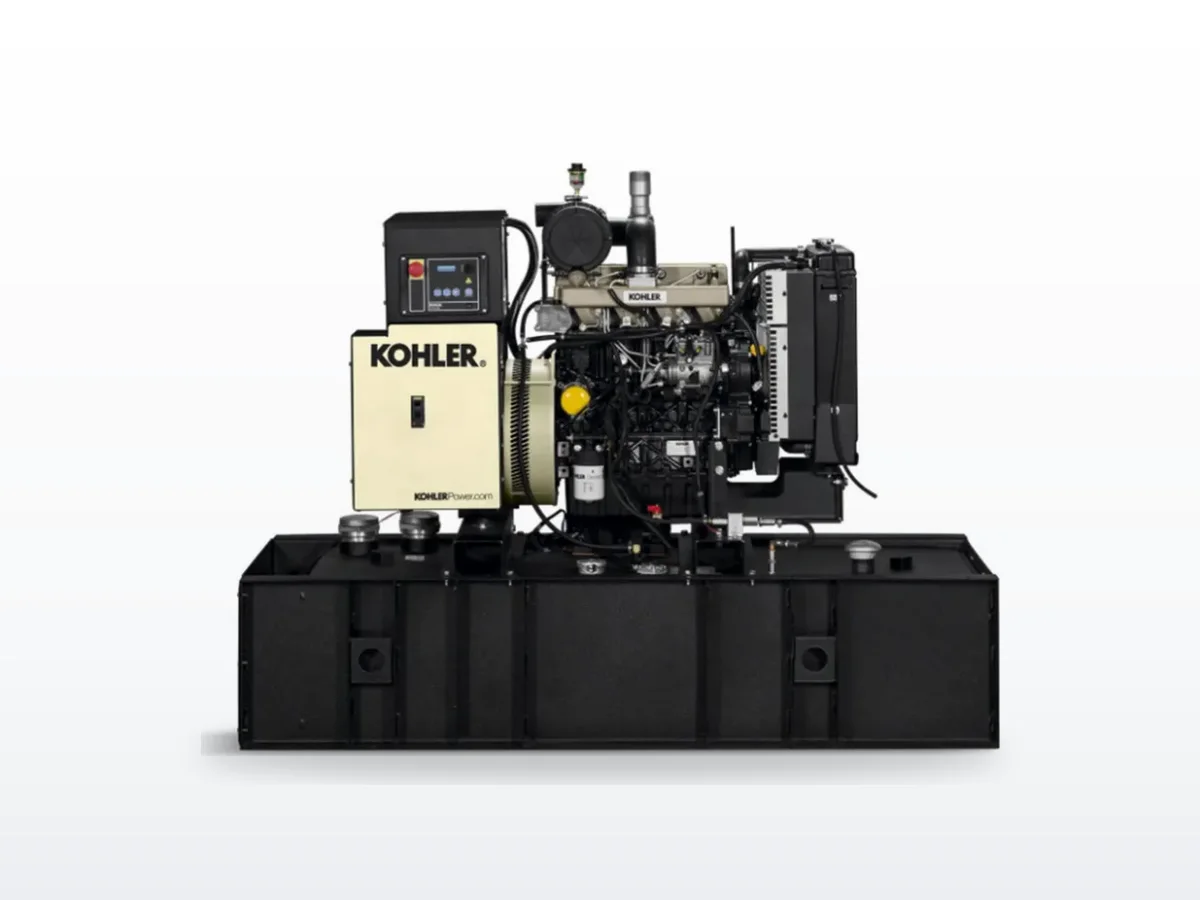
Series Overview#
The Kohler REOZ Series is the primary diesel commercial standby product line for the 10–510 kW power band. It is built around three engine platforms — Yanmar at the 10 kW entry point, Kohler's own KDI diesel engines from 15 to 60 kW, and John Deere's PowerTech and PowerTech E platforms from 80 kW through the 510 kW top of the line. All units are liquid-cooled, run at 1800 RPM, and carry UL 2200 listing. The series covers single-phase and three-phase outputs, with voltage configurations from 120/208V through 277/480V and 347/600V for Canadian applications.
The REOZ name maps to real application requirements. Below 80 kW, the REOZK and REOZK4 sub-families use Kohler diesel engines with either standard Tier 3-equivalent certification or EPA Tier 4 Final compliance depending on the suffix. The K4 designator specifically indicates Tier 4 Final, achieved through cooled exhaust gas recirculation and a diesel oxidation catalyst — relevant for California CARB and other strict air districts. From 80 kW upward, the REOZJ family shifts to John Deere powerplants. The 80–100 kW units use the John Deere 4.5 L 4045 inline-4; the 125–275 kW range uses the 6.8 L 6068 inline-6; and the 300–510 kW band steps up to the 9.0 L 6090 and 13.5 L 6135 platforms. Most REOZJ units are EPA Tier 3 certified for stationary emergency applications, with the 500REOZJB carrying a Tier 2 certification for the 510 kW output.
Where Kohler consistently differentiates from competitors is power quality. The REOZ alternators use either Fast-Response permanent magnet excitation or PowerBoost wound-field excitation, both of which deliver sustained short-circuit capability up to 300% of rated current for 10 seconds — a meaningful specification for hospitals and data centers with large motor or UPS loads that impose high inrush at transfer. Total harmonic distortion on Kohler alternators runs below 3% in this class, which matters for facilities with sensitive electronic equipment or medical imaging hardware. The Decision-Maker controller series provides NFPA 110 compliance monitoring, exercise scheduling, and remote annunciation as standard.
The series is the workhorse of OnPoint's commercial standby portfolio in Northern California. We service units from the compact 10REOZDC through the 500REOZJB in hospitals, school campuses, government buildings, and retail centers across the region.
How to Choose#
10–60 kW (REOZK and REOZK4 sub-family): These models use Kohler's own diesel engines. The standard REOZK units (10REOZDC, 15REOZK, 20REOZK, 30REOZK, 40REOZK, 50REOZK, 60REOZK) are appropriate for most commercial applications. If you are in a jurisdiction requiring EPA Tier 4 Final — California's South Coast AQMD or San Joaquin Valley APCD are the common examples — specify the K4 variant instead: 30REOZK4, 40REOZK4, or 48REOZK4. Note that the K4 models use a different displacement Kohler engine with EGR and DOC aftertreatment, which adds maintenance complexity and the potential for DPF/SCR fault codes if the unit exercises infrequently.
80–100 kW (REOZJF / REOZJ4): The step up to John Deere's 4045 inline-4 platform. The REOZJF suffix is Tier 3 certified; the 80REOZJ4 achieves Tier 4 Final on the same basic architecture with aftertreatment. Both are offered in 120/240V single-phase or three-phase at 120/208V or 277/480V. This is the most common entry point for small hospital wings, larger retail locations, and light manufacturing.
125–275 kW (REOZJ / REOZJG / REOZJ4 / REOZJE): The John Deere 6068 6.8 L inline-6 platform covers this entire range. The JG suffix denotes specific alternator or governor configurations; J4 indicates Tier 4 Final; JE denotes the 6090 9.0 L platform beginning at the 230REOZJE. If your facility load schedule lands in this band, model selection comes down to emissions tier, voltage, and whether you need Canadian 347/600V availability. The 125REOZJ4 and 150REOZJ4 are the Tier 4 Final options in this sub-range.
300–510 kW (REOZJ / REOZJB / REOZJC / REOZJD): John Deere 6090 and 6135 platforms. The JC suffix (350REOZJC, 400REOZJC) adds HVO/renewable diesel fuel approval per EN15940/ASTM D975 — relevant for facilities with sustainability mandates or California Low Carbon Fuel Standard compliance goals. The 500REOZJB tops the series at 510 kW standby and is the unit of choice for large hospital central plant installations and data center rows where a single generator covers a full critical branch. At this power level, paralleling two or more units with Kohler's PowerSync controls is the common path to N+1 redundancy.
Voltage configuration must be specified at order. The 277/480V option is standard for commercial three-phase distribution in the U.S.; 120/208V is common in older buildings and smaller commercial occupancies. Do not assume configurability after delivery — alternator winding is set at the factory.
Common Applications#
-
Healthcare and life-safety: The REOZ series appears on the approved equipment lists of hospital systems throughout California because the Kohler alternator's sub-3% THD and 300% short-circuit current capacity accommodate the inrush of medical imaging equipment, surgical lighting, and large motor loads without voltage sag. NFPA 99 and NFPA 110 compliance is standard across the line.
-
Government and institutional facilities: 32 of 33 models in the series carry government application tags. Court buildings, municipal utilities, and public safety facilities favor the REOZ because the Decision-Maker controller supports remote monitoring and the units are compatible with existing Kohler ATS infrastructure already specified into building standards.
-
Education and campus power: School districts and university campuses often run multiple REOZ units — commonly the 100–200 kW band — to cover data centers, life-safety loads, and critical HVAC systems independently. The 125REOZJG and 150REOZJF are frequent choices in this segment.
-
Data centers and mission-critical facilities: The 200–500 kW REOZJ models are specified for colocation and enterprise data center standby. The combination of John Deere's field-proven reliability, Kohler's low-THD alternator, and the availability of paralleling controls positions the top of the REOZ range as a direct competitor to Cummins C-Series and Caterpillar D-Series in this segment.
-
Large retail and commercial occupancies: Regional shopping centers, big-box retail, and commercial office towers use the 80–200 kW range for life-safety circuits, exit lighting, elevators, and HVAC. The 80REOZJF and 100REOZJF are the most common units in this sub-segment based on OnPoint's service history in Northern California.
Service & Maintenance#
Standard intervals across the series: Oil changes are specified every 250 hours or 12 months, whichever comes first — applicable to 29 of 33 models; all 33 models share the 12-month interval. Fuel filters are due at 500 hours (23/33 models share this interval), and air filters at 500 hours (confirmed across all models with published intervals). Coolant replacement is specified at 3,000 hours on 20 of the 30 models with published coolant service data.
Fuel quality is the top field failure driver. The most common failure mode across the series is injector fouling, hard starting, and filter clogging caused by diesel fuel degradation — appearing in the service history of 21 models. Generators that sit in standby for months without a fuel polishing program are particularly vulnerable. Diesel stored more than 6–12 months without stabilizer or microbial treatment will develop water contamination and algae growth. For REOZ units on extended standby, we recommend annual fuel polishing and microbial testing at minimum, with biocide treatment if any contamination is detected.
Turbocharger wear is the second most common failure mode (20 models). Power loss and excessive smoke under load are the typical presenting symptoms, usually appearing around 12,000 hours of service. Turbocharger longevity in standby applications is directly tied to load levels during exercise — units that exercise at light load (below 30% rated kW) for extended periods build up carbon deposits in the turbo and exhaust system. If monthly exercise is conducted at light load, schedule a quarterly load bank test at 75–100% rated output to flush deposits.
Battery failures round out the top three (20 models), with slow crank and failed start events typically appearing at the 8,760-hour mark — roughly the annual interval. Standby generators sit at float charge for months between exercises, and starting batteries degrade without the cycling that automotive batteries receive. Replace batteries proactively on a 3–5 year schedule depending on climate exposure; do not wait for a failed exercise event. For Tier 4 Final models (30REOZK4, 40REOZK4, 48REOZK4, 80REOZJ4, 125REOZJ4, 150REOZJ4), also monitor for DPF regen warnings and DEF system faults — these aftertreatment components require periodic inspection and are sensitive to infrequent or light-load operation.
All REOZ units should be maintained under an NFPA 110 compliant program: monthly exercise at rated load where possible, annual inspection of all fluid levels, belts, hoses, and connections, and a comprehensive load bank test every 36 months at minimum. OnPoint structures REOZ service contracts around this framework for our Northern California accounts.
Application Guidance#
The Kohler REOZ diesel commercial standby series is the correct specification for life-safety and code-mandated standby loads in the 10–510 kW range at commercial buildings, healthcare facilities, government installations, and educational campuses. The series' combination of Kohler's sub-3% THD alternators, NFPA 110-compliant Decision-Maker controllers, and UL 2200 listing makes it the default choice for permit-driven projects where the Authority Having Jurisdiction requires a documented commercial standby platform. The John Deere-powered REOZJ models from 80 kW upward are the most common specifications across OnPoint's Northern California portfolio — hospitals, court buildings, school districts, and retail centers — because the JD PowerTech platform has a strong local service network independent of Kohler's own dealer coverage. Tier 4 Final compliance (REOZK4 and REOZJ4 models) is mandatory for new installations in California's South Coast AQMD and San Joaquin Valley APCD; confirm emissions tier requirements with the air district before specifying any model.
This series is not appropriate for applications requiring gaseous fuel — the REOZ is diesel-only across all 33 models. For facilities where diesel tank permitting or fuel management is prohibitive, the Kohler REZX Series (190–500 kW, natural gas/LPG) and the Kohler Industrial Gaseous 500REZK (500 kW, natural gas) are the alternatives. For requirements above 510 kW on diesel, the Kohler REOZ large industrial diesel series picks up at 515 kW with Volvo, Mitsubishi, and MTU engines. Buyers evaluating the REOZ against Cummins D-Series or CAT C-Series in the 100–500 kW band should compare alternator THD, short-circuit capability, and ATS ecosystem compatibility — all three OEMs serve this segment, and the specification often follows existing campus infrastructure standards.