Series Overview#
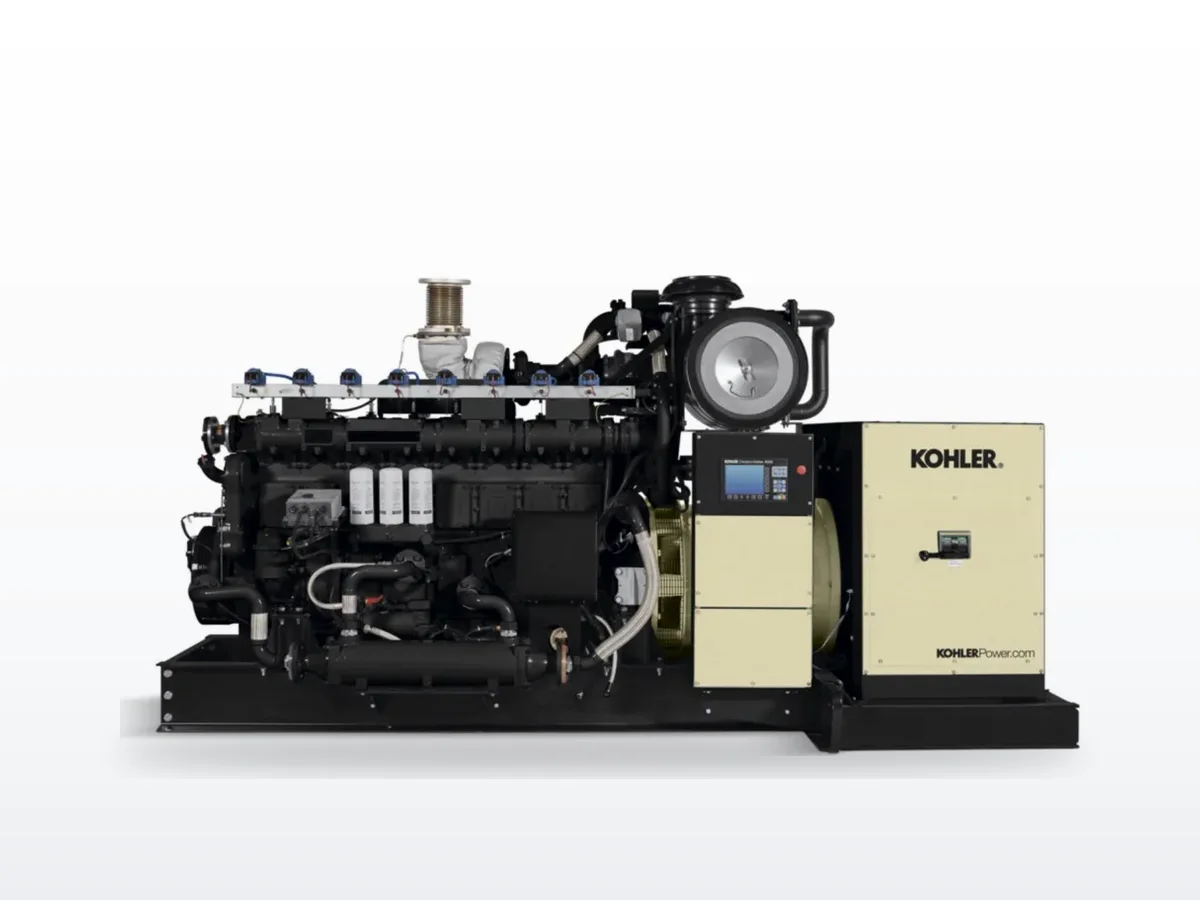
The Kohler Industrial Gaseous category at 500 kW is represented by a single model: the 500REZK. Unlike the rest of Kohler's gaseous industrial lineup — which uses Doosan, PSI/Doosan, or Kohler-branded engines — the 500REZK is powered by a Siemens SGE-24SL natural gas engine. This makes it a distinct product from the REZX Series that covers 180–500 kW in LPG and dual-fuel configurations. The 500REZK is natural-gas-only, operating at 1800 RPM with a Brushless Permanent-Magnet Pilot Exciter alternator.
At 490–500 kW standby and 430–435 kW prime, the 500REZK occupies the upper boundary of what is achievable as a single-unit gaseous genset in the North American market. It is EPA certified for both stationary emergency and non-emergency operation, giving facility operators the flexibility to use the unit for demand response, peak shaving, or prime power applications in addition to emergency standby duty. This dual-certification distinguishes it from most standby-only competitors at this power level.
The unit supports three-phase output in 208V, 240V, and 480V configurations. It is a liquid-cooled platform, consistent with the industrial gaseous series, and is designed for commercial and industrial facilities where natural gas service is available and on-site diesel storage is not desired or permitted.
How to Choose#
The 500REZK is a single-model series — there is no sizing decision to make within this product line. The decision is whether the 500REZK is the right unit for your application:
Choose the 500REZK if: Your facility requires approximately 500 kW of natural-gas-only standby power. You have confirmed that your gas utility can deliver adequate pressure and volume to sustain the engine under full load. You need dual emergency/non-emergency certification for operational flexibility or regulatory reasons. You are comparing this unit against the 500REZXD (LPG-rated PSI/Doosan) — the 500REZK is the natural gas option at this power level.
Consider alternatives if: Your load requirement is significantly above or below 500 kW, in which case the REZX Series (180–500 kW range) or the KD Series diesel platform (900–4000 kW) may be more appropriate. If LPG is an acceptable fuel, the 500REZXD provides the same rated output with a different engine platform. If your facility requires medium-voltage output, neither the 500REZK nor the REZX Series supports that natively — the large REOZ diesel series is the correct choice.
Common Applications#
-
Large commercial buildings. Facilities in the 350–450 kW continuous load range use the 500REZK with operational margin for load growth or temporary peak loads. Natural gas connectivity eliminates fuel storage requirements, simplifying permitting for urban and suburban commercial properties.
-
Healthcare facilities. Mid-sized hospitals and large outpatient complexes with critical loads in the 300–450 kW range specify the 500REZK where natural gas utility service is reliable. The prime power certification allows the unit to run continuously during extended utility outages without the 200-hour emergency-use hour restriction that applies to standby-only certified generators in some jurisdictions.
-
Light industrial operations. Manufacturing facilities, food processing plants, and warehouse operations that have established natural gas service and wish to avoid diesel fuel management use the 500REZK for process continuity backup.
Service & Maintenance#
The 500REZK uses a 500-hour or 12-month oil change interval — longer than the 250-hour interval typical of the smaller REZXB models, reflecting the Siemens engine's specification. Coolant is replaced at 4,000 hours, air filter at 1,000 hours, and spark plugs at 1,000 hours. The 1,000-hour spark plug interval is longer than the 500-hour interval seen on the Doosan-powered REZX models, but spark plug condition should still be inspected at every annual service regardless of hour count.
The most maintenance-sensitive components in this unit are the spark plug and ignition system (typical symptom onset around 1,000 hours: misfire, cylinder dropout, rough running under load) and the gas train/pressure regulator (hard starting, gas pressure fault, no-start condition at approximately 8,000 hours). The turbocharger seals are the primary wear component between 10,000 and 12,000 hours — oil carryover, blue smoke, and boost pressure loss are typical early indicators.
Starting battery condition should be checked at every service interval. A battery that appears functional under float charge may fail to deliver adequate cranking amperage after the unit has been dormant between outages. Replace batteries on a two-to-three-year cycle regardless of apparent state of health.
Application Guidance#
The Kohler 500REZK is purpose-built for facilities requiring approximately 500 kW of standby power from a natural gas source with dual emergency and non-emergency EPA certification. The non-emergency certification is the defining feature: it opens the unit to demand response program enrollment, peak shaving, and prime power applications where typical emergency-only standby generators cannot legally operate beyond their rated annual runtime. Key qualifying conditions are confirmed natural gas utility service at adequate pressure and volume to sustain the Siemens SGE-24SL engine at full load, and a facility load profile in the 350–500 kW range. Large commercial buildings, mid-sized hospitals, and light industrial operations that have established gas main connectivity and want to avoid diesel tank permitting, spill containment, and fuel polishing programs represent the primary use cases.
This unit is not appropriate when the standby requirement is substantially above or below 500 kW, when LPG is the required fuel (the Kohler REZX Series covers 190–500 kW on LPG with PSI/Doosan engines), or when medium-voltage output is required (the large Kohler REOZ diesel industrial series covers medium-voltage configurations starting at 750 kW). Buyers comparing the 500REZK to the CAT G-Series (G3412 at 512 kW) should note the CAT unit uses a legacy 3400 Series engine platform with a broader diesel-familiar service network, while the Kohler 500REZK's Siemens SGE-24SL requires Siemens-trained technicians — factor service contract access into the specification decision.