Series Overview#
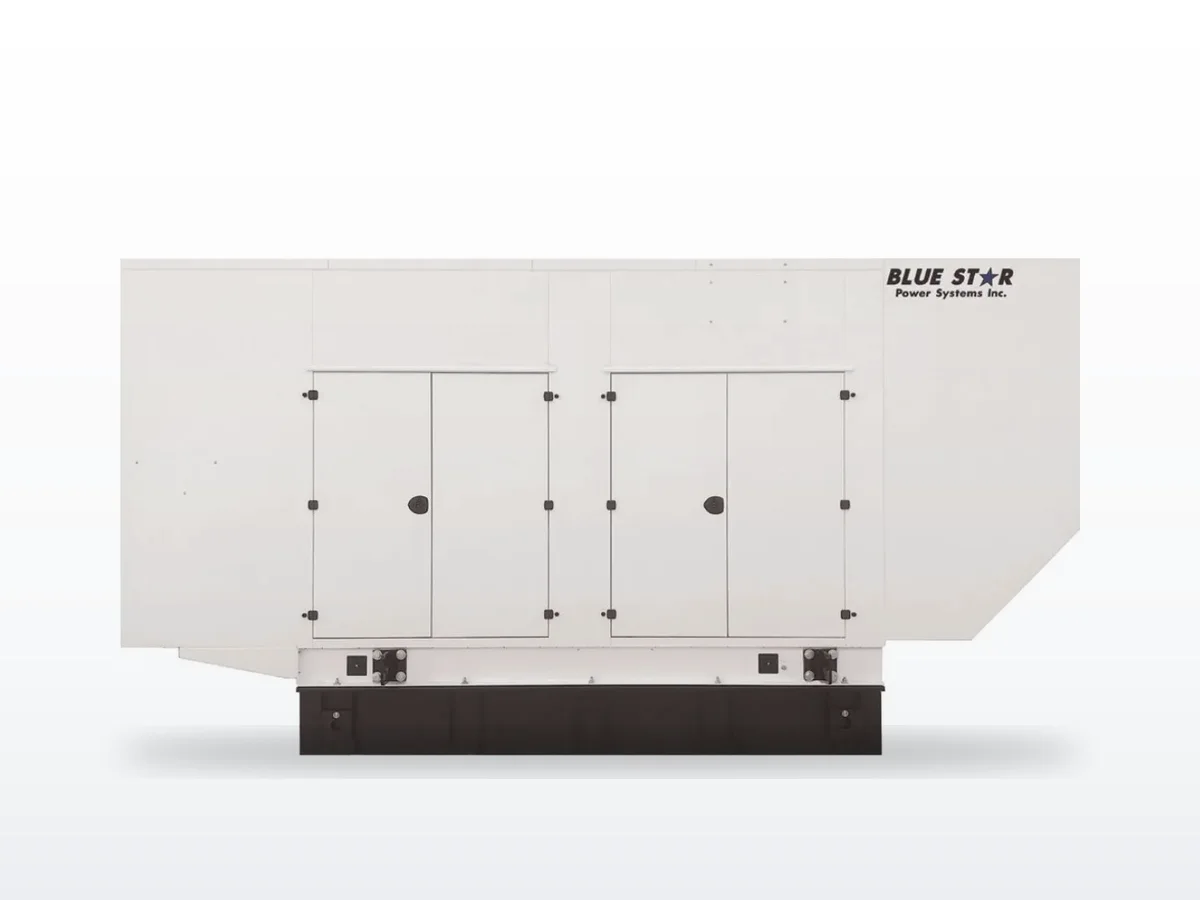
The Blue Star Perkins Diesel Standby series — designated PD — is the broadest single-engine-family diesel line in Blue Star's standby product portfolio, spanning 17 kW to 750 kW across 19 models. It covers single-phase and three-phase applications, four distinct footprint classes, and three EPA emissions tiers (Tier 4 Interim, Tier 3, and Tier 2), making it the primary choice when a Perkins engine is required or preferred and the load study falls anywhere from a small commercial installation to a large industrial facility.
The PD series uses multiple Perkins engine platforms segmented by power class: compact 2.22-liter four-cylinder engines for the PD20 and PD30, the 4.4-liter platform for PD50 through PD100, the 7.01-liter six-cylinder for PD125 through PD200, the 9.29-liter six-cylinder for PD250 and PD300, the 12.5-liter for PD350 and PD400, the 15.2-liter for PD450 through PD600, and the 18.1-liter twin-turbocharged platform for the PD750. Each engine family transition represents a physical footprint change — site planners should verify pad dimensions against the specific model range.
Blue Star pairs all PD models with an open-architecture controller — smaller models use the DSE DCP7310 — and Stamford alternators. Blue Star Power Systems (North Mankato, Minnesota; DEUTZ AG subsidiary since 2024) assembles each unit. Voltages span 120/208V, 120/240V, 277/480V, and 347/600V; three-phase 4160V medium voltage is not available in the Perkins lineup, which distinguishes it from the higher-powered Mitsubishi and Volvo Penta series.
How to Choose#
PD20-01IT4 / PD30-01IT4 (17–25 kW, Tier 4 Interim): The smallest models in the lineup, built on the Perkins 2.22-liter four-cylinder. Single-phase and three-phase available. Suited for small commercial, light-commercial, and municipal installations where a compact, fuel-efficient unit covers essential loads and Tier 4 compliance is required. The PD20 is naturally aspirated; the PD30 adds turbocharging and charge-air cooling for the additional output.
PD50-01 through PD100-01 (50–100 kW, Tier 3): All four models use the Perkins 4.4-liter four-cylinder with progressively aggressive turbo and intercooler specifications. The PD50 and PD60 share the 80×38 in footprint; the PD80 and PD100 step to 90×44 in. When the load study falls in the 50–100 kW range, select the model closest to 100% of the standby load without exceeding it — oversizing beyond 80% of generator capacity causes wet-stacking on light loads.
PD125-01 through PD200-01 (125–200 kW, Tier 3): The 7.01-liter Perkins six-cylinder, used in four calibrations (TAG2 through TAG5), enables four power levels from a single 110×54 in footprint. This is a significant advantage for equipment room planning: a site built for the PD125 can accommodate any model up to PD200 without structural modification.
PD250-01 / PD300-01 (250–300 kW, Tier 3): Step up to the 9.29-liter Perkins six-cylinder. Three-phase only on most configurations. The 120×66 in footprint is larger than the 110×54 in six-cylinder platform below.
PD350-01 / PD400-01 (350–400 kW, Tier 3): The 12.5-liter Perkins six-cylinder on a 140×72 in structural steel base. Both models share the footprint; choose by whether 350 kW or 400 kW meets the load study.
PD450-01 through PD600-01 (450–600 kW, Tier 3): The 15.2-liter Perkins six-cylinder on a 150×78 in structural steel base. This platform marks the transition from formed steel to structural steel base construction.
PD750-01 (750 kW, Tier 2): The top of the series, powered by the Perkins 2806C-E18TTAG7 — an 18.1-liter twin-turbocharged six-cylinder. Three-phase only, 277/480V and 347/600V only (no 120/208V). Tier 2 compliance applies.
Common Applications#
- Municipal infrastructure: All 19 PD models are rated for municipal use — covering applications from small lift stations (PD20–PD60) through large water treatment and wastewater facilities (PD500–PD750). Perkins' global parts network supports long-term municipal procurement requirements.
- Telecom and network infrastructure: Cell towers, data hubs, and telecom equipment rooms in the 17–300 kW range are a primary application segment. The compact lower-output models fit the footprint constraints of roadside and rooftop telecom installations.
- Commercial buildings: Retail, office, light-commercial, and multi-family buildings with 50–400 kW emergency loads represent the highest-volume application class. The 4.4L and 7.01L platforms cover most mid-rise commercial standby requirements.
- Pump stations: Agricultural, municipal, and industrial pump stations with motor loads from a few kilowatts to several hundred kW use PD series units across the full range. The diesel fuel supply is well-suited to remote locations without natural gas infrastructure.
- Houses of worship and small campuses: Multi-building campuses, houses of worship, and school districts with 100–250 kW standby requirements are common applications for the 7.01-liter platform (PD125–PD200), where a single compact unit covers the full load.
Service & Maintenance#
The full-series standard maintenance schedule is: oil changes at 500 hours or 12 months, fuel filter replacement at 500 hours, air filter inspection at 1,000 hours, and coolant changes at 6,000 hours. These intervals apply uniformly across all 19 models.
Battery failure is the leading documented failure mode, appearing across 15 of 19 models. Failed starts or slow cranking during an actual outage are the symptoms. Replace batteries on a 2–4 year preventive schedule — before they exhibit obvious degradation — because a battery that tests adequately under a shop charger can still fail to deliver adequate cranking current at the engine's compression ratio under cold-weather conditions.
Fuel quality and tank contamination is the second most significant failure risk, showing moderate severity across 10 models. Standby diesel tanks accumulate water ingress, microbial growth, and fuel degradation over months of storage. Biocide additives, annual tank polishing, and quarterly fuel sampling are the preventive measures. Injector fouling and fuel filter clogging are the failure presentations.
Turbocharger wear appears at approximately 12,000 hours across models in the 100–750 kW range. Power loss and excessive smoke under load are the first symptoms. For Perkins turbocharged models (PD30 and above), include a turbocharger condition assessment as part of the 10,000-hour service event.
Coolant hoses are a minor but documented failure mode in the mid-range models. Slow coolant loss weeping at clamps can go undetected during routine visual checks if the generator is enclosed. Include a hose pressure test and visual inspection during each 500-hour service.
Application Guidance#
The Blue Star Perkins Diesel Standby series is purpose-built for commercial and light-industrial standby applications where the broadest possible kW coverage from a single engine OEM is the procurement priority — 17 kW to 750 kW across 19 models on seven Perkins engine platforms. The Perkins global parts network and Caterpillar ownership structure mean parts availability is strong across the full range, which matters for municipal, rural, and institutional operators who need confidence in long-term supply. Single-phase configurations are available through the PD200 class, providing unusual flexibility for smaller commercial applications where three-phase distribution is not yet installed. The PD750 at 750 kW extends Perkins coverage into territory normally held by larger-displacement or competing-OEM platforms, without requiring the medium-voltage configurations of the Mitsubishi or Volvo Penta upper-range series.
This series does not offer 4160V medium-voltage output — a hard boundary that distinguishes it from the Blue Star Mitsubishi Diesel Standby (800–2,000 kW, 4160V available) and Blue Star Volvo Penta Diesel Standby (100–700 kW, 4160V available) for facilities requiring medium-voltage distribution. The PD750 is Tier 2 only; for applications requiring Tier 3 or Tier 4 Final above 600 kW, this series does not have a compliant model. For loads below 17 kW or applications requiring gaseous fuel, the Blue Star PSI Small Gaseous or PSI Mid Gaseous series covers the natural gas and LP standby segment.