Series Overview#
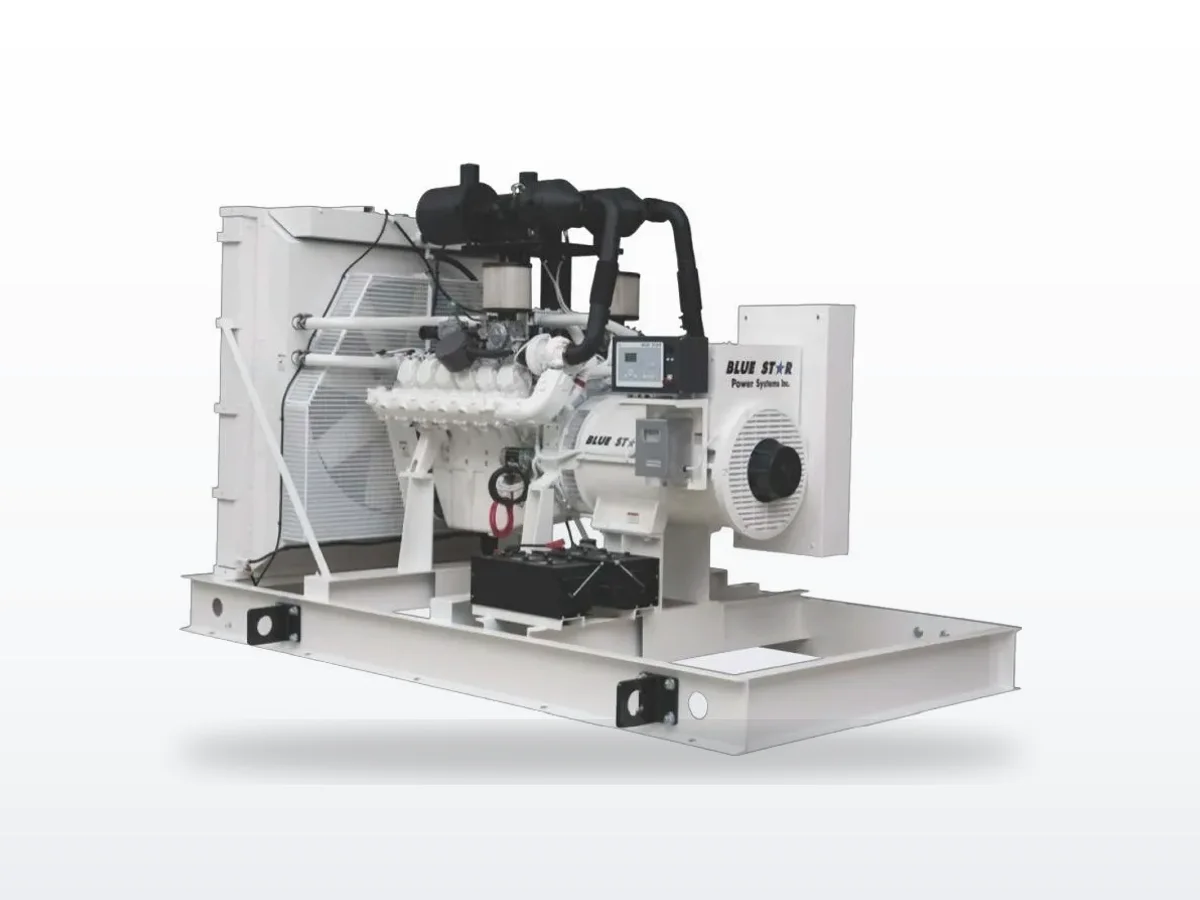
The Blue Star PSI Small Gaseous series covers 20 kW to 100 kW natural gas and LP standby output across seven models on Power Solutions International (PSI) spark-ignition engine platforms. The series uses three engine families: the PSI 2.4-liter inline-four (PS25-01), the PSI 4.3-liter V6 (PS40-01 and PS40-01P), and the PSI 5.7-liter V8 — naturally aspirated on the GM50-03, GM60-02, and GM60-02P, and turbocharged with charge air cooling on the GM100-03. All seven models are available in both single-phase and three-phase configurations, and the LP output equals the natural gas output on all models except the turbocharged GM100-03.
This series is the entry point into Blue Star's natural gas and LP standby product line. It occupies the 20–100 kW segment — appropriate for small commercial buildings, light-industrial facilities, light-commercial applications, schools, multi-family residential buildings, and hotels where natural gas is available and the emergency power requirement falls below the 130 kW threshold where the PSI Mid Gaseous series begins. The PS and GM prefix models in this range are the most compact gaseous standby options in the Blue Star lineup, with formed steel base construction and relatively small footprints versus the structural steel base units at 265 kW and above.
Blue Star Power Systems (North Mankato, Minnesota; DEUTZ AG subsidiary since 2024) pairs all models with the DSE DCP7310 controller and Stamford alternators using the same open-architecture approach as the rest of the lineup. No OEM proprietary tooling is required for controller programming or troubleshooting. All models require standard utility natural gas service pressure.
How to Choose#
PS25-01 (20 kW, PSI 2.4L inline-four, NA): The smallest model in the Blue Star gaseous lineup — 20 kWe standby on both natural gas and LP. Single-phase and three-phase available. For the smallest commercial and light-commercial installations: small offices, retail units, small schools, and telecom equipment rooms where the emergency load does not exceed 20 kW. The 2.4L naturally aspirated engine is the simplest powertrain in the series — no turbocharger, no charge air cooler.
PS40-01 / PS40-01P (40 kW standby / 35 kW prime, PSI 4.3L V6, NA): The V6 step up, producing 40 kWe standby on both NG and LP. The PS40-01P provides prime-rated continuous duty at 35 kWe. Choose the standby variant for emergency-only applications; choose the -01P when the unit will run continuously (prime power, peak-shaving, or frequent scheduled testing).
GM50-03 (50 kW, PSI 5.7L V8, NA): The step to the 5.7L V8 naturally aspirated platform. 50 kWe standby on both NG and LP. Single and three-phase. The GM prefix in the model name reflects the PSI 5.7L's heritage as a General Motors-derivative V8 engine platform (Power Solutions International). This is a well-proven engine with broad parts availability and straightforward service procedures.
GM60-02 / GM60-02P (60 kW standby / 55 kW prime, PSI 5.7L V8, NA): The same 5.7L V8 as the GM50-03, calibrated to 60 kWe. LP output equals NG output at 60 kWe standby. The GM60-02P delivers 55 kWe continuous on natural gas (with three-way catalyst). Choose the prime variant for applications requiring continuous-duty operation.
GM100-03 (100 kW standby, PSI 5.7LTCAC V8, turbocharged): The top of the series. Adding turbocharging and charge air cooling to the 5.7L V8 nearly doubles the output versus the naturally aspirated GM50/60. Natural gas standby is 100 kWe; LP standby drops to 80 kWe — a meaningful derating to account for in LP-primary applications. Single and three-phase available. Standby rated only — no prime variant.
Common Applications#
- Commercial and small retail: The 20–60 kW range from the PS25 through GM60 covers small commercial offices, retail units, and mixed-use tenant spaces where emergency lighting, POS systems, and HVAC backup are the primary loads.
- Light-commercial and light-industrial: Workshop facilities, small manufacturing cells, and light-commercial buildings with 40–100 kW emergency requirements use the GM50 through GM100 range where natural gas eliminates diesel storage permits.
- Schools: Smaller school buildings and portable classroom complexes with 20–100 kW emergency loads for emergency lighting, server rooms, and essential HVAC use this series — rated across 5 of 7 models for school applications.
- Multi-family residential: Small apartment buildings and condominium complexes with elevator, common-area lighting, and life-safety loads in the 40–100 kW range where natural gas piping to the mechanical room is available.
- Hotels: Small hotel properties with 40–100 kW emergency requirements for elevator, common area, and safety lighting use the GM60 and GM100 as a natural gas alternative to diesel.
Service & Maintenance#
All seven models share the PSI spark-ignition service schedule: oil changes every 250 hours or 12 months, spark plug replacement at 1,500 hours, air filter inspection at 1,000 hours, and coolant changes at 4,000 hours. The 250-hour oil change interval is not optional — gaseous combustion chemistry degrades oil more rapidly than diesel, and extended intervals cause bearing and ring wear that shortens engine life.
Battery failure is the most common failure mode across the series (all 7 models), presenting as a failed start or slow cranking during an actual outage. The PS and GM series use 12V starting systems consistent with their engine platform sizes. Replace batteries preventively on a 2–3 year schedule; include a load test at each annual inspection to confirm cold-cranking capacity.
Spark plug and ignition degradation appears across 6 of 7 models, with misfire under load and hard starting as the presentations around the 1,500-hour replacement interval. The naturally aspirated engines (PS25, PS40, GM50, GM60) run relatively clean compared to the turbocharged GM100-03, but all require scheduled plug replacement and not selective replacement of failed plugs only.
Coolant system issues — overtemperature and coolant loss — appear across 6 models at the 6,000-hour horizon. The liquid-cooled PSI engines require coolant change at 4,000 hours. For enclosed generator installations, verify that cooling airflow is adequate to the ambient specification — restricted radiator airflow causes accelerated coolant temperature rise that shortens engine life before coolant condition becomes the issue.
For the GM100-03 specifically, the turbocharger and charge air cooler add maintenance requirements not present on the naturally aspirated models. Include turbocharger condition assessment at 10,000 hours, and schedule a charge air cooler inspection and cleaning at 6,000–8,000 hours.
Application Guidance#
The Blue Star PSI Small Gaseous series is purpose-built for the 20–100 kW natural gas and LP standby segment — commercial retail spaces, small offices, light-industrial facilities, schools, and multi-family buildings where natural gas is piped to the mechanical room and diesel storage is either prohibited or operationally inconvenient. All seven models are available in single-phase and three-phase configurations, which is broader than most diesel alternatives at equivalent power levels and makes this series directly applicable to facilities with single-phase distribution. The PSI 5.7L V8 GM-derivative engine platform at the core of the GM50, GM60, and GM100 models has extensive field history and accessible parts supply — a practical advantage for small commercial operators who service equipment through local shops rather than OEM dealer networks.
This series is not appropriate above 100 kW — at that point the Blue Star PSI Mid Gaseous (130–200 kW) series is the correct continuation on PSI inline-six platforms with prime-rated options. The GM100-03 on LP produces only 80 kWe versus 100 kWe on natural gas — if LP is the primary fuel and the load study is at or above 80 kW, evaluate the Cummins commercial gas or Generac SG Series as alternatives with more favorable LP-to-NG output ratios at the 100 kW class. For diesel standby at equivalent loads with lower service frequency (500-hour oil intervals versus 250-hour for PSI gaseous), the Blue Star Perkins Diesel Standby series covers 17–750 kW.