Series Overview#
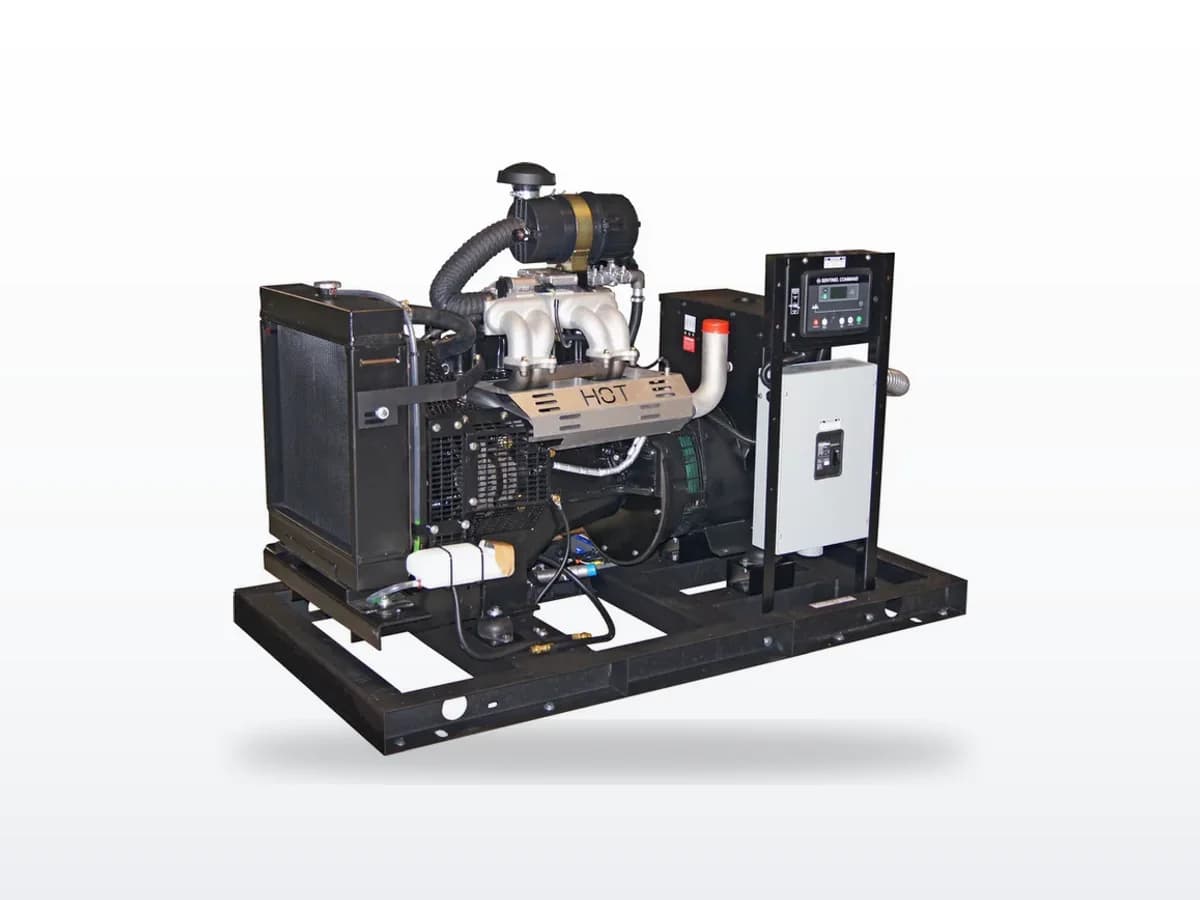
The Gillette SP Series is the company's natural gas and LPG standby lineup, covering 25 kW to 1,050 kW across 14 models. It is the broadest product line Gillette offers — spanning everything from a small commercial retail backup (SP-250 at 25 kW) to a utility-class 1 MW campus standby unit (SP-1M). Every model in the series uses Power Solutions International (PSI) engines, Stamford alternators, and Deep Sea Electronics DSE 7420 MKII controllers — all open-architecture components serviceable without a proprietary dealer relationship.
Natural gas standby is the default choice for commercial facilities with reliable gas utility service: it eliminates diesel fuel storage, compliance costs, and fuel degradation concerns, while providing essentially unlimited runtime as long as the gas utility remains operational. The SP series covers the full commercial range — restaurants and retail on the small end, through data centers, hospitals, and industrial campuses at the top of the range. Both single-phase and three-phase configurations are available across most of the lineup, making the SP series applicable to the full spectrum of commercial electrical service types.
The SP series runs through five distinct PSI engine platforms by displacement: 2.4L I4 (SP-250), 4.3L V6 (SP-410), 5.7L/8.8L V8 family (SP-620 through SP-2000P), 13L/14.6L inline and V8 platforms (SP-2500P through SP-3500), and 21.9L/31.8L/39.2L/52.3L V12/V16 platforms (SP-4000 through SP-1M). Understanding which engine platform underlies which model is key to choosing correctly — the 13L models (SP-2500P, SP-3000P) and the 8.8L models (SP-960 through SP-2000P) have different LPG capability profiles, voltage options, and enclosure footprints despite overlapping in apparent kW range.
Gillette prices the SP series 15–30% below Kohler, Cummins, and Generac equivalents and typically ships in 3–7 days — a meaningful advantage when a project or emergency replacement cannot wait for a major OEM's 12–20 week delivery cycle.
How to Choose#
25–60 kW (SP-250, SP-410, SP-620) — Small commercial: Single-phase and three-phase available. PSI 2.4L I4, 4.3L V6, and 5.7L V8 respectively. These serve restaurants, retail, small offices, and light commercial buildings. Both NG and LPG rated. Start here if your load calculation falls under 75 kW.
80–200 kW (SP-960, SP-1500, SP-2000P) — Mid-commercial: The PSI 8.8L V8 platform powers all three models. The SP-960 produces 96 kW NG / 80 kW LPG; the SP-1500 produces 150 kW NG / 130 kW LPG with turbocharging added; the SP-2000P produces 200 kW NG only (no LPG, natural gas only). If LPG is required above 130 kW, step to the 13L platform (SP-2500P). The SP-2000P is the high-output ceiling of the 8.8L platform.
250–300 kW (SP-2500P, SP-3000P) — PSI 13L I6 platform: Both models use the same 13L inline-6 enclosure. The SP-2500P produces 250 kW NG / 165 kW LPG; the SP-3000P produces 300 kW NG / 165 kW LPG from the high-output calibration. Note that LPG output is identical between the two — if your primary fuel is LPG, the SP-2500P and SP-3000P are equivalent on that fuel. Three-phase only, 120/208V, 277/480V, or 346/600V.
350 kW (SP-3500) — PSI 14.6L V8: The only model on this platform. Bridges the 13L and 21.9L families with genuine LPG capability (210 kW) that the SP-2500P/3000P cannot match. Three-phase only.
400–500 kW (SP-4000, SP-5000) — PSI 21.9L V12: Both models from the same physical block. SP-4000 at 400 kW NG / 300 kW LPG; SP-5000 at 500 kW NG / 300 kW LPG (HO calibration). If load is at or above 400 kW and LPG is required, this is the last platform with LPG support. Three-phase only.
650–1050 kW (SP-6500, SP-8000, SP-1M) — Natural gas only: All three are NG only, three-phase only. The SP-6500 (PSI 31.8L V12, 650 kW) and SP-8000 (PSI 39.2L V12, 800 kW) use the HCI634 alternator family; the SP-1M (PSI 52.3L V16, 1,050 kW) uses the Stamford AVK S6D series with PMG excitation. If natural gas standby above 500 kW is required, these are the options.
Common Applications#
-
Commercial facilities (restaurants, retail, multi-family, hotels): The SP series spans the full commercial spectrum. The SP-250 through SP-620 cover small commercial loads; the SP-960 through SP-1500 serve larger restaurants, hotels, and multi-family buildings. Natural gas is the preferred fuel for commercial applications because it eliminates fuel storage, permits, and diesel delivery logistics.
-
Data centers: 10 of 14 SP series models are tagged for data center applications. At the upper end, the SP-5000 (500 kW) through SP-1M (1,050 kW) serve facilities requiring large natural gas standby capacity — typically where a gas utility with N+1 redundancy is more operationally practical than diesel fuel management at scale.
-
Hospitals and healthcare: 8 of 14 models serve hospital applications. For healthcare facilities where diesel storage and spill risk are concerns, natural gas standby on the SP series provides a compliant alternative for non-critical backup circuits. Note that most life-safety systems require NFPA 110-compliant diesel; verify code applicability with your AHJ before specifying gas standby for Level 1 loads.
-
Industrial and campus standby: Industrial facilities and large campuses with centralized natural gas service can use the SP series for full-building backup. The three-phase configurations from the SP-960 upward match standard industrial distribution voltages (480V, 208V).
-
Municipal infrastructure: 8 of 14 models serve municipal applications — pumping stations, government buildings, water treatment facilities, and public infrastructure where natural gas service is available and diesel fuel management is operationally burdensome.
Service & Maintenance#
The SP series shares uniform service intervals across all 14 models: oil changes every 250 hours or 12 months (whichever comes first), air filter service at 1,000 hours, coolant system service at 4,000 hours, and spark plug replacement at 1,500 hours. The spark plug interval is the most frequent maintenance touchpoint and the one most commonly missed on standby units — at 1,500 hours of cumulative run time (including weekly testing), ignition service is due roughly every 2–4 years depending on testing frequency.
The dominant failure modes in the SP series reflect the standby duty profile. Battery failure — failed to start during an outage — is the most prevalent issue across 6 of 14 models and is purely a maintenance management problem. Standby units sit for extended periods on float charge; batteries degrade silently until a real outage demands a cold start. Annual battery load testing and replacement on a 3–4 year cycle eliminates this failure mode entirely.
Charge air cooler degradation (affecting 6 models) manifests as gradually reduced output under load and elevated intake manifold temperatures. This is typically visible in load bank testing before it becomes a hard failure. Coolant hose inspections at each service interval catch the early weeping that precedes a coolant loss event. Turbocharger wear (12,000+ hours) produces progressive power loss and smoke under load — inspect turbo shaft play and oil sealing at the 6,000-hour coolant service.
For larger models (SP-4000 and above) using 12-cylinder engines, the ignition service interval means 12 individual plug changes every 1,500 hours. On standby units accumulating hours primarily through weekly exercise cycles, this interval can span several years — but the calendar-based annual service should include spark plug inspection at minimum.
Application Guidance#
The Gillette SP Series is the broadest natural gas standby platform in its price tier, covering 25 kW to 1,050 kW across 14 models with factory-direct pricing 15–30% below Kohler, Cummins, and Generac equivalents and 3–7 day lead times. For commercial, institutional, and industrial facilities with reliable natural gas utility service where diesel storage permitting, fuel management, and degradation concerns are drivers, the SP series eliminates those operational burdens across the complete commercial power range. The SP-2500P through SP-5000 models' genuine LPG capability (up to 300 kW LPG on the SP-5000 V12) is a differentiator for facilities without pipeline natural gas; most competitors drop LPG support well before 300 kW. The SP-6500 through SP-1M models extend the range to 1,050 kW on natural gas alone — the only factory-direct option at that output level with this lead time profile.
For standby applications requiring EPA Stationary Spark Ignition certification documentation (NSPS permits, non-emergency operation hours), verify that your specific SP model and configuration carries the required EPA SI certification — the SP series carries the EPA SSI standard across all models, but project submittal requirements vary by jurisdiction. The SP series is a standby-rated lineup; for continuous prime power duty, the Gillette PR Series (80–540 kW natural gas prime) is the correctly rated alternative — do not run SP standby models as prime power. For diesel standby at equivalent output levels where natural gas is unavailable, the Gillette industrial diesel lineup spans from the SPD Series (30–200 kW Perkins) through the SPMI Series (800 kW–2 MW Mitsubishi). For the largest natural gas standby requirements above 1,050 kW, the Cummins Large Gas 750–1000 kW and CAT 3500 Series Gas cover that range from major OEMs.
FAQ#
See frontmatter for FAQ items.