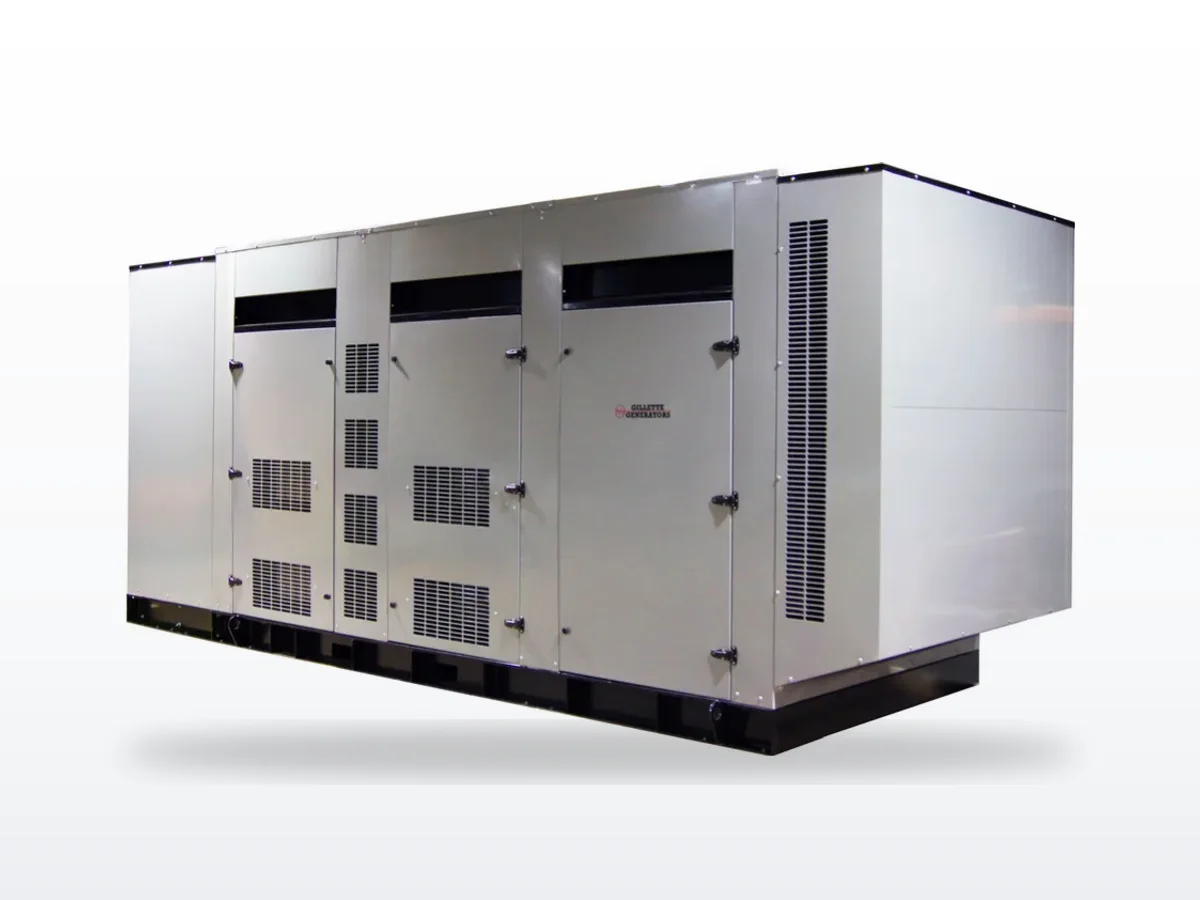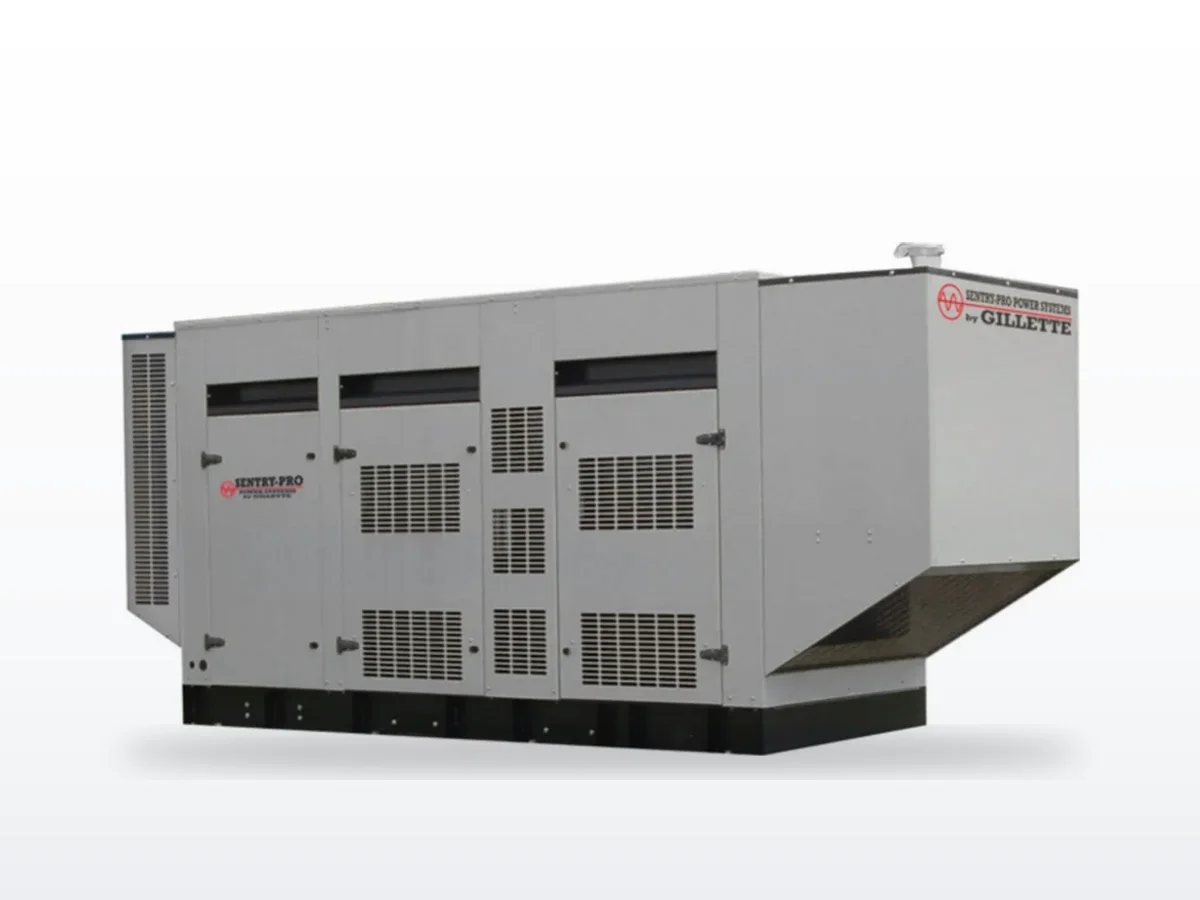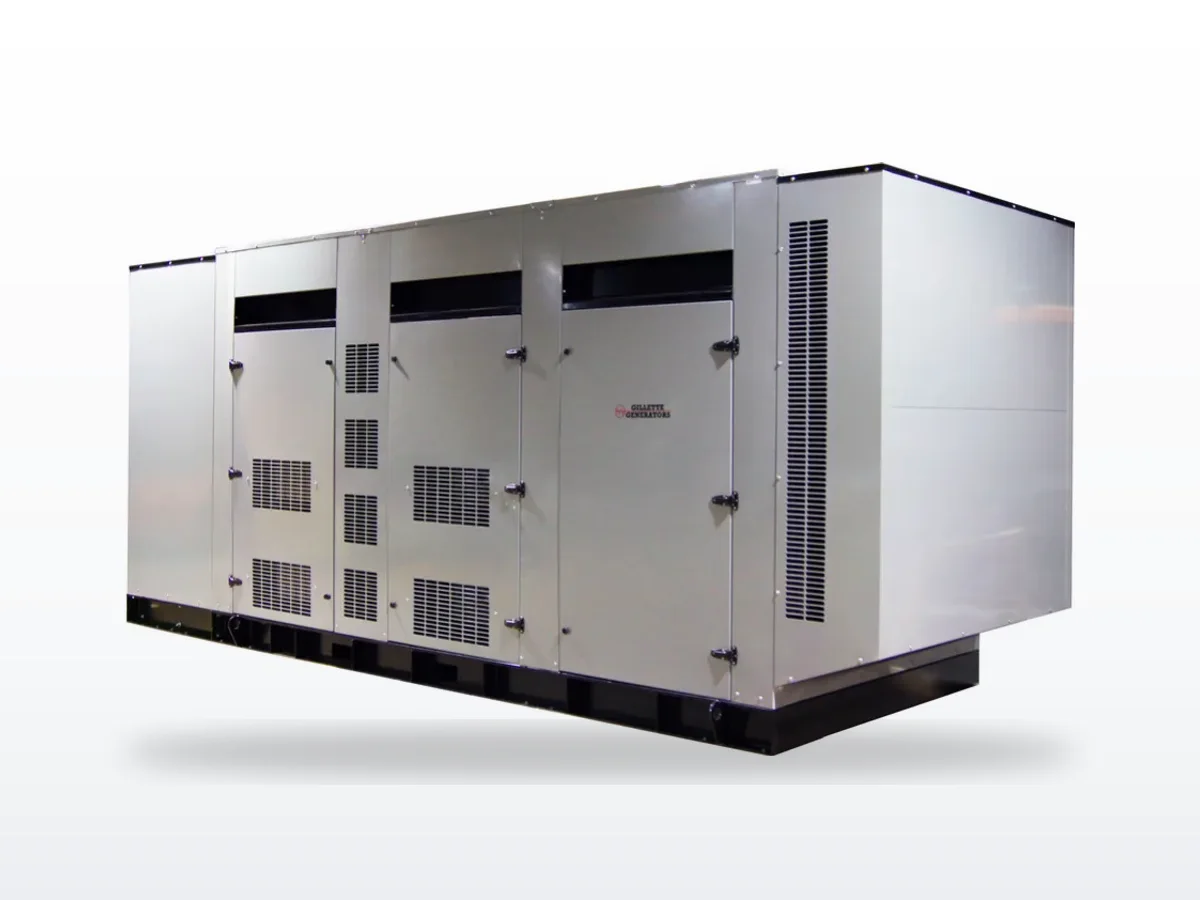
The Gillette SP-3500 is a 350-kilowatt natural gas / 210-kilowatt LPG stationary standby generator built on PSI's 14.6L turbocharged V8. It bridges the 13L inline-6 platform (SP-2500P/3000P) and the 21.9L V12 platform (SP-4000/5000), offering a unique 350 kW NG output point with genuine LPG capability (210 kW) that the 13L models cannot achieve.
The standby exhaust temperature is 1,382°F (750°C) — among the highest in the SP lineup — requiring careful exhaust system design for confined installations.
At 350 kW, this unit typically backs up entire medium-large commercial buildings or critical circuits in larger campuses. Applications in our service territory:
Large hotels (full emergency power for elevators, egress lighting, HVAC, life safety)
The PSI 14.6L V8 is a well-proven industrial gas engine. V8 architecture means slightly more access complexity than the inline-6 models — rear bank spark plugs require careful scheduling in confined enclosures. At 350 kW, annual load bank testing is critical: a generator this size that has never run at full load will reveal cooling, governor, and fuel system issues that monthly no-load tests miss. We recommend commissioning at 100% rated load for at minimum 2 hours on initial installation.
Tell us about the application — kW, voltage, application, install timeline — and we'll respond within one business day with budgetary pricing, lead time, and any sizing notes.
Adjust load percent and tank size to estimate runtime. Pre-filled with this model's spec where available.
Estimate runtime on this tank
Fuel demand at 75% load
3,675,000 BTU/hr≈ 3675.0 cf/min @ 1,000 BTU/cf
On utility natural gas the runtime is generally unlimited provided the supply line and meter can deliver this BTU/hr at the engine's required inlet pressure (typically 5–14" WC residential, up to 5 psi commercial). Confirm against the OEM's published fuel-pressure spec.
Service intervals
Manufacturer-recommended intervals for the Gillette SP-3500 under standby duty. Field intervals may differ based on load profile, ambient conditions, and fuel quality.
Oil & filter
Every 250 hours or 12 months
Coolant change
Every 4000 hours
Air filter
Every 1000 hours
Spark plugs
Every 1500 hours
Major overhaul
≈ 15,000 hours
Load bank test
Every 12 months
Common failure modes
What we've seen fail on this platform. Use as a service-planning reference, not a diagnostic — actual failure modes depend heavily on duty cycle and maintenance history.
Component
Symptom
Typical hours
Severity
Turbocharger
Power loss, black smoke under load
12,000+
moderate
Charge air cooler
Reduced output, elevated intake temperatures
10,000+
moderate
Spark plugs / ignition (8 cylinders)
Misfire, rough running under load
1,500+
minor
Exhaust manifold
Exhaust leaks, elevated underhood temperatures
15,000+
minor
Frequently Asked Questions
Why does Gillette use a V8 (14.6L) for the SP-3500 when the SP-3000P uses an inline-6 (13L) for 300 kW?
The SP-3500 steps from the 13L inline-6 platform to a 14.6L V8 to achieve the next power tier (350 kW NG). The V8 architecture delivers higher torque at the same RPM, which PSI uses to add 50 kW NG output (536 bhp at standby) vs. what the 13L inline-6 HO achieves at 469 bhp. The V8 also adds LPG output: 210 kW LPG vs. 165 kW LPG on the 13L models.
What is the LPG standby rating of the SP-3500?
210 kW LPG standby — a meaningful improvement over the 165 kW LPG limit of the 13L inline-6 models. The SP-3500's V8 architecture and LPG fuel system are capable of higher LPG throughput per the larger displacement.
The SP-3500 and SP-3000P have nearly the same dimensions — what is different?
The open footprint is nominally the same (152 x 72 x 80 in) but the Level 2 enclosure for the SP-3500 is slightly shorter (186 x 72 x 94 in vs. 200 x 72 x 94 in for the 3000P). Weight differs: 8,625 lbs vs. 8,175 lbs. The SP-3500 uses dual 2" NPTF fuel inlets vs. one on the 13L models.
What are the dual fuel inlet requirements?
The SP-3500 uses two 2" NPTF fuel inlets at 11-14" water column. Full-load NG consumption: 3,499,000 BTU/hr. Verify gas service capacity and run dual supply lines where the distribution system requires it.
How does the 14.6L V8 differ from the 21.9L V12 used in the SP-4000?
The 14.6L V8 (SP-3500) and 21.9L V12 (SP-4000) are both PSI turbocharged V-configuration engines but different displacement classes. The V12 adds 50% more cylinder count for 400 kW output. The V8 at 14.6L is the more compact option for 350 kW. Oil capacity: 49.7 qt (V8) vs. 49.1 qt (V12) — similar at these output levels.
200 kW natural gas stationary standby generator. Made-in-USA commercial unit with PSI 8.8L high-output turbocharged V8, Stamford alternator, and DSE 7420 MKII controller. NG only.