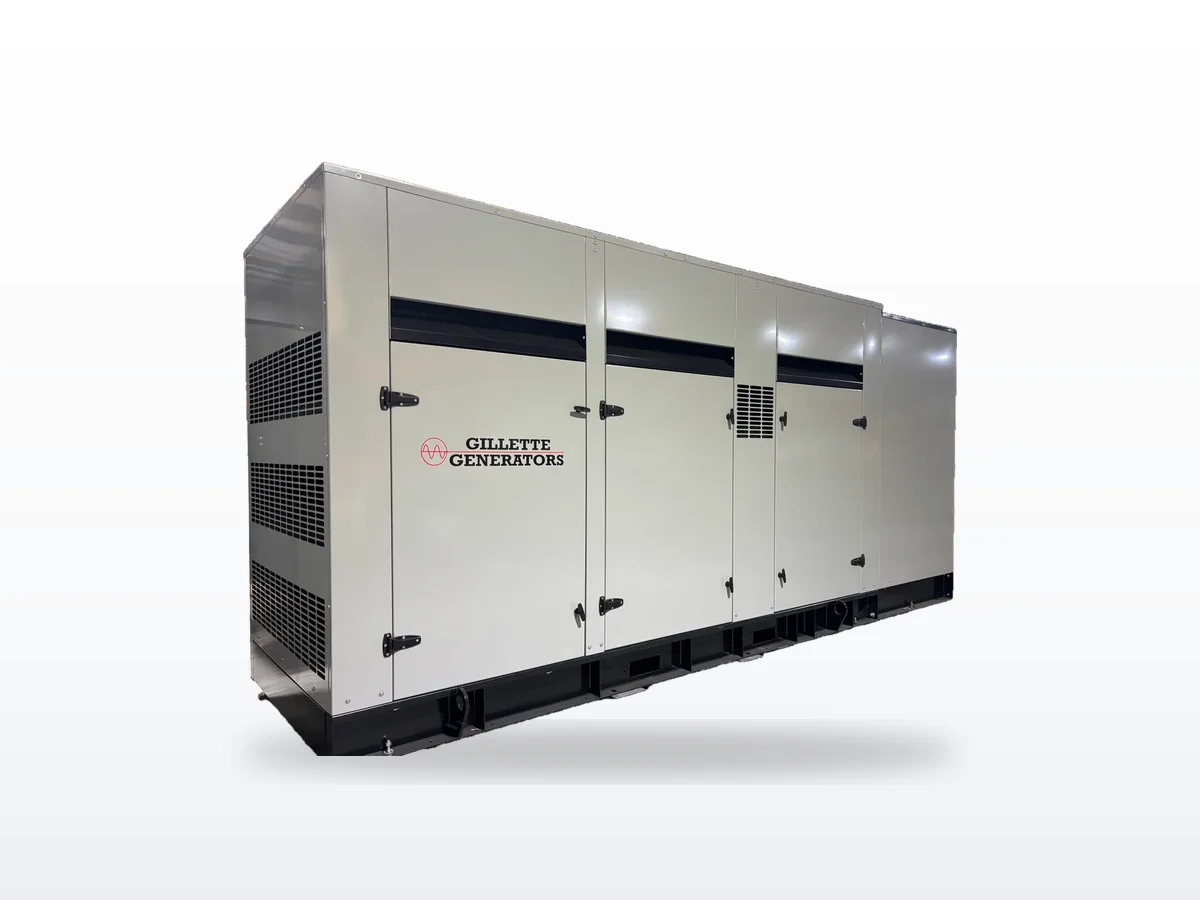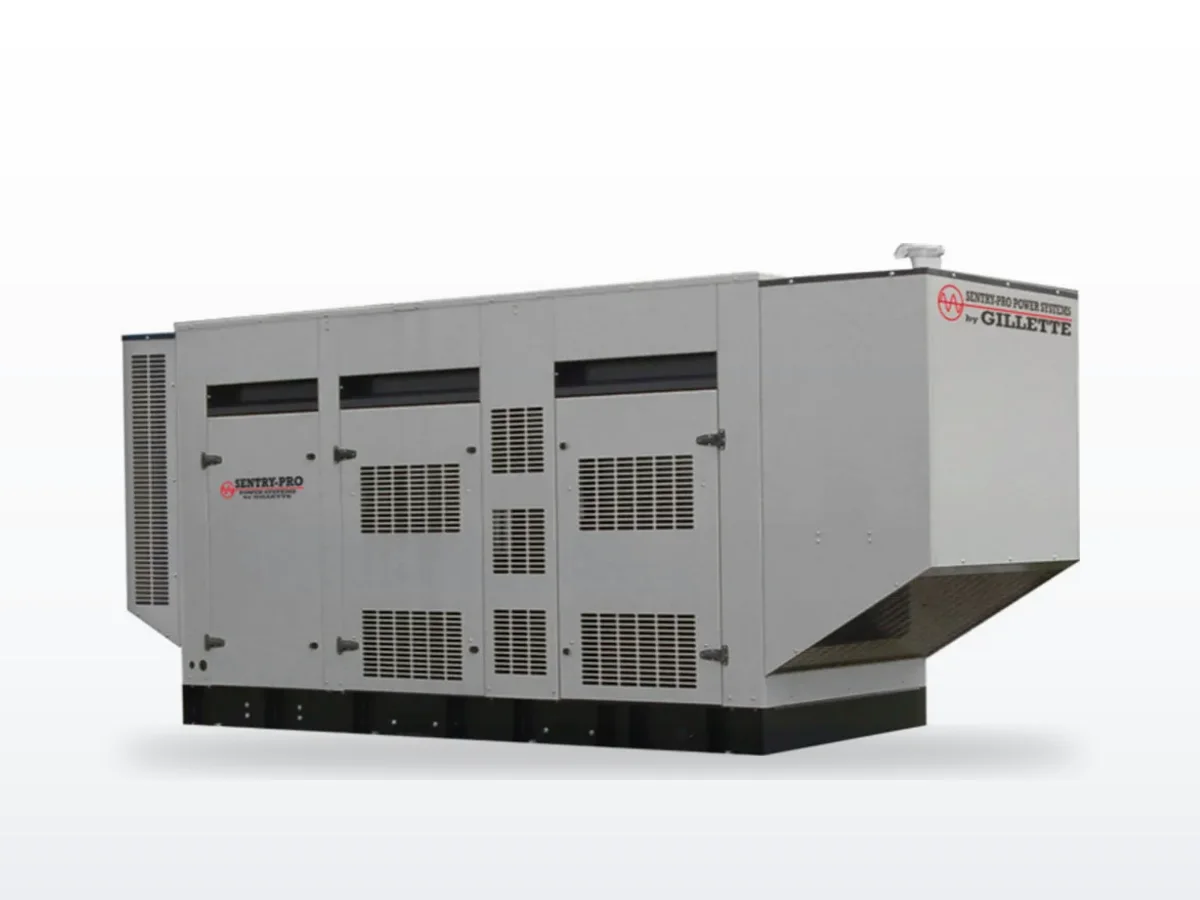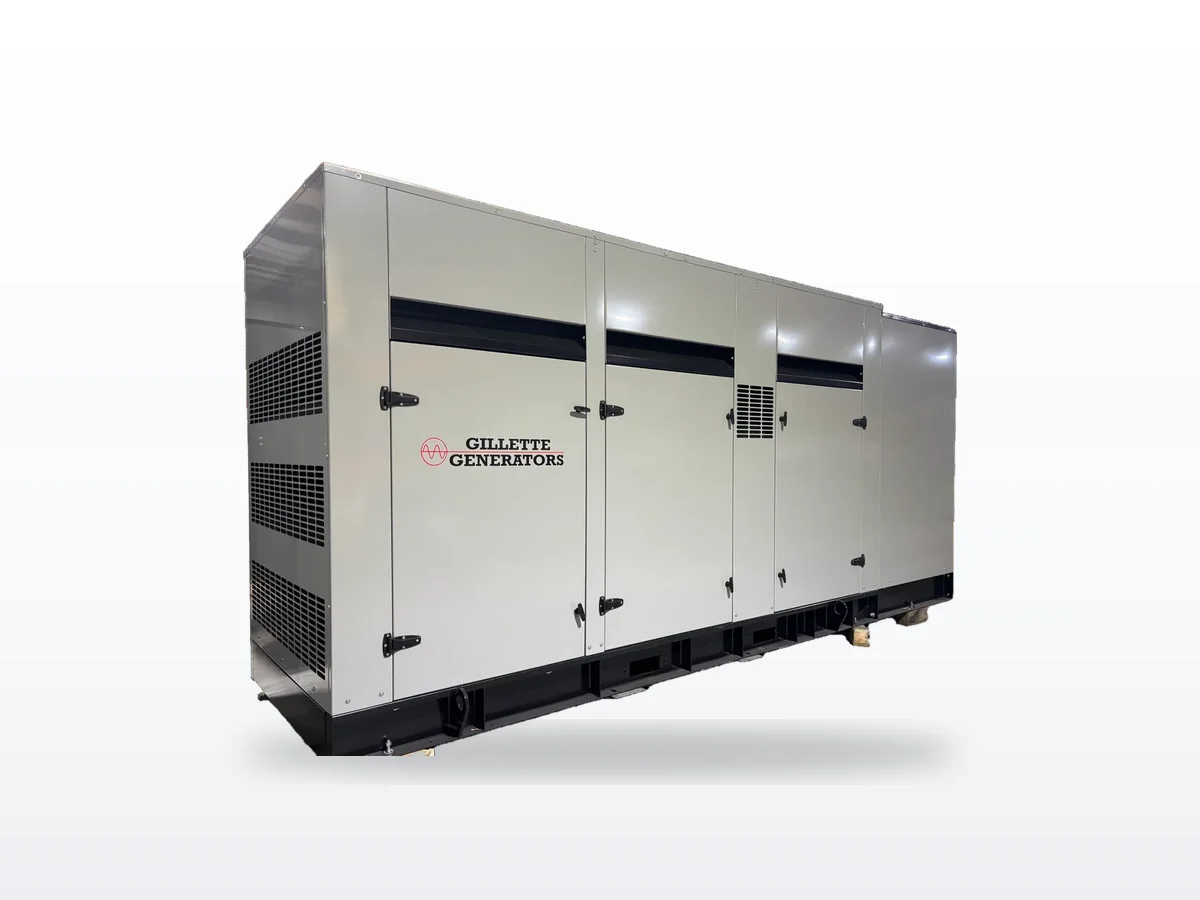
The Gillette SP-2500P is a 250-kilowatt natural gas / 165-kilowatt LPG stationary standby generator — the first model in the SP series to use PSI's 13L inline-6 turbocharged platform, stepping beyond the 8.8L V8 family used in the SP-960 through SP-2000P. Stamford S4L1DD alternator, DSE 7420 MKII controller, three-phase only.
At 250 kW, this unit serves large commercial and institutional facilities: hotels, larger office buildings, data centers, hospitals, and multi-building campuses where a single generator feeds critical distribution switchgear.
PSI's 13L inline-6 is a purpose-built industrial spark-ignition engine in a long-stroke configuration (5" bore × 6.5" stroke). Key characteristics:
Inline-6 architecture — inherently balanced, vibration-free at 1800 RPM. Simpler than a V8 or V12 at similar displacement for maintenance access
12.54L actual displacement — Gillette designates the family as "13L" across the SP-2500P and SP-3000P
Turbocharged and charge air cooled — boosted for high specific output; the turbo and CAC systems are engineered for sustained standby duty, not intermittent peak loads
10 main bearings, precision half-shell — robust bearing load distribution for long service life
28 qt oil capacity (31.7 qt with filter) — 2 spin-on filters for efficient oil changes at 250-hour intervals
Mechanical output: 402 bhp NG / 243 bhp LPG at standby. The large NG-to-LPG gap (250 kW vs. 165 kW) is characteristic of this turbocharged platform where fuel delivery systems are optimized for NG.
The SP-2500P uses the Stamford S4L1DD-311 — a larger, 4-pole frame that Stamford uses across the 200-350 kW class. Motor starting capacity: 730 kVA at 30% voltage dip on 208-240V systems, 990 kVA at 480V. Class H insulation, single pre-lubricated bearing, direct flexible disc coupling to the engine.
The PSI 13L inline-6 is a well-established commercial generator engine. The inline-6 architecture means good access to the top of the engine — spark plug changes, injector service, and valve clearance inspection are straightforward compared to V-configuration engines at similar output. This is one of the larger units we commission for commercial standby — at 8,175 lbs open, installation requires a crane or forklift. Full-load commissioning and annual load bank testing are essential at this power level.
Tell us about the application — kW, voltage, application, install timeline — and we'll respond within one business day with budgetary pricing, lead time, and any sizing notes.
Adjust load percent and tank size to estimate runtime. Pre-filled with this model's spec where available.
Estimate runtime on this tank
Fuel demand at 75% load
2,625,000 BTU/hr≈ 2625.0 cf/min @ 1,000 BTU/cf
On utility natural gas the runtime is generally unlimited provided the supply line and meter can deliver this BTU/hr at the engine's required inlet pressure (typically 5–14" WC residential, up to 5 psi commercial). Confirm against the OEM's published fuel-pressure spec.
Service intervals
Manufacturer-recommended intervals for the Gillette SP-2500P under standby duty. Field intervals may differ based on load profile, ambient conditions, and fuel quality.
Oil & filter
Every 250 hours or 12 months
Coolant change
Every 4000 hours
Air filter
Every 1000 hours
Spark plugs
Every 1500 hours
Major overhaul
≈ 15,000 hours
Load bank test
Every 12 months
Common failure modes
What we've seen fail on this platform. Use as a service-planning reference, not a diagnostic — actual failure modes depend heavily on duty cycle and maintenance history.
Component
Symptom
Typical hours
Severity
Turbocharger
Loss of power, black smoke under load
12,000+
moderate
Charge air cooler
Reduced output, elevated intake temperatures
10,000+
moderate
Spark plugs / ignition
Misfire, rough running
1,500+
minor
Battery bank (24V)
Slow cranking, failed start
8,760+
minor
Frequently Asked Questions
What engine does the SP-2500P use?
PSI's 13L turbocharged and charge air cooled inline-6 (12.54L actual displacement). This is PSI's step above the 8.8L V8 platform — a 6-cylinder in-line configuration at 250 kW NG standby, producing 402 bhp at standby on natural gas and 243 bhp on LPG.
What is the LPG standby rating of the SP-2500P?
165 kW LPG — notably lower than the 250 kW NG rating. Unlike the smaller naturally aspirated models, turbocharged PSI engines at this displacement show a large NG/LPG output gap because the turbocharger and fuel system are optimized for NG at full output. If sustained LPG operation at higher kW is required, consider LPG liquid withdrawal systems or a different model.
How does the SP-2500P differ from the SP-3000P?
Both use the same PSI 13L inline-6 engine block. The SP-3000P is the high-output variant: 300 kW NG (vs. 250 kW), 469 bhp (vs. 402 bhp) from the same displacement. Same enclosure dimensions and weight — only engine calibration and alternator differ.
What is the battery system specification?
24 VDC starting system using two 12V BCI#31 batteries (series) with minimum 1000 CCA each. The 24V system handles the high cranking demand of the 13L engine at low temperatures.
What fuel inlet size and pressure does the SP-2500P require?
2" NPTF fuel inlet at 11-14" water column (2.7-3.5 kPa). Full-load NG consumption: 3,418 ft³/hr (3,418,000 BTU/hr). This is a high-demand gas installation requiring a dedicated commercial meter and distribution.
200 kW natural gas stationary standby generator. Made-in-USA commercial unit with PSI 8.8L high-output turbocharged V8, Stamford alternator, and DSE 7420 MKII controller. NG only.