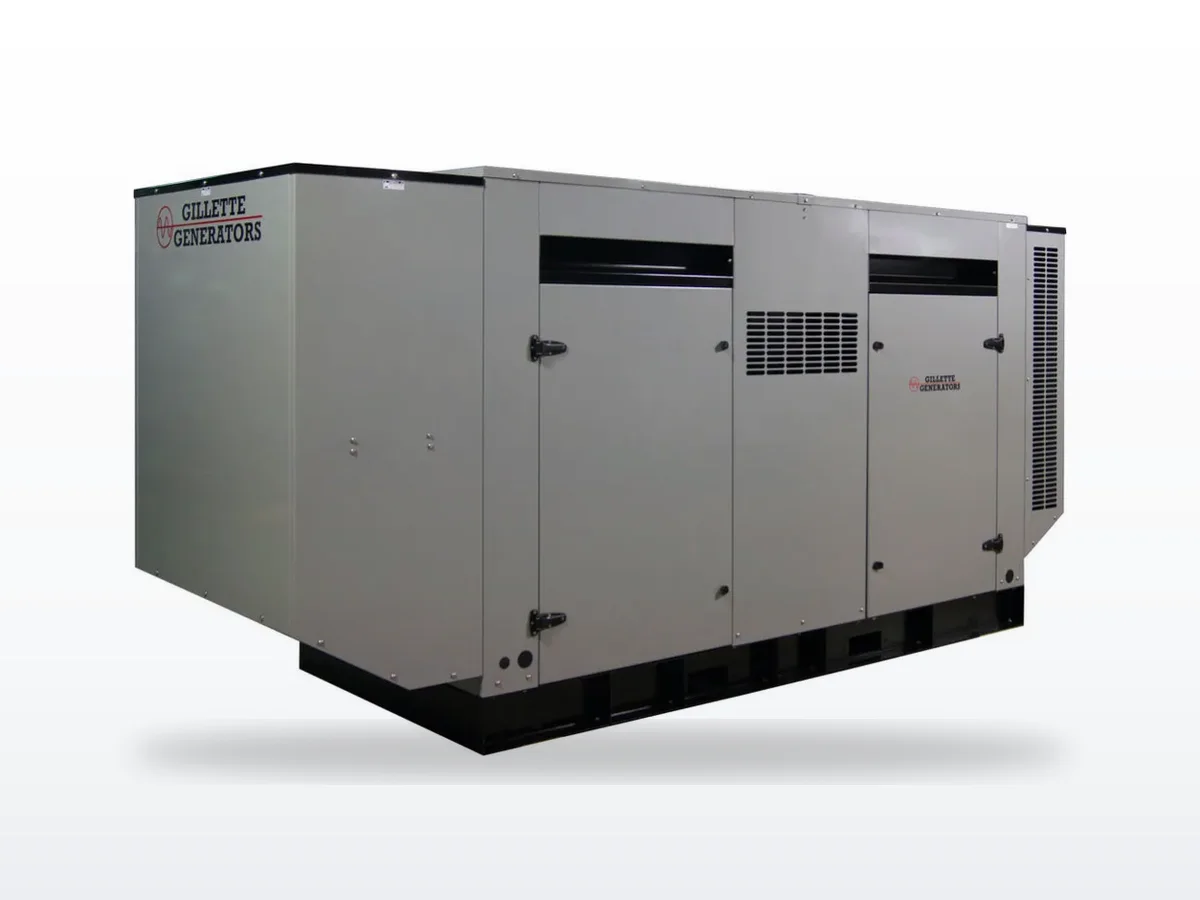
Series Overview#
The Gillette PR Series is the company's natural gas prime power lineup, covering 80 kW to 540 kW across seven models. Unlike the SP Series standby generators, PR units are designed and rated for continuous duty as the primary power source — they run unlimited hours at rated output, serving sites without reliable grid power or where the cost and complexity of grid connection makes on-site gas generation the operational default.
All seven PR models use Power Solutions International (PSI) gaseous engines, Stamford alternators, and Deep Sea Electronics DSE 7420 MKII controllers — open-architecture components that can be serviced by any qualified technician without proprietary dealer access. The series complies with EPA Stationary Spark Ignition standards, which govern stationary natural gas and LPG generator emissions for non-emergency prime power applications.
The prime versus standby distinction is operationally critical. Prime-rated output is the maximum continuous output a generator can sustain indefinitely. Standby ratings — used by the SP series — represent an elevated output permissible only during emergency use. The PR-800, for example, uses the same PSI 8.8L V8 engine as the SP-960 standby unit, but is rated 80 kW prime versus 96 kW standby because the lower prime rating reflects sustainable continuous operation rather than an emergency peak. Specifying a standby-rated generator for continuous prime power duty will result in shortened engine life, increased failure frequency, and warranty issues.
Service intervals on the PR series are tighter than the standby-duty SP series: oil changes at 250 hours or 6 months (vs. 250 hours or 12 months on the SP series), coolant service at 4,000 hours (vs. 4,000 hours shared), and spark plug replacement at 1,000 hours (vs. 1,500 hours on the SP series). For a generator running 8,760 hours per year, this means roughly nine oil changes annually and spark plug service every 5–6 weeks — operating costs that need to be factored into the total cost of ownership analysis.
How to Choose#
80 kW — PR-800 (PSI 8.8L V8, natural gas and LPG): Entry point. The only PR model supporting LPG in addition to natural gas. Uses the same engine as the SP-960 standby unit. For remote sites where natural gas pipeline is unavailable and LPG is the propane supply, the PR-800 is the only LPG-capable prime gas option in the series.
100 kW and 130 kW — PR-1000, PR-1300 (PSI 8.1L I6 TCAC, natural gas only): The PR series uses the 8.1L inline-6 for these outputs — a different platform from the SP series 8.8L V8 at similar kW. Same enclosure footprint between the two. If load may grow from 100 kW to 130 kW, the PR-1300 provides that headroom from the same physical installation.
180 kW — PR-1800 (PSI 11.1L I6 TCAC, natural gas only): The 11.1L is a prime-specific PSI displacement not found in the SP standby series. Steps between the 8.1L (PR-1000/1300) and the 14.6L (PR-2400). Natural gas only.
240 kW — PR-2400 (PSI 14.6L V8 TCAC, natural gas only): The same 14.6L V8 platform as the SP-3500 standby (350 kW). At 240 kW prime, the engine operates well within its thermal design limits for unlimited continuous duty. Three-phase only.
350 kW — PR-3500 (PSI 21.9L V12 TCAC, natural gas only): The V12 platform at continuous duty means 12 cylinders of ignition maintenance every 1,000 hours. Factor this into service budgeting. Same V12 block as the SP-4000/5000 standby series. Three-phase only.
540 kW — PR-5400 (PSI 31.8L V12 TCAC, natural gas only): Largest prime gas generator in the lineup. The same 31.8L V12 as the SP-6500 standby (650 kW). At 540 kW prime, the engine runs at approximately 83% of standby output — a conservative loading appropriate for sustained continuous duty. Three-phase only.
Common Applications#
-
Remote sites and off-grid operations: All seven PR models are classified for remote site and off-grid applications. For facilities that cannot access grid power — oil field support, remote industrial operations, communications infrastructure, wilderness lodges — the PR series provides reliable continuous power from a piped or stored natural gas supply.
-
Mining operations: All seven models serve mining applications. Natural gas prime power is attractive at mining sites where natural gas or LPG can be delivered by truck or pipeline, eliminating the diesel fuel logistics of large standby diesel inventories. Continuous duty is typical at active mining operations.
-
Agricultural facilities: 4 of 7 models serve agricultural applications — grain elevators, irrigation pump stations, poultry and livestock operations in areas where grid power is unreliable or unavailable. The natural gas supply can come from on-site LPG storage (PR-800 only) or from agricultural natural gas pipeline service.
-
Industrial prime power: 4 of 7 models serve industrial applications requiring continuous prime power. Manufacturing operations, process facilities, and industrial sites where on-site gas generation is more economical than grid demand charges or where grid reliability is insufficient for production continuity.
-
Construction and temporary prime power: The PR series is sized for larger construction site prime power requirements where grid service is unavailable and diesel fuel management is operationally burdensome. Natural gas supplied from a utility line at the site perimeter can power the PR series throughout a construction cycle.
Service & Maintenance#
Prime power gas generators accumulate operating hours orders of magnitude faster than standby units. A PR series generator in continuous duty adds 8,760 hours per year — this means annual oil changes become monthly events (roughly every 3.5 weeks at 250-hour intervals), and spark plug service occurs approximately nine times per year on most models.
The dominant failure modes in the PR series reflect continuous duty stress rather than standby maintenance failures. Turbocharger degradation — power loss from continuous high-output wear — is documented in 4 of 7 models, typically appearing around 10,000 hours. Turbo inspection at every coolant service interval (4,000 hours) provides early warning. Spark plug and ignition system failures (misfire, rough running) are documented across all models at the 1,000-hour service interval — these are not unexpected failures but rather the predictable consequence of ignoring the service schedule. The ignition service is the most important scheduled maintenance item on the PR series and the most commonly deferred.
Oil degradation and valve train wear from continuous duty appear as documented risks on models with higher output calibrations. The 250-hour oil change interval exists specifically to prevent this; extending oil change intervals on prime power gas engines accelerates valve guide wear and deposits. Use the manufacturer-specified viscosity and quality for PSI gaseous engines.
Coolant system integrity is important at higher prime power outputs — PR series units running 8,000+ hours annually are cycling through substantial heat load. Coolant system service at 4,000 hours keeps inhibitor levels maintained and prevents scaling. Hose and clamp inspection at each service interval catches early coolant loss before it becomes an overtemp event.
Application Guidance#
The Gillette PR Series is built for one application: continuous-duty natural gas prime power from 80 to 540 kW at remote sites, mining operations, off-grid facilities, and agricultural operations where there is no reliable grid connection or where on-site gas generation is operationally preferred over grid demand charges. PSI engines, Stamford alternators, and DSE 7420 MKII controllers are all open-architecture — no proprietary dealer dependency for service, a genuine advantage at remote sites where factory-authorized service calls may have multi-day lead times. The PR-800's LPG capability is the critical differentiator for the bottom of the range: if the site cannot access pipeline natural gas and LPG truck delivery is the fuel supply, the PR-800 is the only PR model that covers it.
Do not substitute a PR Series unit for standby applications or specify the SP standby series for prime power duty — these are different duty cycles and the engines are calibrated accordingly. Running an SP standby generator as a primary power source will shorten engine life, increase failure frequency, and void warranty. For diesel prime power (where natural gas or LPG is unavailable) with Tier 4 Final emissions compliance, the Gillette T4D Series (100–600 kW) is the correct alternative. For natural gas standby (not continuous prime power), the Gillette SP Series serves the same PSI engine platforms in a standby-rated configuration. For prime power requirements above 540 kW on natural gas, evaluate the Cummins Large Gas 750–1000 kW or the CAT 3500 Series Gas — and budget for the significantly higher service intensity that continuous gas prime power at that scale demands.
FAQ#
See frontmatter for FAQ items.