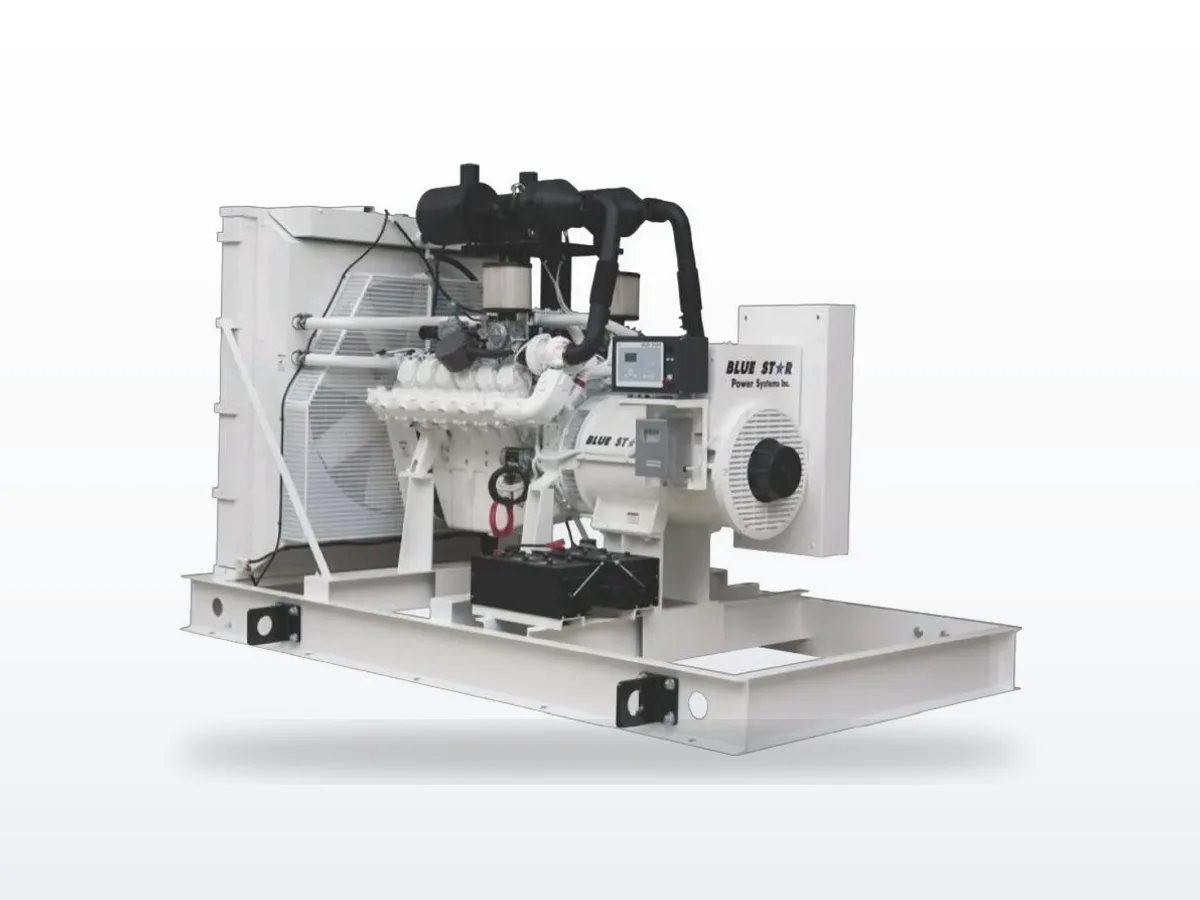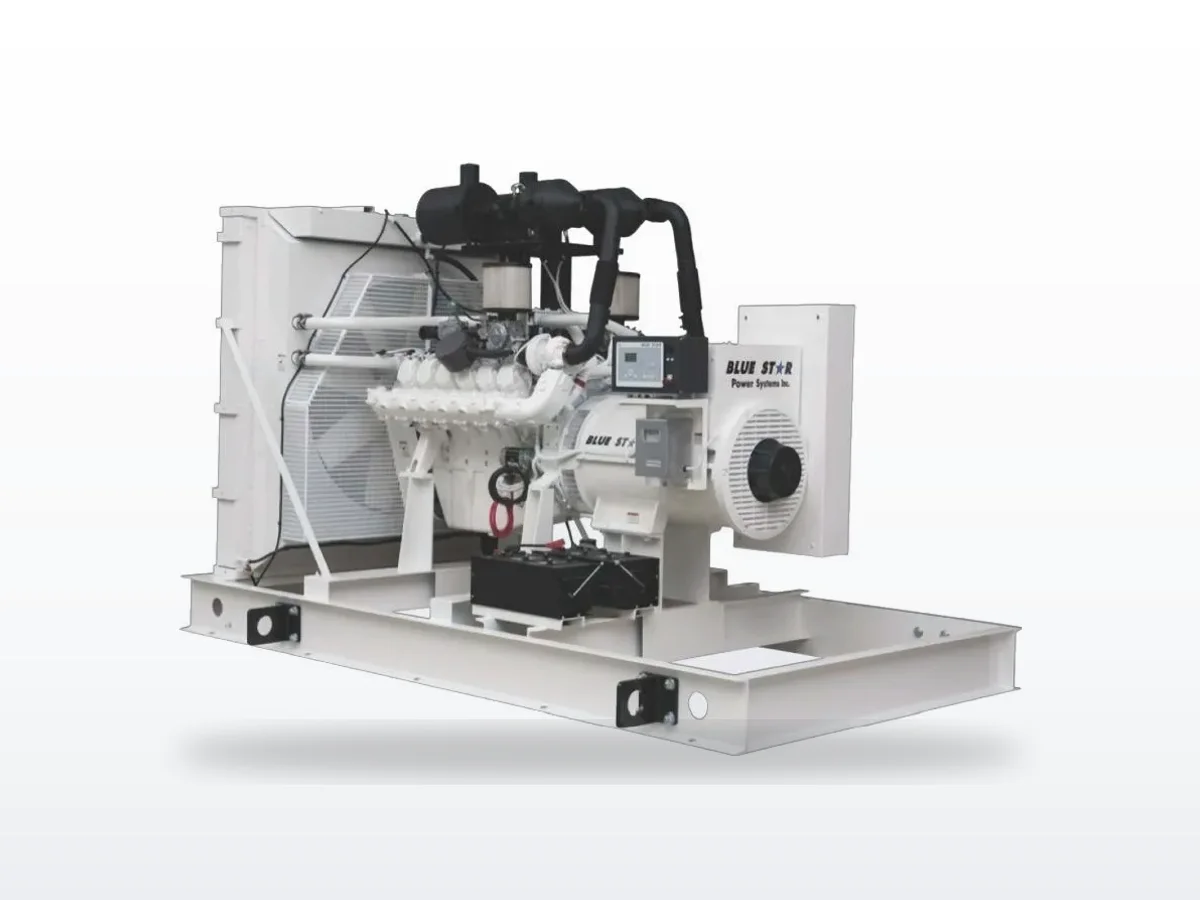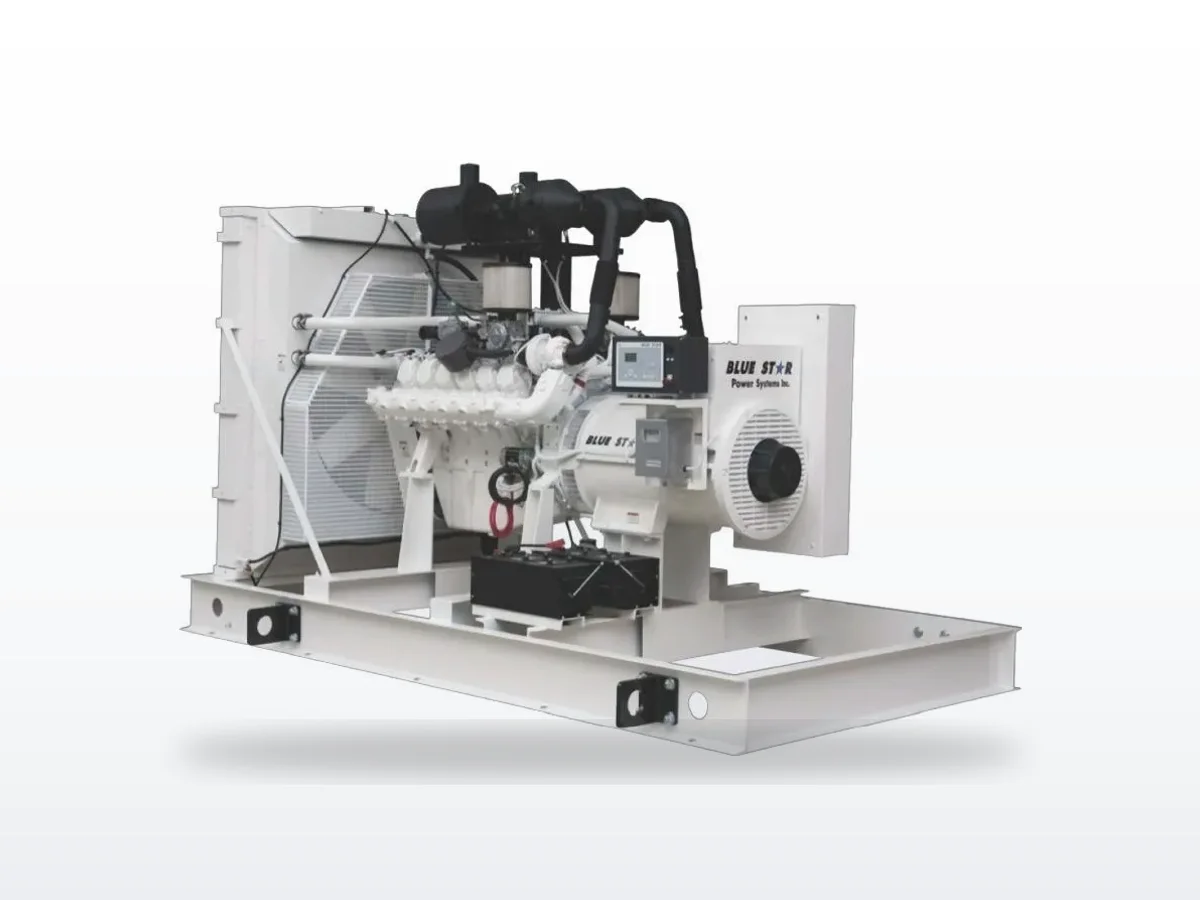
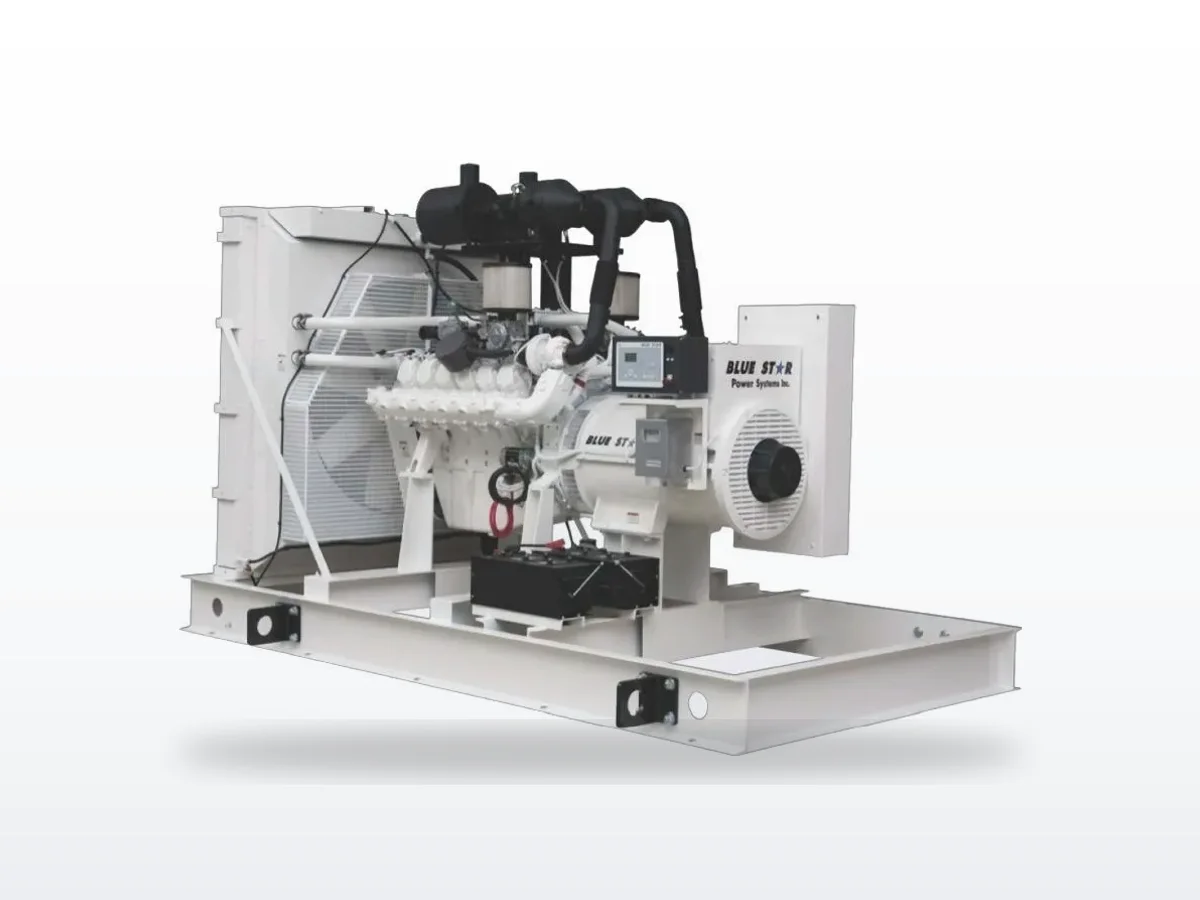
The Blue Star GM50-03 is a 50-kilowatt natural gas and LP standby generator powered by the PSI 5.7L NA — an eight-cylinder V8 naturally aspirated engine from Power Solutions International. It is rated at 50 kWe standby on both natural gas and LP across all voltage configurations from 120/240V single-phase through 347/600V three-phase.
Blue Star Power Systems pairs the 5.7L engine with a Stamford UCI224D alternator and DSE DCP7310 controller on a formed steel base. The OPU footprint is 80 × 38 × 52 in at 1,800 lbs. Level 1, 2, and 3 enclosures are available, with sound levels from 79 dBA (OPU full load) down to 64 dBA (Level 3) at full load.
The PSI 5.7L V8 block at 350 cubic inches powers both the GM50-03 (50 kWe) and the GM60-02 (60 kWe). The two models share the same 80 × 38 in footprint, the same engine architecture, and the same maintenance schedule. The GM50-03 uses a lower fuel delivery calibration that produces 50 kWe while leaving more output margin in reserve — a characteristic reflected in the more favorable altitude deration profile: GM50-03 holds full output to 4,200 ft while the GM60-02 begins derating at 1,200 ft.
The GM50-03 carries no published temperature deration and begins altitude deration only above 4,200 ft at 3% per 1,000 ft. This is notably more favorable than most gaseous generators in this class, which typically begin derating at 1,200 ft. For installations in the Rocky Mountain region, high-altitude construction, or elevated commercial sites, the GM50-03 maintains full 50 kWe output across a broader range than comparable units.
The PSI 5.7L V8 at 50 kWe has significant headroom — 113 hp engine producing 50 kWe electrical output. This means the engine rarely approaches its thermal limits in standby operation, which is good for longevity but creates the same wet-stacking and fouling risks as all lightly loaded gaseous standby units. Annual full-load testing to 50 kWe is required. Natural gas supply pressure must be verified at the generator inlet under load — 736 ft³/hr at 11.0 in. W.C. requires proper regulator and supply line sizing. Spark plug inspection at each annual PM is non-negotiable on naturally aspirated engines of this type.
Tell us about the application — kW, voltage, application, install timeline — and we'll respond within one business day with budgetary pricing, lead time, and any sizing notes.
Adjust load percent and tank size to estimate runtime. Pre-filled with this model's spec where available.
Estimate runtime on this tank
Fuel demand at 75% load
525,000 BTU/hr≈ 525.0 cf/min @ 1,000 BTU/cf
On utility natural gas the runtime is generally unlimited provided the supply line and meter can deliver this BTU/hr at the engine's required inlet pressure (typically 5–14" WC residential, up to 5 psi commercial). Confirm against the OEM's published fuel-pressure spec.
Service intervals
Manufacturer-recommended intervals for the Blue Star GM50-03 under standby duty. Field intervals may differ based on load profile, ambient conditions, and fuel quality.
Oil & filter
Every 250 hours or 12 months
Coolant change
Every 4000 hours
Air filter
Every 1000 hours
Spark plugs
Every 1500 hours
Major overhaul
≈ 15,000 hours
Load bank test
Every 12 months
Common failure modes
What we've seen fail on this platform. Use as a service-planning reference, not a diagnostic — actual failure modes depend heavily on duty cycle and maintenance history.
Component
Symptom
Typical hours
Severity
Spark plugs / ignition
Misfire under load, hard starting
1,500+
minor
Battery
Failed to start during outage
8,760+
minor
Coolant system
Overtemp, coolant loss
6,000+
minor
Frequently Asked Questions
What engine does the GM50-03 use?
The PSI 5.7L NA — an eight-cylinder V8 naturally aspirated engine from Power Solutions International, displacing 350 cubic inches (5.70 liters). At 1800 RPM, it produces 113 hp (84.3 kWm) standby — well above the 50 kWe electrical output, providing headroom on this naturally aspirated platform. Both natural gas and LP outputs are equal at 50 kWe across all voltage configurations. The PSI 5.7L V8 block is shared with the GM60-02 (60 kWe); the GM50-03 uses a lower calibration of the same engine, not a different platform. This means identical maintenance intervals and identical physical footprints (80 × 38 in) between the two models.
Why does the GM50-03 have a different deration profile from the GM60-02?
The GM50-03 derates only for altitude — 3% per 1,000 ft above 4,200 ft — with no published temperature deration. The GM60-02 on the same 5.7L block derates at 1% per 10°F above 77°F temperature and 3% per 1,000 ft above 1,200 ft altitude. The GM50-03's altitude threshold of 4,200 ft is far more favorable than the GM60-02's 1,200 ft threshold, likely because the GM50-03 calibration leaves more thermal margin at the 50 kWe output level. For installations above 1,200 ft where full output is required, the GM50-03 can maintain rated output across a broader altitude range than its 60 kWe companion.
How does the GM50-03 compare to the GM60-02?
The GM50-03 and GM60-02 use the same PSI 5.7L V8 engine and share the same 80 × 38 in OPU footprint, but differ in output calibration (50 vs. 60 kWe), alternator (UCI224D vs. UCI224E), weight (1,800 vs. 1,900 lbs), and deration profile. The GM50-03 has the more favorable altitude deration (starts at 4,200 ft vs. 1,200 ft on the GM60-02) and slightly lower fuel consumption (736 vs. 773 ft³/hr NG at full load). Choose the GM60-02 when 60 kWe is needed; choose the GM50-03 when 50 kWe suffices, particularly at higher-altitude sites.
What are the fuel consumption rates for the GM50-03?
At 100% standby load, the GM50-03 consumes 736 ft³/hr of natural gas or 286 ft³/hr of LP. At 75% load: 592 ft³/hr NG or 262 ft³/hr LP. At 50% load: 465 ft³/hr NG or 182 ft³/hr LP. Required inlet pressure is 11.0 in. W.C. at a 1.0-inch NPT connection. Heat rejected to the coolant circuit at full load is 187,200 BTU/hr; heat radiated to the enclosure or room is 40,620 BTU/hr. Combustion air draw is 173 CFM; ventilation air requirement is 7,400 CFM for a radiator-cooled installation.
55 kW prime / 60 kW standby natural gas / LP generator from Blue Star Power Systems. PSI 5.7L eight-cylinder V8 with catalyst/silencer, Stamford UCI224E alternator, DSE DCP7310 controller, 208-600V output.
35 kW prime / 40 kW standby natural gas / LP generator from Blue Star Power Systems. PSI 4.3L six-cylinder V6 engine with catalyst/silencer, Stamford UCI224C alternator, DSE DCP7310 controller, 208-600V output.
41-50 kW gaseous-fueled commercial standby generator with Brushless Rare-Earth Permanent-Magnet alternator. Industrial gaseous unit for commercial backup on natural gas or propane.