
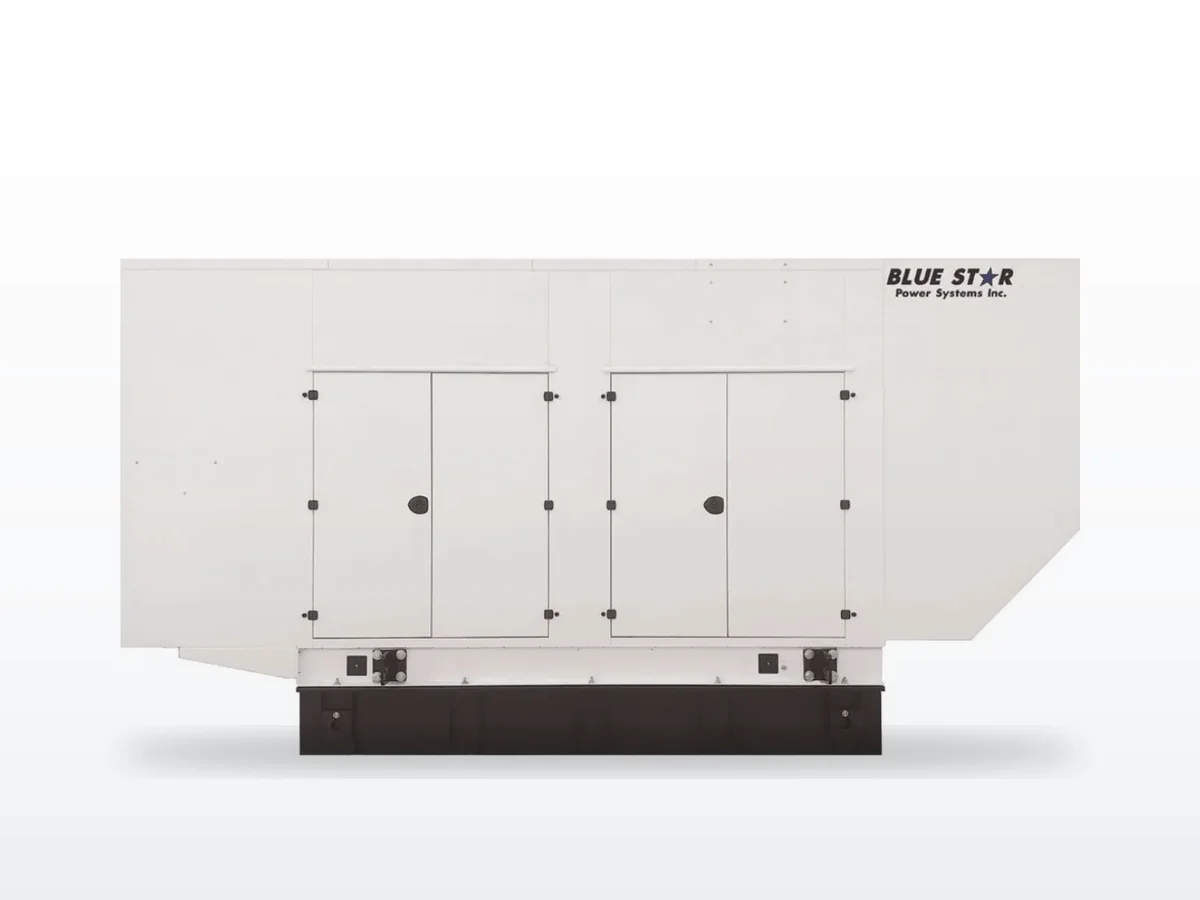
Series Overview#
The Blue Star Mitsubishi Diesel Standby series — designated MD — covers the 800 kW to 2,000 kW standby power band using Mitsubishi's V12 and V16 diesel engine platforms. Five models span the range: the MD800-01, MD1000-01, and MD1250-01 are built on Mitsubishi's V12 engine family, while the MD1600-01 and MD2000-01 step up to the larger V16 architecture. All five are three-phase, liquid-cooled, EPA Tier 2 diesel units available in voltages from 120/208V through 4160V — a voltage range that spans low-voltage distribution through medium-voltage systems used in large industrial and utility applications.
Blue Star Power Systems (North Mankato, Minnesota; a DEUTZ AG subsidiary since 2024) assembles each MD unit with an open-architecture Basler DGC-2020 controller. That controller is a differentiating factor in this power class: unlike proprietary controls from Kohler or CAT, the DGC-2020 can be programmed by any qualified controls technician, accepts replacement modules from independent suppliers, and integrates with third-party building management systems using standard communication protocols. For facilities managing 1 MW or more of standby power, that serviceability is material to long-term operating cost.
The MD series is designed for operators who need massive on-site standby capacity without the restrictions of single-OEM dependency. At 800 kW to 2 MW, these generators serve industrial complexes, large municipal infrastructure, data center campuses, utility substations, and military installations — applications where a failed start or a proprietary parts delay carries serious operational consequences.
How to Choose#
MD800-01 (800 kW) — V12 entry: Powered by the Mitsubishi S12A2-Y2PTAW-2, a 33.9-liter, 12-cylinder engine producing 1,207 HP. The entry point into the MD series; appropriate when an 800 kWe standby rating meets the load study and the site can accommodate a large three-phase unit.
MD1000-01 (1,000 kW) — V12 midrange: Uses the Mitsubishi S12H-Y2PTAW-1, a 37.1-liter V12 producing 1,528 HP. Select when the load study falls between the MD800-01 and the MD1250-01. Shares the V12 architecture with the 800 and 1250 but at a higher displacement.
MD1250-01 (1,250 kW) — V12 top: Built around the Mitsubishi S12R-Y2PTAW-1, a 49.0-liter V12 producing 1,881 HP — the largest V12 in the MD lineup. This is the model to specify when 1,000 kW is marginal and before the application requires a V16 platform.
MD1600-01 (1,600 kW) — V16 entry: The first MD model to use the Mitsubishi S16R V16 platform — specifically the S16R-Y2PTAW-1, a 65.4-liter, 16-cylinder engine producing 2,346 HP. Specify when the load study exceeds what the V12 family can deliver. The step to V16 also moves the generator firmly into utility, military, and large industrial territory.
MD2000-01 (2,000 kW) — V16 maximum: Uses the Mitsubishi S16R-Y2PTAW2-1, a higher-output variant of the S16R producing 2,923 HP from the same 65.4-liter V16 displacement. The top of the Blue Star MD lineup and appropriate for 2 MW–class standby requirements.
For voltage, specify 4160V when the site uses medium-voltage distribution — noting that the 4160V configuration is not UL 2200 listed through 600VAC; verify AHJ requirements accordingly. All other voltage configurations (120/208V, 240V, 277/480V, 347/600V) are standard across the series.
Common Applications#
- Industrial facilities: All five MD models are suited to large manufacturing plants, refineries, and processing facilities where a single high-capacity standby unit is preferred over paralleled smaller sets. The 4160V output option allows direct feed to medium-voltage motor loads.
- Data centers and campus infrastructure: The 800–2,000 kW range aligns with the standby power requirements of hyperscale and enterprise data center pods, as well as multi-building university or hospital campuses with centralized emergency power plants.
- Municipal and utility infrastructure: Sewage lift stations, water treatment plants, and utility substations in this power class require generators capable of starting and sustaining large motor loads. The MD series' three-phase output and medium-voltage option address those requirements.
- Military installations: The combination of high output, multi-voltage availability (including 4160V), and an open-architecture controller that isn't tied to a single OEM service network makes the MD series practical for military base applications requiring long-term maintainability.
- Pump stations: Large municipal and industrial pump stations with motor loads in the hundreds to thousands of horsepower range use standby power in this kW class. The MD series' robust engine platforms are well matched to sustained motor-start and continuous-run duty.
Service & Maintenance#
All MD series generators share a uniform service schedule: oil and fuel filter changes at 500 hours or 12 months, air filter inspection at 1,000 hours, and coolant changes at 6,000 hours. Blue Star specifies these intervals across all five models — they are non-negotiable for warranty compliance and critical for reliability in standby applications where the engine may sit idle for extended periods.
The most significant failure mode documented across the MD series is turbocharger degradation, typically presenting as major power loss and heavy exhaust smoke around 12,000 hours. At megawatt-class outputs, a turbocharger failure causes a full load shed — for a data center or industrial plant this is a critical event. Proactive inspection at 10,000–11,000 hours, including oil contamination checks and bearing play measurement, is recommended.
Fuel quality and degradation is a moderate-severity risk across all five models. Diesel stored in low-turnover standby tanks develops microbial contamination and fuel breakdown that causes injector fouling and hard starting. Biocide treatment and regular tank sampling — minimally every six months — is the industry-standard mitigation.
Battery bank condition (24V) is the most common minor failure mode. Standby generators in this power class use 24V battery banks to support the compressed air or electric starting systems. Battery replacement on a 3–4 year schedule (consistent with the 8,760-hour typical failure horizon) is standard practice, regardless of apparent charge state, because battery failure under cold-start conditions will cause a no-start event during an actual outage.
For sites with the 4160V medium-voltage output option, ensure that voltage regulator calibration and excitation system settings are verified at each major service interval, as medium-voltage alternator output is sensitive to load and power factor variation.
Application Guidance#
The Blue Star Mitsubishi Diesel Standby series is purpose-built for large industrial, campus, data center, and utility applications requiring 800 kW to 2,000 kW from a single stationary diesel unit with an open-architecture controller. The Basler DGC-2020 across all five models allows any qualified controls technician to service the system — a material advantage over proprietary-controls platforms in this power class for operators who need long-term serviceability without single-OEM dependency. The 4160V medium-voltage output option on all five models enables direct feed to campus and industrial distribution infrastructure, and the V12-to-V16 progression from MD800 through MD2000 provides granular sizing across a segment where the next-best alternative is often a paralleling array of smaller units.
This series is not appropriate when the load requirement falls below 800 kW — oversizing into the MD series means significant unnecessary capital expenditure. For commercial and industrial standby in the 100–750 kW range, the Blue Star Volvo Penta Diesel Standby series is the right fit. For direct competition at comparable megawatt-class power levels with established paralleling infrastructure, the CAT 3500 Series Large Diesel (1,000–3,000 kW) and Cummins QSK Series are the primary alternatives. If Tier 4 Final emissions compliance is required at this power class, note that all five MD Series models are Tier 2 only — consult your AHJ before specifying in air districts with stringent standby engine requirements.