
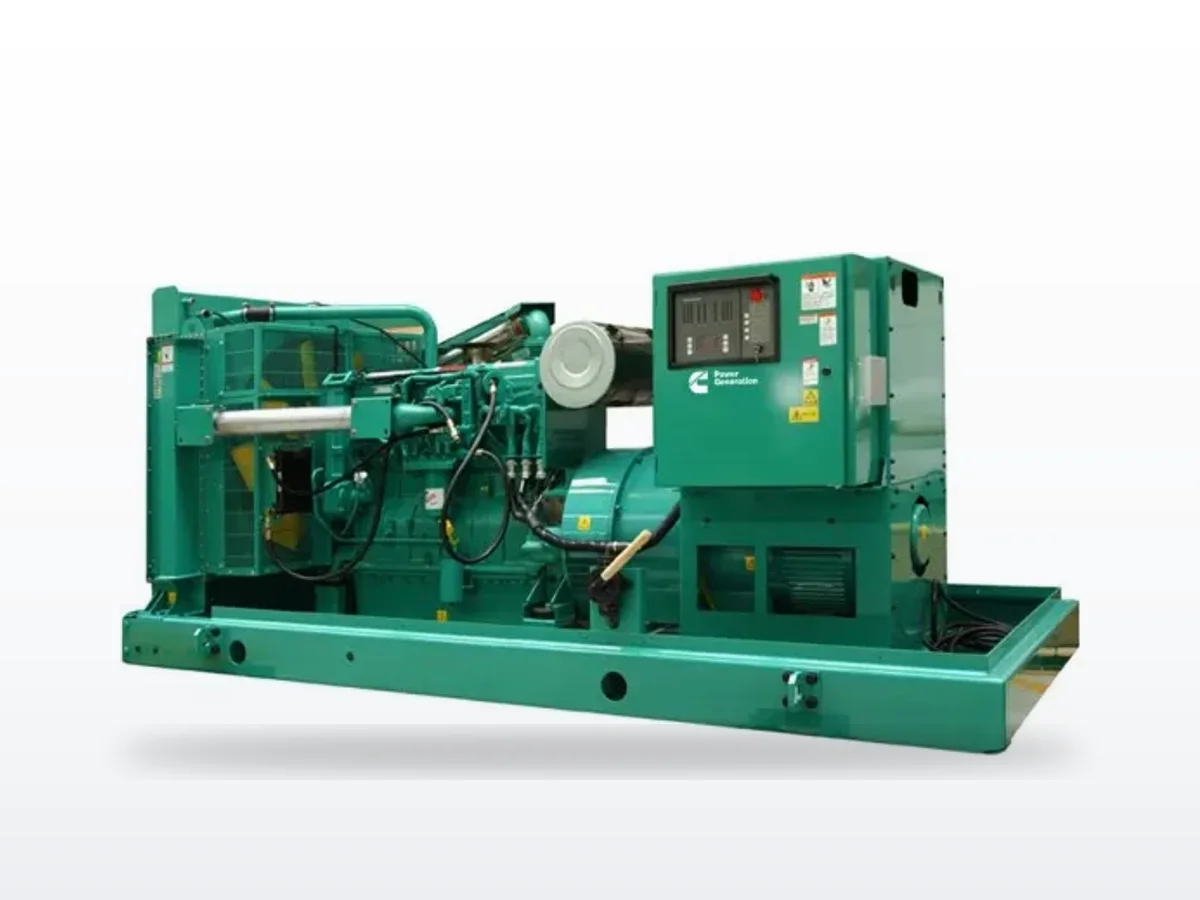
Series Overview#
The Cummins QSK Series is the most comprehensive large-diesel generator product line in the Cummins portfolio, spanning 500 to 3,010 kW across eight models: the QSX15 (500 kW), QSK19 (550 kW), QSK23 (800 kW), QSK38 (1,160 kW), QSK50 (1,500 kW), QSK60 (2,000 kW), QSK78 (2,750 kW), and QSK95 (3,010 kW). The series covers every major large-scale power generation requirement from medium campus standby through hyperscale data center backup — and it does so with Cummins' vertically integrated product architecture, where the engine, alternator, and PowerCommand controls are all designed and manufactured by a single entity.
That vertical integration is the QSK Series' most significant competitive differentiator. When a service event occurs, one manufacturer owns the full system warranty — no finger-pointing between an engine OEM and an alternator packager. The PowerCommand controls provide consistent programming, alarming, and remote monitoring interfaces across the entire series. And Cummins' engineering accountability for the complete drivetrain means that transient performance, voltage regulation, and fault protection are engineered as a system rather than tuned post-assembly.
Emissions tier coverage spans both Tier 2 and Tier 4 Final within the series. The QSK78-G14 carries Tier 4 Final certification with full exhaust aftertreatment (DPF and SCR), while the QSX15 through QSK60 and QSK95 are Tier 2 certified for stationary emergency use. Voltage availability ranges from 277/480V low-voltage through medium-voltage outputs at 2,400/4,160V, 12,470V, 13,200V, and 13,800V — covering the medium-voltage distribution systems that large data centers and campus installations commonly use.
How to Choose#
Output by model: The QSX15 at 500 kW and QSK19 at 550 kW are the smallest QSK Series entries — appropriate for single large commercial buildings or medium hospital standby. The QSK23 at 800 kW bridges to large campus and industrial applications. The QSK38 (1,160 kW) and QSK50 (1,500 kW) use V-12 architecture for the largest single-unit requirements below 2 MW. The QSK60 (2,000 kW) is the benchmark unit for large data center and hospital standby. The QSK78 (2,750 kW) and QSK95 (3,010 kW) represent the top of the series for hyperscale and utility-adjacent applications.
Tier 4 Final (QSK78-G14): If your project requires Tier 4 Final emissions compliance — increasingly required for prime or limited-use non-emergency applications — the QSK78 in its G14 configuration is the QSK Series solution. Note that Tier 4 Final adds DPF and SCR maintenance requirements including periodic regeneration cycles and DEF fluid management that Tier 2 units do not require.
Medium voltage: Medium-voltage alternator configurations are available on the QSK38 through QSK95, covering 4,160V, 12,470V, 13,200V, and 13,800V outputs for direct integration with campus medium-voltage distribution systems.
Paralleling architecture: If your total standby capacity requirement exceeds 3,010 kW, multiple QSK units in a paralleling switchgear arrangement are the standard approach. The QSK60 is the most common paralleling building block for large data center N+1 architectures at 2 MW per unit; the QSK95 is specified where total array capacity must be maximized with the fewest generator footprints.
The QSX15 positioning: The QSX15 uses an inline-6 platform (not a V-block QSK designation, despite the series grouping) and is the most compact entry in the series. It is appropriate for applications where space is constrained and output requirements fall in the 450–500 kW range.
Common Applications#
-
Campus-wide standby: All eight QSK models are documented for campus applications — the most consistent application tag in the series. Universities, healthcare campuses, and corporate campus facilities that need reliable multi-megawatt standby across distributed building loads specify QSK units for their single-manufacturer system integration and broad service support.
-
Data centers: Six of eight models are documented for data center applications. The QSK60 (2,000 kW) and QSK78 (2,750 kW) are particularly common in large enterprise and colocation data centers, where 2–3 MW per generator combined with medium-voltage distribution and N+1 paralleling are standard design parameters.
-
Large hospital standby: Four models are documented for large hospital applications. The QSK38 and QSK50 are common specifications for academic medical centers and regional hospital campuses that require 1–1.5 MW per generator with single-step load acceptance per NFPA 110 requirements.
-
Mission-critical industrial: Heavy industrial facilities — chemical plants, petroleum refining, and large manufacturing — specify QSK Series generators for their continuous duty rating availability, high-pressure fuel injection precision, and the single-source accountability Cummins' integrated drivetrain provides.
-
Paralleling arrays for N+1 redundancy: The QSK60 in particular is the industry-standard building block for data center paralleling arrays, where 4–8 units provide 8–16 MW of total backup capacity. The PowerCommand paralleling controls provide seamless load sharing and automatic transfer between paralleled units.
Service & Maintenance#
All eight QSK models share consistent service intervals: oil changes every 500 hours or 12 months, fuel filter replacement every 500 hours, coolant changes every 6,000 hours (documented across 7 models), and air filter service every 1,000 hours. At this power level, oil volume is substantial — plan for large-format oil disposal logistics and ensure service providers have appropriate equipment.
Four failure modes dominate across the QSK field population. First, fuel quality and tank degradation is the most widespread issue (4 models), causing filter clogging, hard starting, and injector fouling in standby applications where diesel sits in the tank for extended periods. Implement an annual fuel testing and polishing program as a non-negotiable maintenance item. Second, MCRS (Modular Common Rail System) fuel injection system wear at 15,000–20,000 hours produces injector fault codes, rough running, and power imbalance between cylinder banks — plan MCRS injector inspection and rebuilding as a life-cycle maintenance item on high-hour units. Third, 24V battery bank degradation causes slow crank and failed-start events; the 55A alternator charging system on some models must be verified to maintain battery charge during extended standby. Fourth, turbocharger bearing wear at approximately 18,000–25,000 hours produces reduced boost, excessive smoke, and turbo bearing noise.
For Tier 4 Final QSK78-G14 units, two additional maintenance streams apply: exhaust aftertreatment system service (DPF regeneration intervals, DEF quality monitoring, SCR catalyst condition) and DEF injection system maintenance. These are high-severity failure modes if neglected — DPF loading and SCR derating will trigger automatic power derates that affect backup capacity during outages.
The pre-lube system on the QSK95 requires particular attention. Low pre-lube pressure alarms indicate a serious risk of dry-start bearing damage on an engine of this size; document pre-lube pressure at each start and investigate any anomalies immediately.
Application Guidance#
The Cummins QSK Series is the industry standard for mission-critical large diesel standby at 500–3,010 kW — data centers requiring N+1 paralleling arrays, large hospital campuses, and heavy industrial facilities where Cummins' vertically integrated drivetrain (engine, alternator, and PowerCommand controls from one manufacturer) and medium-voltage distribution capability (up to 13,800V) are required. The QSK60 at 2,000 kW is the most widely deployed building block for enterprise and colocation data center paralleling architectures; the QSK95 at 3,010 kW maximizes total array capacity per generator footprint.
For standby requirements below 500 kW where the QSK platform is oversized, the Cummins D6 Commercial Diesel covers the 80–350 kW commercial range on the same integrated Cummins platform. For large-diesel applications where competing alternates are appropriate, the Kohler KD Series at 900–4,000 kW and the Blue Star Mitsubishi Diesel Standby series are the most common direct competitors at megawatt-class ratings.