Series Overview#
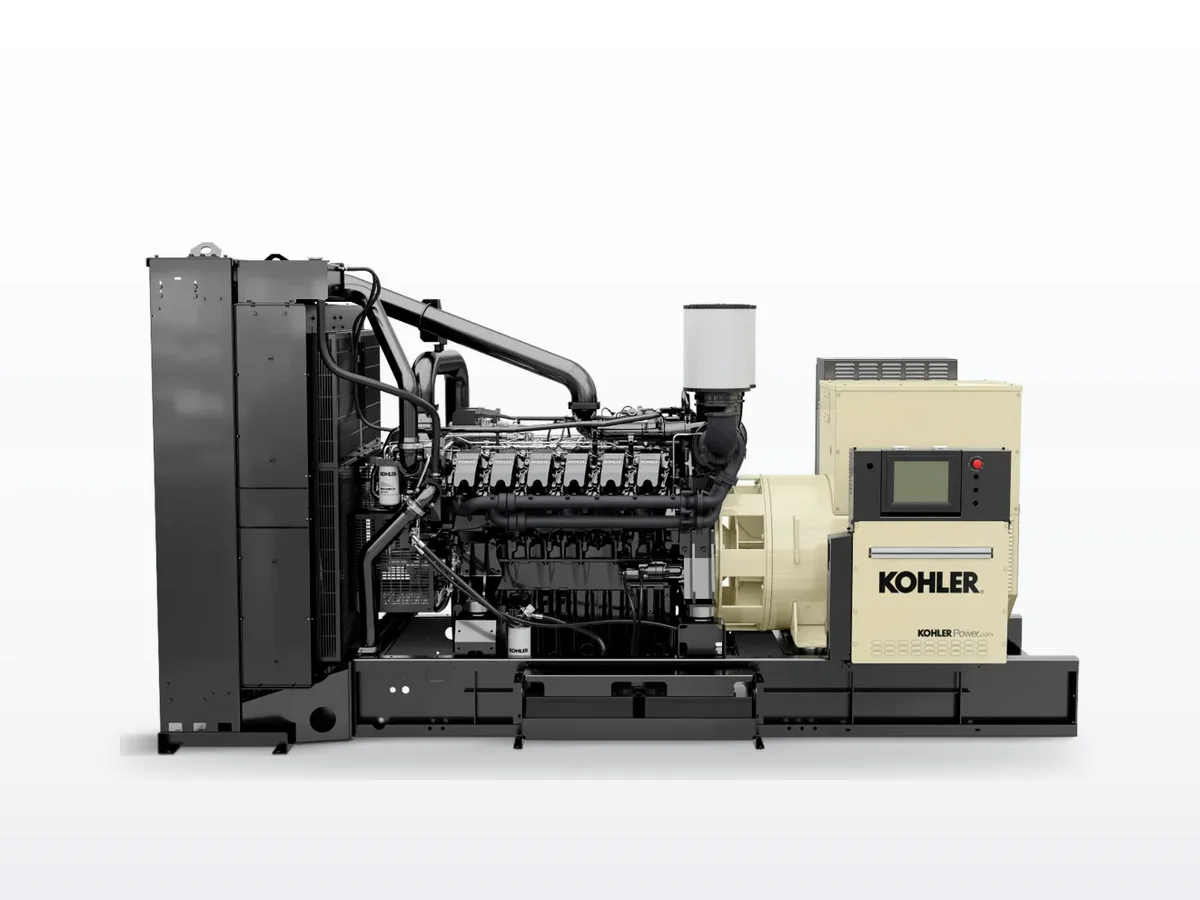
The Kohler KD Series is the flagship large industrial diesel generator line from Kohler Power Systems, spanning 900 to 4000 kW standby across 18 models. Unlike most large diesel gensets that source engines from third-party OEMs — Mitsubishi, Volvo, MTU, John Deere — every KD Series unit is powered by a Kohler-designed and manufactured diesel engine. This vertical integration gives Kohler direct control over engine calibration, warranty support, and long-term parts availability in a product class where single-vendor accountability matters.
The KD Series is built for mission-critical applications where generator failure has direct consequences: data centers, hospital complexes, large government facilities, and heavy industrial campuses. All 18 models operate at 277/480V three-phase with permanent-magnet pilot exciter alternators, which provide voltage regulation and fast excitation response independent of auxiliary power — a requirement for facilities that cannot tolerate a poorly regulated startup transient. The larger KD models (KD2000 and above) include aluminum enclosures rated for 186 mph wind loads, supporting outdoor installation in hurricane-prone regions.
Power class escalation tracks Kohler's engine families. The KD27V12 platform covers the KD900 and KD1000. Moving to 1250–1350 kW, the KD36V16 takes over. The KD45V20 spans the 1500–1750 kW range. At 2 MW and above, the KD62V12 handles the KD2000 through KD2500 range. The KD83V16 carries the KD2800 through KD3250 class, while the KD103V20 — a 20-cylinder platform — powers the KD4000 flagship. In the upper models (KD2800 and above), the alternator uses two-thirds pitch windings and a skewed stator for superior voltage waveform quality, keeping total harmonic distortion well within mission-critical tolerance bands.
Three models carry the Tier 4 Final designation: the KD1250-4, KD2500-4, and KD3250-4. These are dual-certified for both emergency standby and non-emergency (prime) operation, which matters for installations where air quality district rules require Tier 4 compliance or where the genset will run in continuous duty. All other KD models are Tier 2 certified for stationary emergency standby use.
How to Choose#
Entry range: KD900 and KD1000. Both use the KD27V12 engine at Tier 2. If your facility's standby load falls in the 700–900 kW range after demand factor calculations, the KD900 (810 kW prime) is the appropriate choice. The KD1000 (900 kW prime) provides additional headroom for future expansion or higher load factors. Both are 277/480V, three-phase.
Mid-range: KD1250 through KD1750. This bracket covers the most common single-unit data center backup configurations. The KD1250-A (Tier 2) and KD1250-4 (Tier 4 Final) occupy the same frame but differ in emissions compliance — if you need non-emergency or prime power certification, specify the -4 variant. The KD1350 (Tier 2, KD36V16) and KD1500–KD1750 (Tier 2, KD45V20) step up incrementally; choose based on calculated load plus design margin.
Upper range: KD2000 through KD2500. The KD62V12 platform serves this band. The KD2500-4 is the Tier 4 Final option if compliance is required at 2.5 MW. If you're sizing a paralleling array for a hyperscale data center, the KD2000 and KD2500 are common parallel-unit choices that balance footprint, transport logistics, and spare-part inventory.
Flagship: KD2800 through KD4000. The KD83V16 powers the KD2800–KD3250 range; the KD103V20 powers the 4 MW KD4000 — Kohler's largest single-unit industrial genset. Alternators in this class use two-thirds pitch windings and skewed stators for best-in-class waveform quality. The KD3250-4 is Tier 4 Final for the high end of this range. The KD4000 is Tier 2 only.
Tier 4 Final vs Tier 2: In California and other CARB-regulated states, standby diesel generators used infrequently for emergency backup typically qualify for Tier 2 permits. If your district requires Tier 4 for emergency standby, or if your operating hours exceed the emergency-use threshold, specify a -4 variant.
Common Applications#
-
Data centers and colocation facilities. All 18 KD Series models are rated for data center use. At this power class, the KD Series is commonly deployed as the primary backup power source for large server halls, typically in N+1 paralleling configurations. The fast-excitation permanent-magnet alternator supports sensitive IT loads.
-
Hospital campuses and surgical centers. Healthcare facilities operating under NFPA 99 and 110 requirements need generators with documented transfer times and stable voltage output. The KD Series permanent-magnet excitation architecture meets the 10-second transfer standard and the THD requirements that protect sensitive medical imaging and monitoring equipment.
-
Heavy industrial and manufacturing facilities. Large manufacturing operations with significant motor loads, welding equipment, and process controls need generators that can handle high inrush currents without voltage collapse. The KD Series, particularly the KD2000 and above with two-thirds pitch windings, is designed for these transient load conditions.
-
Government and utility infrastructure. Water treatment facilities, emergency operations centers, and military installations require long-term support contracts and parts availability from a single manufacturer. Kohler's vertical integration on the KD Series — engine plus alternator from the same OEM — simplifies this requirement.
-
Mission-critical paralleling arrays. For facilities requiring redundant multi-unit configurations, the KD Series with Decision-Maker 6000 controllers supports synchronized paralleling. This allows data centers or hospitals to build N+2 arrays from KD2000 or KD2500 units rather than deploying a single larger unit with no redundancy.
Service & Maintenance#
All 18 KD Series models share identical service intervals: oil and fuel filter changes every 500 hours or 12 months (whichever occurs first), air filter service every 1,000 hours, and coolant replacement at 6,000 hours. These intervals are consistent across the entire KD line regardless of engine size, which simplifies maintenance scheduling for operators managing multiple units.
The most frequently observed failure mode across the KD Series fleet is fuel quality degradation. Diesel stored in large base tanks for emergency-only generators will degrade — through oxidation, water ingress, and microbial growth — well before operational hours trigger a service interval. Injector fouling, hard starting, and black smoke under load are the typical symptoms. Fuel polishing on a scheduled basis (at least annually for low-cycle standby units) is more reliable than waiting for fuel-quality-triggered faults.
Turbocharger wear typically manifests around 15,000 hours and presents as power loss, elevated exhaust smoke, and oil at the turbo seals. Cooling system components — hoses and thermostat — are the next scheduled replacement candidates at approximately 10,000 hours. Starting battery failure is the single most common cause of failed exercise tests across this fleet; battery replacement every two to three years is strongly recommended regardless of apparent battery health.
For the three Tier 4 Final models (KD1250-4, KD2500-4, KD3250-4), the DPF and DEF/SCR system add maintenance requirements not present on Tier 2 models. DPF back-pressure should be monitored, and forced regeneration cycles should be completed before placing the unit back in standby mode. DEF quality alerts require immediate attention to avoid power derate conditions.
Application Guidance#
The KD Series is purpose-built for standby and prime power in commercial and industrial applications where power quality and single-vendor accountability are non-negotiable — sub-3% total harmonic distortion and permanent-magnet excitation make it the default recommendation for healthcare facilities, data centers, financial trading infrastructure, and buildings with sensitive electronics. Available from 900 to 4,000 kW, these units handle everything from large commercial buildings to megawatt-class paralleling arrays requiring N+1 redundancy.
This series is not appropriate for loads below 900 kW — at that range you are overbuilding significantly. For commercial standby in the 80–350 kW class, the Cummins D6 Commercial Diesel is a better fit. For large-scale standby at comparable power levels from a competing platform, the CAT C-Series Diesel and CAT 3500 Series compete directly with the KD2000–KD4000 class. For applications where gaseous fuel is preferred over diesel in the industrial standby range, see the KG Series.