
Series Overview#
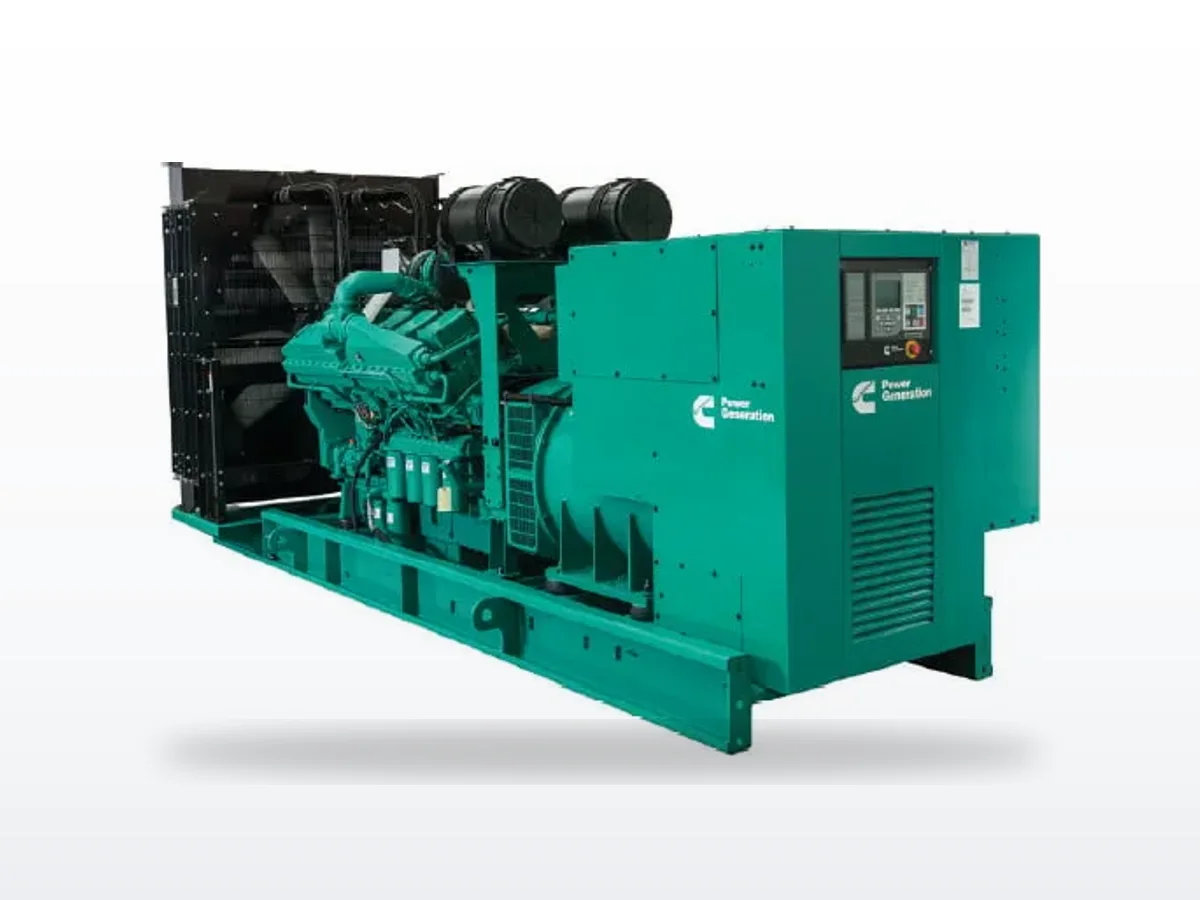
The Cummins KTA Series comprises two large-displacement legacy diesel generator platforms: the KTA38-G5 at 887 kW standby (50 Hz) and the KTA50-GS8 at 1,340 kW standby (50 Hz). Both are built on Cummins' pre-QSK high-output diesel architecture — the KTA38 on a 37.8-liter V-12 and the KTA50 on a 50.3-liter V-16 — using the Cummins PT (Pressure-Time) direct injection system that preceded the Modular Common Rail System (MCRS) of current-production QSK engines.
The KTA Series is a 50 Hz platform. Both models are rated at 1,500 rpm and published specifications — 887 kW for the KTA38-G5 and 1,340 kW for the KTA50-GS8 — apply at 50 Hz. This is a critical operational distinction: buyers evaluating 60 Hz applications should look to the QSK Series, which is available in 60 Hz configurations. The KTA's primary markets have historically been international industrial, mining, and infrastructure applications where 50 Hz grid standards and the platform's proven high-hour durability are the governing requirements.
Both models carry applications in industrial, mining, hospital campus, and paralleling configurations — use cases where the KTA's large displacement, high thermal mass, and proven PT injection system provide long service life at sustained load. The PT injection system is mechanically simpler than modern common rail injection, which can be an advantage in remote or resource-constrained environments where sophisticated electronic injection repair capabilities are unavailable.
How to Choose#
KTA38 vs KTA50: The KTA38-G5 at 887 kW covers the 800–1,000 kW standby requirement common in large hospital branches, industrial facilities, and medium campus installations. The KTA50-GS8 at 1,340 kW addresses larger single-generator requirements in the 1,000–1,500 kW class. If your standby requirement falls between 887 and 1,340 kW and you are evaluating KTA platforms, also assess the used QSK38 (1,160 kW) and QSK50 (1,500 kW) markets — newer MCRS injection and PowerCommand controls may justify the comparison.
Voltage configuration: Both KTA models are documented in 415/240V (standard international three-phase) and 11,000V medium-voltage configurations. If your distribution system requires other voltage levels — 480V, 4,160V, 13,800V — the QSK Series offers broader alternator availability.
Paralleling: Both models are documented for paralleling applications. Industrial and mining sites commonly parallel multiple KTA units for combined capacity with N+1 availability, and the PT injection system's mechanical governor provides stable speed regulation suitable for paralleling control schemes.
Cooling system complexity (KTA50): The KTA50-GS8's two-pump, two-loop cooling system adds operational complexity compared to single-loop systems. Ensure that your maintenance team or service provider has specific experience with the 2P2L cooling architecture before deploying this platform in a remote or resource-constrained location.
50 Hz vs 60 Hz: Confirm your grid frequency before evaluating any KTA unit. The published ratings and engine tuning on both models assume 1,500 rpm at 50 Hz. Operation at 60 Hz (1,800 rpm) would require different calibration and is not the standard application for these platforms.
Common Applications#
-
Industrial facilities: Both KTA models are documented for industrial applications. Heavy manufacturing, process industries, and industrial complexes in 50 Hz markets specify KTA units for their high-displacement durability and long service life under sustained loading.
-
Mining operations: Mining is a documented application for both KTA38 and KTA50. The combination of high displacement, PT injection mechanical simplicity, and global parts availability makes the KTA well-suited for remote mining sites where sophisticated electronic injection repair may not be readily available.
-
Large hospital campuses: Both models appear in hospital-large applications. In international 50 Hz markets, the KTA38 and KTA50 were standard large hospital generator specifications, and many remain operational in existing hospital infrastructure.
-
Campus standby and paralleling arrays: Both models are documented for campus and paralleling applications. Institutional campuses in international markets commonly operate KTA arrays for combined capacity with N+1 redundancy.
-
Data center standby: The KTA50 is documented for data center applications where its 1,340 kW output and paralleling capability support medium-to-large data center backup requirements in 50 Hz markets.
Service & Maintenance#
The KTA Series requires more frequent oil changes than the QSK Series: every 250 hours or 6 months (versus 500 hours on QSK), reflecting the older engine architecture's lubrication demands. Fuel filter replacement is required every 500 hours, coolant changes every 6,000 hours, and air filter service every 1,000 hours. The shorter oil change interval is a meaningful operating cost difference for high-runtime applications — budget accordingly.
Four failure modes appear consistently across both KTA models. PT fuel injection system timing drift is the primary high-hour failure mode at approximately 18,000 hours, producing rough running, power loss, and injection timing errors. PT injection calibration is a specialized skill; ensure your service provider has PT system expertise before committing to this platform. Turbocharger bearing wear at approximately 18,000 hours produces reduced boost, excessive smoke, and bearing noise — plan turbocharger rebuilding as a life-cycle maintenance item. Fuel quality and tank degradation causes filter clogging, hard starting, and injector fouling in standby applications — implement annual fuel sampling and polishing. Battery bank degradation on the 24V starting system causes slow crank and failed-start events — test and replace on schedule.
The 2-pump 2-loop cooling system on the KTA50 deserves specific attention: coolant temperature exceedances or pressure loss in either loop are documented as a severe failure mode. Monitor both cooling loops independently during operation and at service inspections. Verify water pump function, thermostat operation, and coolant condition in both circuits at each major service interval.
Application Guidance#
The Cummins KTA Series is the correct evaluation target for one specific situation: an existing installed KTA38 or KTA50 in 50 Hz international service requiring ongoing support, spare parts, or planned overhaul. These are legacy platforms — no longer manufactured as new generator sets — with PT injection systems, 250-hour oil change intervals, and 50 Hz-only calibration. They remain well-supported through Cummins' global parts network, and their mechanical PT injection simplicity is a genuine advantage for remote mining and industrial sites where sophisticated electronic injection repair is unavailable. For facilities already operating KTA units, continued support through the existing platform is usually more cost-effective than replacement until a major overhaul milestone forces the decision.
Do not specify a KTA unit for a new installation. For new large diesel requirements at 50 Hz in the 887–1,340 kW range, evaluate the CAT 3500 Series Large Diesel or the Generac SD/MD Series (2,250–3,000 kW) if higher output is needed. For 60 Hz applications in North America at comparable output levels, the Cummins QSK Series is the current-generation replacement with MCRS injection, PowerCommand controls, and modern emissions compliance. The KTA's 250-hour oil change interval also makes it a poor fit for any high-runtime prime power application compared to current QSK platforms at 500-hour intervals.