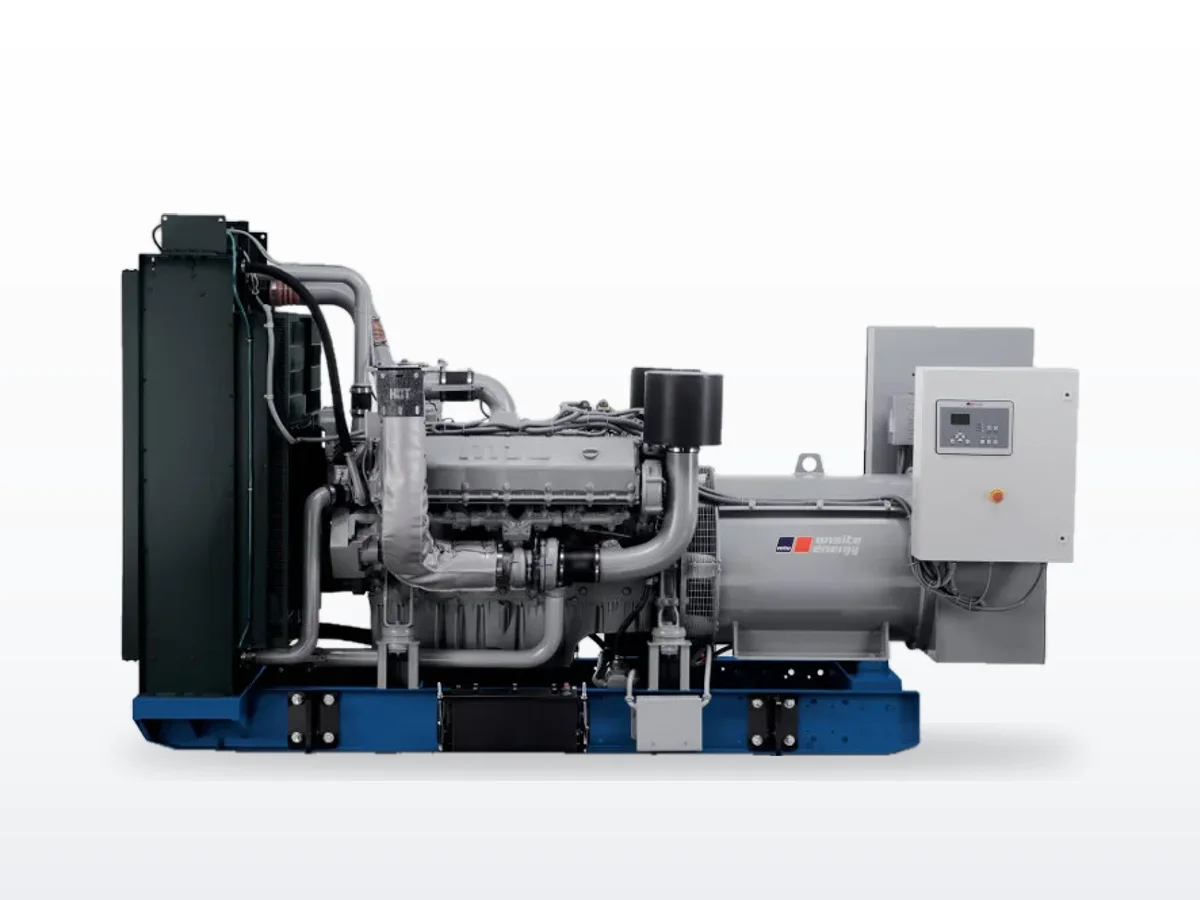
Series Overview#
The MTU 12V1600 Series consists of two diesel generator models, the DS750 (750 kW standby, 690 kW prime) and the DS900 (900 kW standby, 820 kW prime), built on the MTU 12V1600 engine platform, a 22.44-liter, 12-cylinder diesel. Both data sheets list EPA Tier 2 certification and SCAQMD approval, and print three-phase voltages from 208V through 600V. The DS750 uses the 12V1600G71S (836 kWm, 1,121 bhp) and the DS900 the 12V1600G91S (996 kWm, 1,335 bhp).
Both data sheets print the same 178 x 84.1 x 85.8 in open power unit, with a weight range of 10,524-12,850 lb. The DS750 sheet prints a 50 °C radiator ambient capacity and the DS900 sheet 40 °C.
How to Choose#
DS750 (750 kW standby, 690 kW prime, 12V1600G71S): appropriate when the load study produces a standby requirement up to 750 kW. Its exhaust gas temperature is 898 °F.
DS900 (900 kW standby, 820 kW prime, 12V1600G91S): appropriate when the load study requires between 750 and 900 kW standby. Its exhaust gas temperature is 1,024 °F and its radiator ambient capacity 40 °C.
The choice is driven by the standby power requirement and the site's design ambient temperature.
Common Applications#
- Commercial standby: Large commercial buildings such as office towers, hotels and convention centers with standby requirements in the 750–900 kW range.
- Healthcare: Regional hospitals and large medical centers with life-safety standby requirements up to 900 kW.
- Data centers (mid-size): Edge data centers, mid-size colocation, and enterprise data rooms with a single-unit standby requirement in the 750–900 kW range.
- High-rise buildings: Mechanical rooms and integrated building standby systems.
- Municipal and industrial: Water treatment facilities, government buildings, and industrial plants with three-phase standby requirements in the 750–900 kW class.
Application Guidance#
The MTU 12V1600 Series covers the 750–900 kW standby class. Above 900 kW, the MTU Series 2000 DS1000 is rated at 1,000 kW standby; at 1,250 kW and above, the MTU Series 4000 is the platform.