
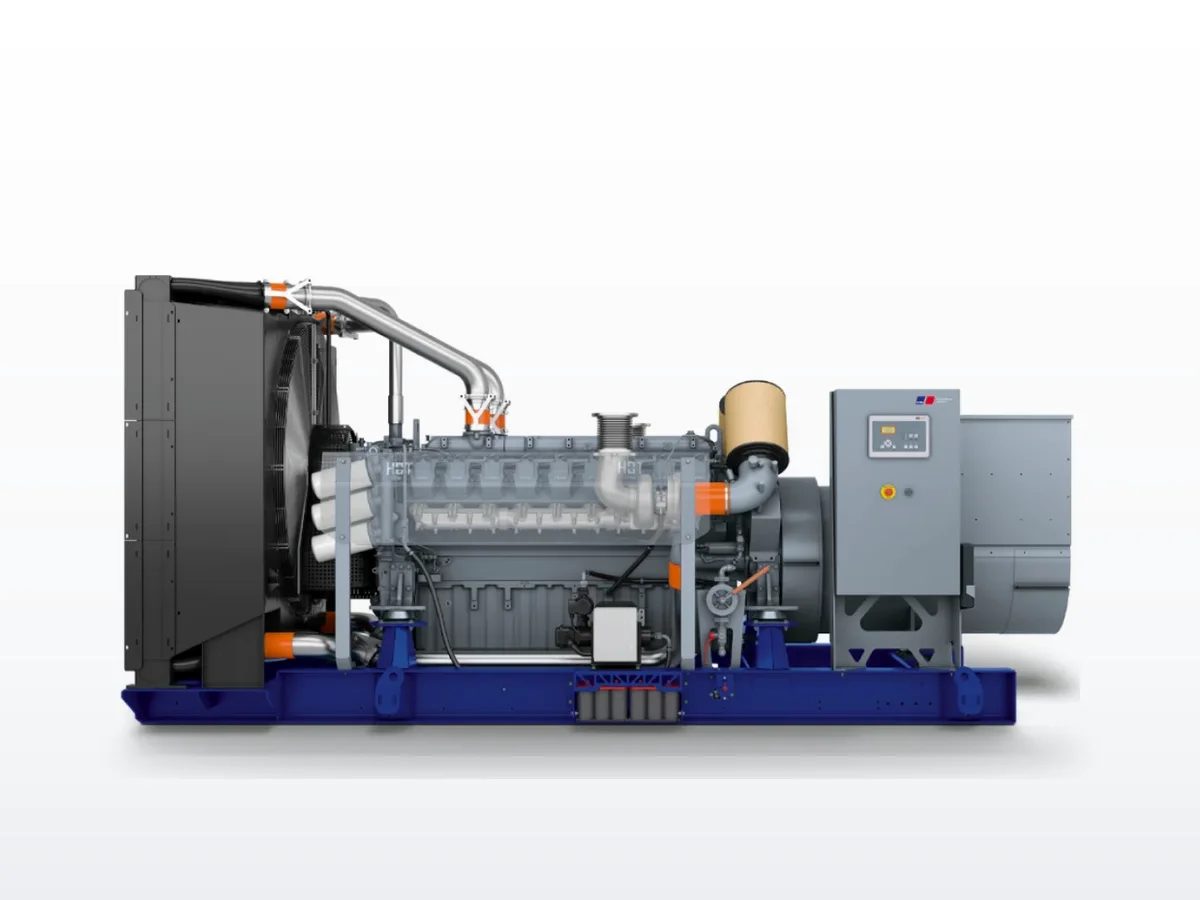
Series Overview#
The MTU Series 2000 Diesel is represented in the Rolls-Royce Power Systems generator lineup by a single model: the 16V2000 DS1000, rated at 1,000 kW standby and 900 kW prime. Built on the Series 2000 engine platform — a 35.7-liter V16 with a smaller bore and stroke than the Series 4000 — the DS1000 bridges the gap between mid-range standby generators and the larger Series 4000 lineup. It delivers a full megawatt of standby capacity in a package that weighs under 19,000 lbs and fits within a 200 x 90 inch footprint — more compact than any comparable Series 4000 model.
The 16V2000G26S engine uses a V16 configuration with water-to-air two-circuit charge air cooling. The Series 2000 platform is designed specifically for the 750–1,000 kW standby class, optimizing the engine for that output range rather than derating a larger platform. For facilities where 1,250 kW (the entry point of the Series 4000) exceeds the load requirement and 750 kW (the entry point of the Series 1600) is insufficient, the DS1000 provides the right-sized MTU solution.
This is a focused single-model line with a clear positioning: commercial and institutional facilities in the 750–1,000 kW standby range where MTU's fuel efficiency and power density advantages justify the premium over Cummins or Generac alternatives at this capacity.
How to Choose#
With a single model in the Series 2000 lineup, the choice is binary: does the 16V2000 DS1000 match the application requirements?
Choose the DS1000 when:
- The load study requires between 750 kW and 1,000 kW standby from a single unit
- The Series 4000 DS1250 exceeds the power requirement or the budget
- The MTU fuel efficiency and power density premium is justified by the facility's operating economics
- The facility can service the 16V2000 engine through MTU's service network
Consider alternatives when:
- The load exceeds 1,000 kW standby: step up to the Series 4000 DS1250
- Budget constraints favor Generac, Cummins, or Kohler alternatives at the 1,000 kW class
- The application is primarily prime power (not standby): the 900 kW prime rating governs
For voltage selection, the DS1000 supports the full range from 208V through 4,160V three-phase. The 4,160V medium-voltage option is available for facilities with medium-voltage distribution.
Common Applications#
- Commercial standby (large buildings): Large commercial facilities — office towers, shopping centers, large hotels — with standby requirements in the 750–1,000 kW range. The Series 2000's compact footprint allows installation in equipment rooms where a Series 4000 would not fit.
- Medium hospitals: Regional hospitals and large medical centers with standby requirements between 700 kW and 1,000 kW. The DS1000 covers the full essential electrical system of a substantial medical facility from a single generator position.
- Campus and industrial standby: Universities, government complexes, and industrial facilities with central plant electrical distribution. The DS1000's paralleling capability supports N+1 array configurations.
- Water treatment facilities: Municipal water and wastewater treatment plants are documented applications for the DS1000. Critical pump and process loads at these facilities require dependable, sustained standby capacity.
- Paralleling arrays: The DS1000 is specified for paralleling array applications. For facilities requiring 2–3 MW of redundant standby, a paralleled array of DS1000 units provides the MTU platform advantages at scale.
Service & Maintenance#
The DS1000 follows the standard MTU service schedule: oil and fuel filter changes every 500 hours or 12 months, air filter service every 1,000 hours. The 24VDC starting system uses four 8D batteries — the same requirement as the Series 4000. Battery bank load testing and proactive replacement are the highest-priority preventive maintenance items for a unit that may sit for extended periods between exercises.
The charge air cooler (water-to-air TB cooling) is the DS1000's most distinguishing maintenance item: degradation of the two-circuit charge air cooling system causes elevated charge air temperatures, boost pressure drops, and progressive power derating. Charge air cooler inspection should be included at each major service interval from 8,000 hours onward.
Common rail fuel injector wear on the 16-cylinder V16 is a severe-consequence item at approximately 15,000 hours — rough running, smoke, and power imbalance between cylinders. Fuel quality management is the primary preventive measure. Implement a fuel polishing and sampling program on any standby tank that does not turn over fuel regularly.
Application Guidance#
The MTU Series 2000 DS1000 is purpose-built for the 1,000 kW standby class — a compact 35.7-liter V16 delivering a full megawatt in a footprint lighter and smaller than any Series 4000 equivalent. It is the right specification for commercial facilities, medium hospitals, campuses, and water treatment plants with standby requirements in the 750–1,000 kW range where the Series 4000 DS1250 would be oversized or over-budget, and where the MTU fuel efficiency and power density advantages over Cummins or Generac alternatives at 1,000 kW justify the premium. The 4,160V medium-voltage output option is available for facilities with medium-voltage distribution, eliminating a transformer tier in the power path. The DS1000 supports paralleling for N+1 array configurations at campuses requiring 2–3 MW of redundant standby.
This series is not appropriate when the load study produces a requirement below 750 kW — the MTU 12V1600 DS750 is right-sized for that range, and the MTU 6R0225 DS400 for requirements below 400 kW. Above 1,000 kW, the MTU Series 4000 picks up at 1,250 kW standby on the 12V4000 and 16V4000 platforms. Buyers comparing the DS1000 against the CAT C32 (1,000 kW) and Cummins QSK Series should weigh the MTU's compact footprint and documented 5–10% fuel efficiency advantage against the broader North American CAT and Cummins dealer service networks — the MTU 16V2000 requires MTU-trained technicians for major service events, which matters for facilities in markets with limited MTU coverage.