
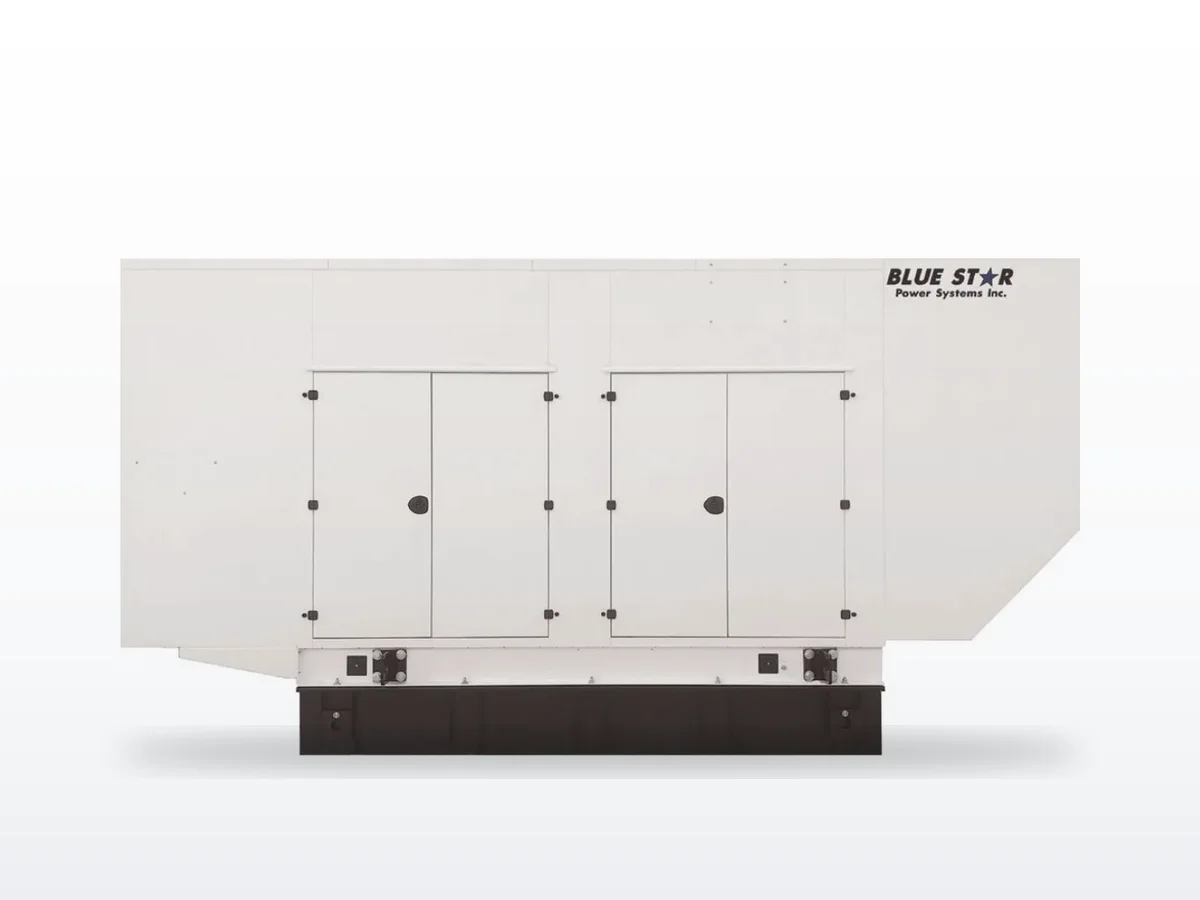
Series Overview#
The Blue Star John Deere Diesel Standby series — designated JD — covers 30 kW to 300 kW standby power across 14 models, using John Deere inline-three, inline-four, and inline-six diesel engine platforms. The lineup spans three EPA emissions tiers: Tier 4 Interim at the smallest model, Tier 3 across most of the mid-range, and Tier 4 Final in updated variants at 40, 60, and 80 kW. Both single-phase and three-phase configurations are available through the JD200 class; the JD250-02, JD275-02, and JD300-02 are three-phase only.
The series is organized around John Deere's generator engine platform progression. The 2.9-liter 3029 inline-three covers the 30–40 kW Tier 4 Final applications; the widely deployed 4.5-liter 4045 inline-four spans 40–100 kW across both Tier 3 and Tier 4 Final variants; the 6.8-liter 6068 inline-six covers 150–200 kW; and the 9.0-liter 6090 inline-six covers 250–300 kW. Each engine platform transition represents a footprint change that site planners must account for.
Blue Star Power Systems (North Mankato, Minnesota; DEUTZ AG subsidiary since 2024) assembles all JD units with Stamford alternators and DSE DCP7310 or compatible controllers using the same open-architecture philosophy as the rest of the Blue Star diesel lineup. Available voltages span 120/208V, 120/240V, 277/480V, and 347/600V — single-phase and three-phase as appropriate to the model. No 4160V medium-voltage option is offered in the JD series.
How to Choose#
JD30-03IT4 (30 kW, Tier 4 Interim, 3029TFG89): The entry model — a compact 2.9-liter three-cylinder in Tier 4 Interim compliance. Single-phase and three-phase available. For small commercial, municipal, and light-industrial installations where the load study is comfortably below 40 kW and Tier 4 compliance is required.
JD40-03 (40 kW, Tier 3) vs. JD40-05FT4 (40 kW, Tier 4 Final): Both produce 40 kW standby, but from different engines (4045TF280 Tier 3 vs. 3029HG530 Tier 4 Final). The JD40-05FT4 uses a different, smaller displacement engine to meet Tier 4 Final — verify aftertreatment requirements and service schedule differences before specifying. Choose the Tier 3 model for applications in non-attainment areas where Tier 4 Final is not mandated; choose the Tier 4 Final model when required by AHJ.
JD50-03 through JD100-01 (50–100 kW, Tier 3, 4045 platform): The 4.5-liter 4045 engine family covers four standby outputs. Footprint steps from 80×38 in (JD50, JD60 basic) to 90×44 in (JD80, JD100). The JD60-04FT4 and JD80-03FT4 are Tier 4 Final alternatives at 60 and 80 kW using the 4045HFG04 engine with SCR/DOC aftertreatment — both standby and prime rated equal at these outputs.
JD150-01 / JD200-01 (150–200 kW, Tier 3, 6068 platform): The 6.8-liter six-cylinder transition. Both share a footprint (110×54 in equivalent) — a site built for the JD150 can accept the JD200 without layout changes. The JD200 uses the 6068HFG85, a higher-calibration variant of the same block. Three-phase and single-phase available.
JD250-02 / JD275-02 (250–275 kW, Tier 3, 6090 platform): The 9.0-liter 6090 inline-six at two output levels, sharing a 120×66 in footprint. Three-phase only. Choose by load study requirement — both use the same 6090HF484 engine, differentiated primarily by alternator selection.
JD300-02 (300 kW, Tier 3, 6090HFG86): The top of the JD standby series. The 6090HFG86 is a higher-output variant of the 6090 block producing 463 HP at 1800 RPM. Three-phase only (120/208V, 277/480V, 347/600V). Same 120×66 in footprint as the JD275.
Common Applications#
- Municipal infrastructure: All 14 JD standby models are rated for municipal use — the John Deere engine brand's broad parts availability through agricultural and construction dealer networks makes it a preferred engine for municipal fleet standardization.
- Telecom and network infrastructure: The compact 4045-based models (JD30–JD100) fit the footprint and access constraints of telecom equipment buildings, roadside network nodes, and cell tower base equipment.
- Commercial buildings: Mid-range commercial and small office buildings, retail centers, restaurants, and light-commercial facilities in the 50–200 kW class are the dominant volume application for this series.
- Houses of worship: The JD30 through JD150 range covers the emergency power requirements of most churches, mosques, synagogues, and other religious facilities — a listed application across 8 of 14 models.
- Multi-family residential: Low-to-mid-rise apartment buildings with 30–200 kW emergency loads for elevators, corridor lighting, and life-safety systems are a primary commercial application for the 4045 and 6068 platforms.
Service & Maintenance#
The uniform service schedule across all 14 JD standby models is: oil changes at 500 hours or 12 months, fuel filter replacement at 500 hours, air filter inspection at 1,000 hours, and coolant changes at 6,000 hours.
Battery failure is documented across all 14 models — the most prevalent failure mode in the series. Failed starts and slow cranking during actual outage events are the only presentations that matter for standby units. Replace batteries preventively on a 2–4 year schedule using batteries that meet the OEM cold-cranking ampere specification for the model's starting system.
Fuel quality and tank contamination — hard starting, filter clogging, and injector fouling — appears across 8 of 14 models at moderate severity. Standby diesel held in low-turnover tanks accumulates microbial growth and fuel breakdown products over months of storage. Biocide additives and annual tank polishing are the standard preventive measures.
Coolant hose condition is a minor but documented failure mode across 8 models. Slow coolant loss at clamps is the presentation. Include hose pressure testing during each 500-hour service interval — enclosed generator sets make small coolant leaks invisible to routine visual inspection.
Turbocharger wear appears at approximately 12,000 hours across the turbocharged models (JD30 Tier 4 Interim and above). Include a turbocharger condition assessment as part of the 10,000-hour preventive service. Tier 4 Final models with SCR aftertreatment also require DEF system inspection — DEF quality faults can trigger engine derates that present as inadequate standby output during actual use.
Application Guidance#
The Blue Star John Deere Diesel Standby series is purpose-built for commercial and light-industrial standby applications in the 30–300 kW range where John Deere engine availability through agricultural, construction, and industrial dealer networks is a procurement or serviceability priority. Fourteen models across four engine platforms — the 3029 inline-three, 4045 inline-four, 6068 inline-six, and 6090 inline-six — cover everything from small municipal pump stations and telecom equipment buildings at the entry models through large commercial standby and warehouse facilities at the JD300. Open-architecture DSE and Stamford alternator pairing means controls are serviceable without OEM proprietary tooling, which matters for rural and municipal operators who rely on local technicians.
This series is not appropriate for applications requiring Tier 4 Final compliance above 80 kW — only the JD40-05FT4, JD60-04FT4, and JD80-03FT4 carry Tier 4 Final certification; mid and upper models are Tier 3 or Tier 4 Interim. For projects in California or other jurisdictions requiring Tier 4 Final above 80 kW standby, evaluate Cummins commercial diesel or Doosan series with current-tier certification across the full range. For mobile trailer-mounted deployment on the same John Deere engine platforms, the Blue Star John Deere Diesel Mobile series covers 40–80 kW. For standby requirements above 300 kW with Volvo Penta engines and a wider emissions-tier matrix, the Blue Star Volvo Penta Diesel Standby series extends from 100 to 700 kW.