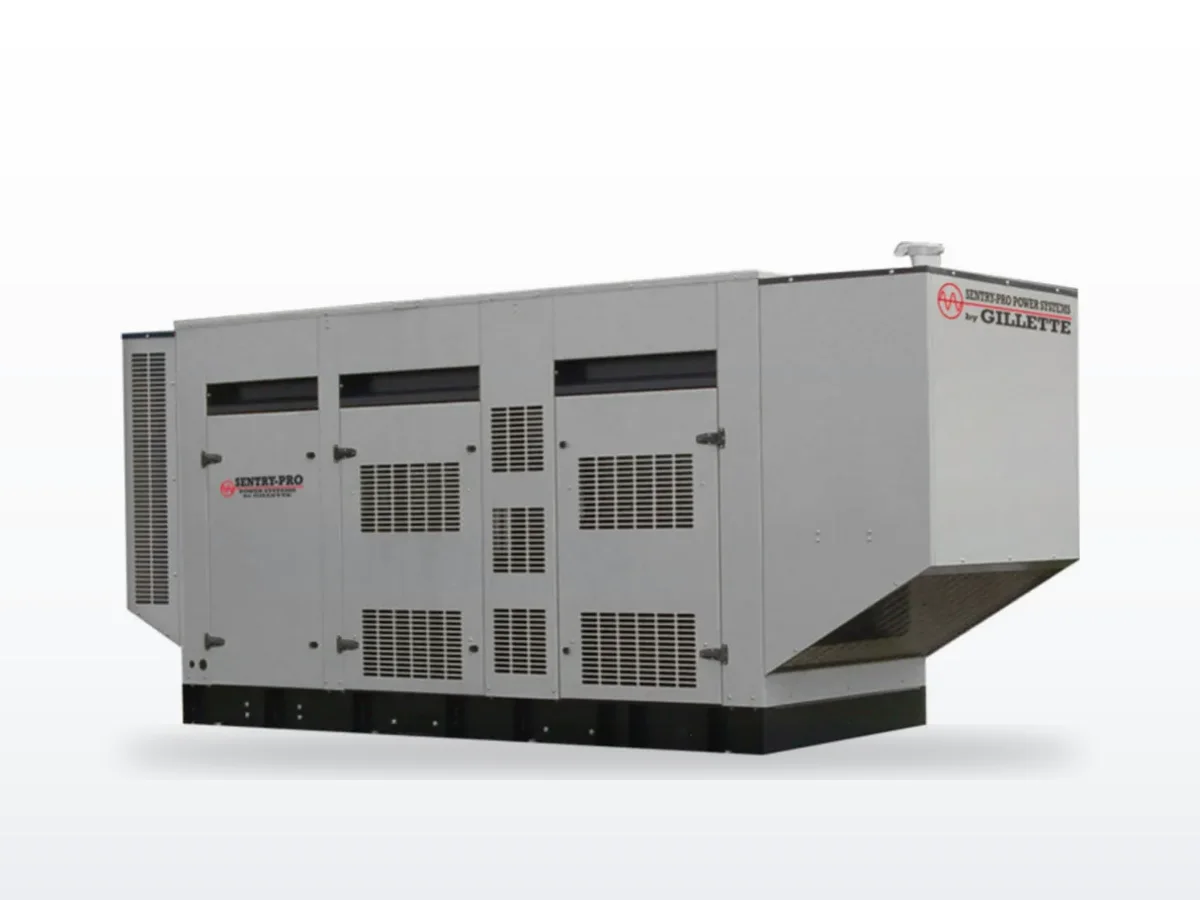
Series Overview#
The Gillette SPVD Series is the company's Volvo Penta diesel standby lineup, covering 250 kW to 700 kW across eight models. It bridges the John Deere-powered SPJD series (ceiling: 210 kW) and the Mitsubishi-powered SPMI series (floor: 800 kW), making it the core mid-range industrial diesel standby option in Gillette's catalog. Every SPVD model is three-phase only, liquid-cooled, and pairs Volvo Penta TAD or TWD engines with Stamford alternators and Basler DGC-2020 controllers.
The series spans two emissions tiers. The SPVD-2500 through SPVD-4000 (250–400 kW) meet EPA Tier 3. The SPVD-5000 through SPVD-7000 (500–700 kW) are rated Tier 2. Both tiers are acceptable for emergency standby applications under most jurisdictional requirements; buyers in regions with more restrictive air quality rules should verify applicability with their AHJ.
Three distinct Volvo Penta engine platforms power the SPVD series. The SPVD-2500 uses the 7.7L TAD852GE inline-6 — the entry point into Volvo's generator-specific engine family. The SPVD-3000, 3500, and 4000 all run the 12.8L TAD13xx inline-6 at three different output calibrations (TAD1351GE, TAD1352GE, TAD1353GE) from the same physical block and enclosure. The SPVD-5000, 5500, 6000, and 7000 step up to Volvo's larger 16.1L–17.3L platform — the TAD1641GE and TAD1642GE using air-to-air aftercooling (500–550 kW), the TWD1644GE and TWD1744GE switching to water-to-air aftercooling at higher specific loading (600–700 kW). All SPVD models support the full standard commercial voltage range: 120/208V, 120/240V, 277/480V, and 346/600V.
How to Choose#
250 kW — SPVD-2500 (Volvo Penta TAD852GE, Tier 3): Entry point into the SPVD range. The 7.7L TAD852GE is Volvo's smallest genset engine in this series. Good choice when load sits just above the SPJD-2100 (210 kW John Deere) ceiling and diesel is required.
300–400 kW — SPVD-3000, SPVD-3500, SPVD-4000 (Volvo Penta TAD13xx, Tier 3): Three models from the same 12.8L inline-6 block at TAD1351GE (300 kW), TAD1352GE (350 kW), and TAD1353GE (400 kW) calibrations. All share the same enclosure footprint, so the choice is output level only. The SPVD-4000 operates at the highest specific loading of the three — if load may grow to 400 kW, specifying the SPVD-4000 from the same physical foundation is the efficient path.
500 kW — SPVD-5000 (Volvo Penta TAD1641GE, Tier 2): Steps to the 16.1L platform and to Tier 2 classification. Enclosure grows from the 12.8L footprint. Uses air-to-air aftercooling. If Tier 3 is required at this output level, the SPVD series does not offer it — consider alternatives or evaluate the T4D-3500 (350 kW Tier 4 Final) and T4D-6000 (600 kW Tier 4 Final) for emissions-compliant alternatives.
550 kW — SPVD-5500 (Volvo Penta TAD1642GE, Tier 2): Mid-point of the 16.1L range. Same platform as SPVD-5000 with higher output calibration. Air-to-air aftercooling. Bridges the 500 kW and 600 kW output points.
600 kW — SPVD-6000 (Volvo Penta TWD1644GE, Tier 2): Transitions to water-to-air aftercooling to extract 600 kW from the 16.1L block. Also moves to the Stamford HCI634G alternator (larger frame than the HCI534 used at 500–550 kW). The aftercooling change has maintenance implications — the water-to-air aftercooler requires periodic inspection for coolant leaks and core fouling.
700 kW — SPVD-7000 (Volvo Penta TWD1744GE, Tier 2): Top of the SPVD range. Steps to the 17.3L TWD1744GE — Volvo's largest genset inline-6 — with water-to-air aftercooling and Stamford S6DC311 alternator. Above 700 kW, the lineup transitions to Mitsubishi engines in the SPMI series (floor: 800 kW SPMI-8000).
Common Applications#
-
Hospitals and healthcare facilities: All eight SPVD models appear in hospital application contexts, reflecting the 250–700 kW range matching typical hospital emergency system sizing. Diesel fuel storage and standby reliability make the SPVD appropriate for life-safety backup where NFPA 110 compliance is required.
-
Data centers: All eight models serve data center applications. The 250–700 kW range covers the standby requirements of colocation and edge data center installations. The Basler DGC-2020 controller supports the automatic mains failure and parallel operation requirements common in data center standby configurations.
-
Municipal infrastructure: Water treatment plants, pumping stations, wastewater facilities, and public buildings are consistent application contexts across the full SPVD range. Diesel fuel compatibility with existing municipal infrastructure and Volvo's widespread parts availability support long-term operational sustainability.
-
Industrial plants: Manufacturing and process facilities requiring 250–700 kW diesel standby. Volvo Penta TAD/TWD engines have wide industrial support ecosystems — parts and service are available through Volvo distributor networks independently of Gillette's service infrastructure.
-
Large commercial facilities: Hotels, large office complexes, and commercial campuses at the 250–700 kW output range. Full four-voltage support across all SPVD models covers both 208V commercial distribution systems and 480V industrial distribution.
Service & Maintenance#
All eight SPVD models share identical service intervals: oil and fuel filter changes at 500-hour or 12-month intervals, air filter service at 1,000 hours, and coolant system service at 6,000 hours. These align with Volvo Penta's published maintenance schedules for TAD/TWD generator engines in standby duty.
Turbocharger degradation is the most prevalent identified failure mode across the series — five of eight models show it as a documented risk, typically manifesting around 12,000 hours as power loss and excessive exhaust smoke under load. Turbo shaft play inspection at coolant service intervals provides early warning. Fuel quality issues (injector fouling, hard starting, filter clogging) appear in most models, driven by fuel degradation in storage — diesel in standby day tanks can degrade within 12 months. Annual fuel polishing and biocide treatment are strongly recommended.
Battery failure (failed to start, slow crank) is documented in five of eight models. This is a maintenance management issue, not a reliability deficiency: standby batteries on float charge degrade silently until an outage demands a cold start. Annual battery load testing and replacement on a 3–4 year calendar cycle eliminates this failure mode. For the SPVD-6000 and SPVD-7000 models, the water-to-air aftercooler requires inspection for internal fouling and coolant seepage — check at each 6,000-hour coolant service interval.
Application Guidance#
The Gillette SPVD Series fills the 250–700 kW industrial diesel standby bracket between the John Deere-powered SPJD (ceiling: 210 kW) and the Mitsubishi-powered SPMI (floor: 800 kW), making it the primary mid-range industrial standby option in Gillette's diesel catalog. Volvo Penta TAD/TWD engine support is available through Volvo distributor networks independently of Gillette, which provides an additional service pathway for large commercial and municipal facilities that prefer OEM-direct engine support access. Full four-voltage support across all eight models (120/208V, 120/240V, 277/480V, 346/600V) is a specific advantage over the SPMI-1.5M and SPMI-2M (which are 480V/600V only), making the SPVD series applicable to both 208V commercial and 480V industrial distribution systems in the 250–700 kW output band.
The SPVD-5000 through SPVD-7000 models are Tier 2 — do not specify these in California or other jurisdictions that mandate Tier 4 Final for stationary emergency standby equipment in this output range. The Tier 3 models (SPVD-2500 through SPVD-4000) also require AHJ confirmation for your specific jurisdiction. For Tier 4 Final compliance at overlapping output levels (100–600 kW), the Gillette T4D Series is the correct alternative. Above 700 kW, the Gillette SPMI Series (starting at 800 kW SPMI-8000) is the direct continuation. For the same 250–700 kW range on natural gas rather than diesel, the Gillette SP Series (SP-3000 through SP-6500) covers comparable facility types without diesel fuel storage requirements.
FAQ#
See frontmatter for FAQ items.