
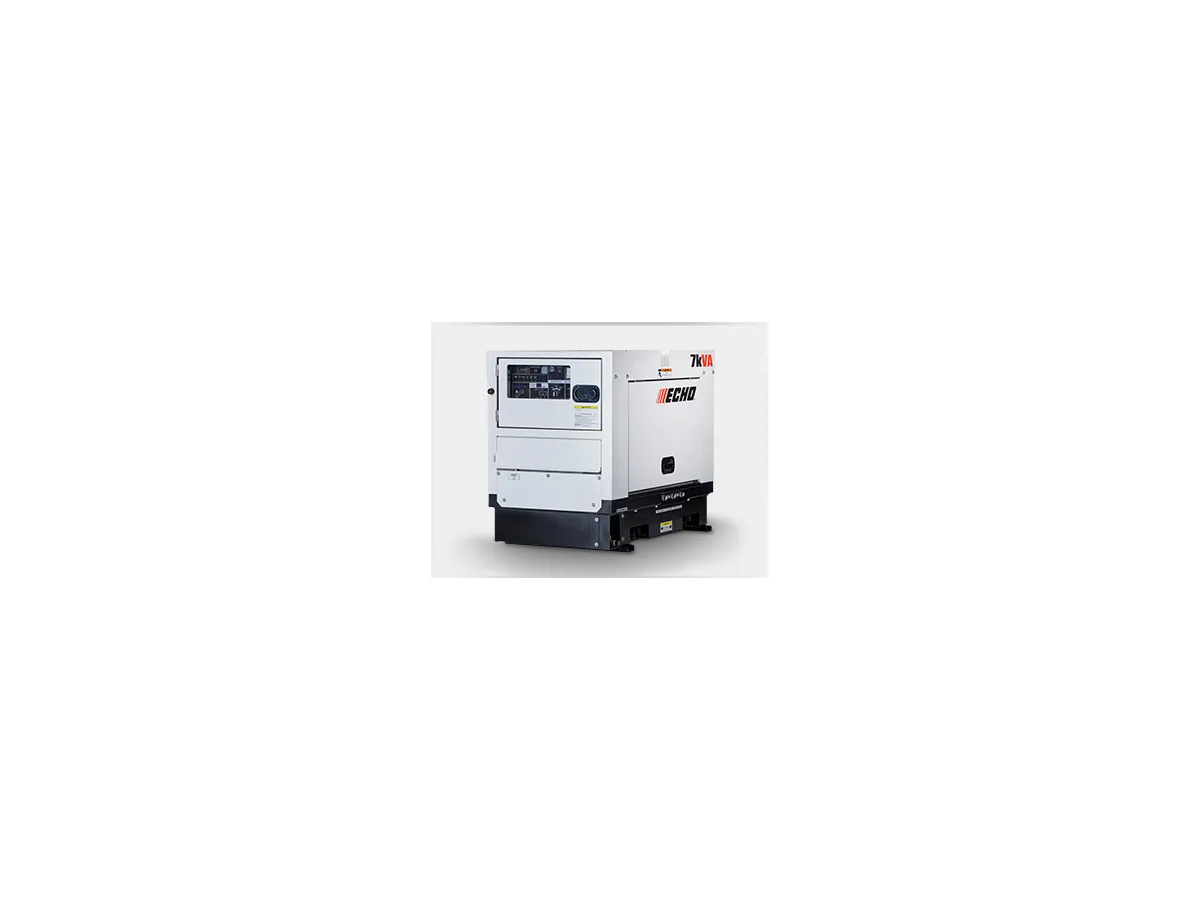
Series Overview#
The Echo DGK Series is a 14-model portable diesel generator lineup spanning 6 to 352 kW standby, manufactured in Japan by Yamabiko Corporation — formerly known as Shindaiwa, with over 50 years of generator manufacturing heritage. All 14 models are Tier 4 Final certified and CARB compliant. The lineup uses Kubota engines in the three smallest models and Isuzu engines from 20 kW upward, covering Kubota Z482 and D-series two- and three-cylinder platforms at the compact end and Isuzu 4LE2, 4JJ1, 4HK1, 6HK1, and 6WG1X platforms across the mid-range and large-frame models.
The defining differentiator of the DGK Series is Echo's patented SimulPhase technology, which provides simultaneous single-phase and three-phase output from a single generator without external transformers. This is not a switchable output configuration — it is true simultaneous multi-voltage delivery. For construction sites and events where both 120/240V single-phase and 208V or 480V three-phase loads must be fed from one unit, SimulPhase eliminates the need for a transformer rental and the associated cable runs and connection complexity. SimulPhase is present on the majority of the DGK lineup; the exceptions are the DGK20FS and DGK36FS (dedicated single-phase units) and the DGK400F (three-phase only at 277/480V).
The DGK Series is positioned for the construction, rental fleet, and temporary power markets — all 14 models carry those three application ratings. Three models also carry event ratings. The lineup does not include emergency standby-rated models in the same way that permanent standby products do; it is explicitly a portable, temporary-power-focused product line. Sound levels are competitive across the lineup, with several models documented at 58–65 dBA at 7 meters. The DGK15FL variant of the DGK15F provides a 60-gallon fuel tank in the same compact footprint, delivering approximately 48 hours of continuous full-load operation — over six times the standard tank's runtime.
The parallel-capable variants — DGK125FP and DGK180FP — expand the lineup's scalability. These models allow operators to synchronize multiple units for combined output, a key feature for large temporary power deployments where a single large-frame generator is less practical than paired mid-range units.
How to Choose#
The DGK lineup breaks into four subgroups by engine platform and output configuration:
Compact Kubota-powered — DGK7F, DGK14F, DGK15F, DGK15FL (5–12 kW prime):
- DGK7F (5 kW prime, Kubota Z482): The smallest diesel in the Echo lineup. Two-cylinder, 62 dBA at 7 meters, 120/240V single-phase only. For applications requiring a compact, quiet, ultra-reliable diesel where gasoline generators are impractical.
- DGK14F (11 kW prime, Kubota D1503): Three-cylinder Kubota, 58 dBA at 7 meters — one of the quietest units in its class. SimulPhase for simultaneous single/three-phase output. The step-up choice when multi-voltage output is needed in the compact class.
- DGK15F (12 kW prime, Kubota D902): Similar output to the DGK14F with the D902 engine. Standard 9.62-gallon tank. SimulPhase standard.
- DGK15FL (12 kW prime, Kubota D902): Large-tank variant of the DGK15F with a 60-gallon fuel tank providing approximately 48 hours of continuous full-load runtime. Choose the DGK15FL wherever refueling frequency is a constraint — remote sites, multi-day events, and extended construction operations.
Single-phase Isuzu — DGK20FS, DGK36FS (20–36 kW prime, 120/240V only):
- DGK20FS (20 kW prime, Isuzu 4LE2T): Dedicated single-phase. 51.5-gallon tank, approximately 32 hours runtime at full load. 62 dBA at 7 meters. Choose when only 120/240V single-phase loads need to be served and the SimulPhase premium is unnecessary.
- DGK36FS (36 kW prime, Isuzu 4LE2X): Larger single-phase Isuzu unit. 79-gallon tank, approximately 28 hours runtime. 65 dBA. The dedicated single-phase option at the upper-mid range before transitioning to multi-voltage models.
Multi-voltage SimulPhase Isuzu — DGK25F, DGK45F, DGK70F (20–56 kW prime):
- DGK25F (20 kW prime, Isuzu 4LE2T): SimulPhase with triple voltage output: 120/240V, 208V, and 480V. 59 dBA. The choice when multi-voltage output is needed at the 20 kW level and both single-phase and three-phase loads must be served simultaneously.
- DGK45F (36 kW prime, Isuzu 4LE2X): Steps up to the 4LE2X engine. SimulPhase, 63 dBA, 3-year warranty — the longest in its class among competing portables. Choose when extended warranty coverage is a fleet procurement criterion.
- DGK70F (56 kW prime, Isuzu 4JJ1X): Transitions to the larger 4JJ1X platform. SimulPhase with 120/240V, 208V, and 480V. 105-gallon fuel tank and 7.4-gallon DEF tank. First model in the lineup to require DEF.
Large-frame Isuzu — DGK125F/FP, DGK180F/FP, DGK400F (100–320 kW prime):
- DGK125F (100 kW prime, Isuzu 4HK1X): 171.7-gallon fuel tank, 14.8-gallon DEF tank. SimulPhase across 120/240V, 208V, and 277/480V. 65 dBA.
- DGK125FP: Parallel-capable variant of the DGK125F — choose when combined output above 100 kW is needed and two synchronized units are preferable to a single large-frame machine.
- DGK180F (144 kW prime, Isuzu 6HK1): First inline-six in the Echo lineup. 275-gallon tank, 26+ hours runtime. 277/480V three-phase only. 65 dBA.
- DGK180FP: Parallel-capable variant of the DGK180F. Synchronize two units for combined 288 kW prime output.
- DGK400F (320 kW prime, Isuzu 6WG1X): Flagship. 15.7-liter inline-six, 277/480V three-phase only. Important constraint: the 100-gallon integral fuel tank yields approximately 4 hours at full load — external fuel supply is required for extended operation. Select the DGK400F only when fuel logistics can be managed.
Common Applications#
- Construction: All 14 DGK models are construction-rated. SimulPhase's simultaneous multi-voltage output is operationally valuable on construction sites where both 120/240V receptacle loads and 480V three-phase equipment must be powered simultaneously from one generator. This reduces the generator count and eliminates transformer rentals on jobsites with mixed load types.
- Rental fleet: All 14 models carry rental-fleet ratings. The all-Tier 4 Final compliance simplifies fleet management for rental operators who cannot maintain separate Tier 2 and Tier 4 fleets. The 250-hour oil change interval is shorter than competitors — rental companies should build this into their PM scheduling and rental pricing.
- Temporary power: All 14 models serve temporary power applications. The DGK15FL's 60-gallon tank and the DGK125F's 171.7-gallon tank are specifically suited for multi-day temporary power deployments where refueling is infrequent. The parallel-capable FP variants (DGK125FP, DGK180FP) address larger temporary power requirements through scalable deployment of matched units.
- Events: Three models carry event ratings. The compact DGK7F through DGK25F class units — particularly those rated below 63 dBA at 7 meters — are practical for noise-sensitive event environments. The sound levels documented across the Kubota-powered models (58–62 dBA) are competitive with purpose-built ultra-quiet rental generators.
Service & Maintenance#
All 14 DGK Series models share common service intervals: oil changes at 250 hours or 12 months, whichever comes first; fuel filter at 500 hours; air filter at 500 hours. The 250-hour oil change interval is the most operationally significant difference between the DGK Series and competitors that specify 500-hour intervals — fleet operators should build PM costs accordingly.
The highest-frequency failure mode across all 14 models is fuel filter contamination from portable job site fueling. The OEM specification is 500 hours, but in dusty environments or with fuel sourced from portable bowsers or non-commercial delivery equipment, changing fuel filters at 250 hours or sooner is warranted. Contaminated fuel is the leading cause of premature fuel filter failure and injector wear in portable generators generally; the DGK Series is no exception.
Isuzu injector tip wear from extended low-load operation affects 10 of 14 models — those powered by Isuzu engines. Carbon buildup on injector tips occurs when units run below approximately 50% of rated load for extended periods. Operators should avoid prolonged light-load operation. If a DGK unit must serve a light load for an extended deployment, plan for periodic full-load runs to clear carbon deposits. This is particularly important for rental fleet units that may be used at widely varying load fractions across different jobs.
The SimulPhase selector switch relay is a documented failure point on 8 models after high-cycle portable use. Contact failure leads to output loss on one phase — the symptom is a sudden single-phase output failure on a unit that was previously delivering three-phase. Inspect selector switch contacts at each major service interval on high-cycle units. Replacement contacts are a straightforward repair, but the failure can strand a deployment if it occurs on site.
Battery degradation from extended storage periods without maintenance charging affects 6 models. As with all portable generators, units that sit idle for more than a few weeks should be connected to a battery maintainer. DEF system issues — quality degradation and SCR fault codes — affect 3 models (those with SCR aftertreatment). Use fresh DEF, check DEF tank condition annually, and avoid DEF contamination with diesel or water.
Coolant hose weeping at clamps or from age-related swelling appears after 5,000 hours on one model. Inspect hose condition at each major service interval regardless of model — this is preventive maintenance that avoids a field coolant loss event.
Application Guidance#
The Echo DGK Series is purpose-built for construction, rental, and temporary power applications where SimulPhase simultaneous multi-voltage output is the differentiating need — jobsites and events where both 120/240V single-phase and 208V or 480V three-phase loads must be served from a single unit without transformer rentals. The all-Tier 4 Final lineup (except no exceptions in the sub-100 kW range) simplifies fleet management for rental operators who cannot run separate Tier 2 and Tier 4 inventories. The DGK15FL's 60-gallon tank for 48-hour runtime and the DGK125FP/DGK180FP parallel-capable variants are specifically valuable for multi-day remote deployments and large temporary power applications where runtime between refueling or combined output above a single unit's capacity are the binding constraints.
The DGK Series is not rated for permanent emergency standby in the same way fixed commercial standby products are — it is explicitly a portable temporary-power product line. For fixed commercial or industrial diesel standby in the same 6–350 kW range, the Gillette SPJD Series (60–210 kW John Deere) or Gillette SPD Series (30–200 kW Perkins) serve those applications. The DGK's 250-hour oil change interval is also shorter than the 500-hour interval on most competing portables — rental operators must build this into PM scheduling and rental pricing or the maintenance economics become unfavorable versus Doosan G-Series or Atlas Copco QAS Series alternatives at comparable output. For the DGK400F flagship specifically, the 100-gallon fuel tank providing only ~4 hours at full load makes it unsuitable for any deployment without external fuel supply infrastructure in place from day one.