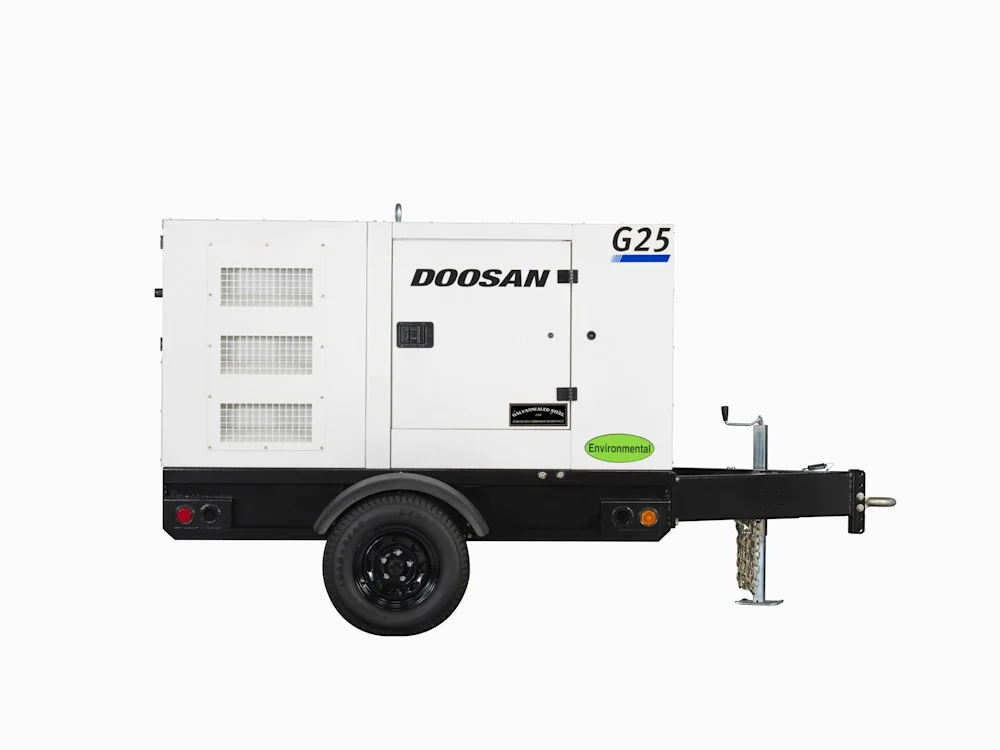
Series Overview#
The Doosan G-Series is a 13-model portable diesel generator lineup spanning 22 to 500 kW, built for the construction, rental fleet, and temporary power markets. Every G-Series unit is liquid-cooled and diesel-fueled. The lineup is organized around two engine families: Doosan's own engines in the four smallest models (G25 through G70), and Cummins engines from the G100 upward. This engine strategy gives buyers Doosan's proprietary powertrain at the entry level and Cummins' established North American service network at mid-range and large-frame capacities.
The G-Series enclosure is a consistent design differentiator throughout the lineup. The CoolBox acoustically-treated enclosure used on the smaller models — G25 through G70 — integrates fuel tank, sound attenuation, and environmental containment into a single package. At larger frame sizes (G190 and up), Doosan transitions to the DualBox enclosure, which separates the powertrain compartment from the cooling system for improved thermal management. Integral fuel tanks are standard across the lineup, with capacities scaled to support extended runtime: the G50 delivers over 37 hours at full load, and the G190 and larger models carry 368 to 530+ gallons.
The lineup covers standby applications (9 of 13 models carry emergency standby ratings), temporary power, construction site power, and — at the large-frame end — data center temporary power and large commercial emergency backup. Doosan positions the G-Series against MQ Power, Atlas Copco, and CAT portable units in the same power classes, typically pricing 15 to 30 percent below comparable competitive units while using the same Cummins engine platforms that those competitors rely on above the G100. The G450 is the one legacy Tier 2 model in the lineup; all other G-Series models are Tier 4 Final certified.
Several G-Series models are sold concurrently as Bobcat-branded generators — the PG150, PG400, and PG570 are mechanically identical to their Doosan counterparts. Buyers considering the Bobcat brand for dealer access or fleet uniformity should be aware that parts, service documentation, and components are interchangeable across the two brands.
How to Choose#
The G-Series breaks naturally into four subgroups by frame size, engine, and intended use:
Entry-level portables — G25 through G70 (22–56 kW prime, Doosan engines, Tier 4 Final):
- G25 (20 kW prime, Doosan D18): Smallest model. CoolBox enclosure, 25 hours runtime at full load. The entry point for construction site power and single-phase applications.
- G40 (31 kW prime, Doosan D24): Steps up to the D24 engine. 110-gallon fuel tank, 24+ hours runtime. Share the same engine platform as the G50.
- G50 (38 kW prime, Doosan D24): Same D24 engine and same 130.5" x 72.8" footprint as the G40 with higher alternator output. At 37.2 hours runtime at full load, the G50 is the longest-running compact model in the lineup.
- G70 (56 kW prime, Doosan D34): Largest Doosan-engined model. The D34 is the largest of Doosan's proprietary diesel engines used in the G-Series. Standard dual-frequency switching (50/60 Hz).
Mid-range — G100 through G150 (80–123 kW prime, Cummins F3.8 and QSB5, Tier 4 Final):
- G100 (80 kW prime, Cummins F3.8): First Cummins-powered model. Stamford alternator. 67 dBA.
- G125 (100 kW prime, Cummins QSB5-G11): Transitions to the 4.5L QSB5 platform — and notably does not require a DPF for Tier 4 Final compliance, simplifying maintenance. 176.5-gallon tank, 24.9 hours runtime.
- G150 (123 kW prime, Cummins QSB5-G12): Higher-output QSB5 variant on the same chassis as the G125. A 23% power increase without changing footprint. The step-up before moving to the DualBox-enclosed G190.
Large portables — G190 through G240 (145–190 kW prime, Cummins QSB7, Tier 4 Final):
- G190 (145 kW prime, Cummins QSB7-G8): First DualBox-enclosed model. 368-gallon fuel tank. The 6.7L inline-six provides strong motor starting capability.
- G240 (190 kW prime, Cummins QSB7-G9): Higher-output QSB7 variant on the same DualBox chassis. Same 368-gallon tank as the G190, approximately 27 hours runtime.
Large-frame — G325 through G570 (260–456 kW prime, Cummins QSL9/QSG12/QSX15/X15):
- G325 (260 kW prime, Cummins QSL9-G8): Large portable class entry. 480-gallon tank, 1,000A main breaker. 14,000 lbs. Competes directly against Atlas Copco QAS 330 and MQ Power DCA-300.
- G400 (340 kW prime, Cummins QSG12): Tier 4 Final large-frame. 470-gallon tank. Bridges the gap between the G325 and G570. Also sold as Bobcat PG400.
- G450 (375 kW prime, Cummins QSX15, Tier 2): The only Tier 2 model in the current lineup. Suitable where Tier 2 is permissible. Does not require DEF. 530+ gallon tank. Choose this model only when Tier 4 Final compliance is not mandated.
- G570 (456 kW prime, Cummins X15): Flagship. 500 kW standby, 680 HP. The largest mobile generator Doosan offers. Targets major construction projects, data center temporary power, and large commercial emergency standby. Also sold as Bobcat PG570.
Common Applications#
- Construction: All 13 G-Series models carry a construction application rating. The CoolBox enclosure on the G25–G70 is compact enough for tight jobsite placement; the G325–G570 serve multi-trade general contractor operations requiring 200–450 kW of site power with extended runtime between refueling.
- Rental fleet: All 13 models are rental-fleet rated. The Cummins engine standardization across the G100 and larger models is a direct operational advantage for rental operators — a single service vendor and common parts inventory across a wide power range.
- Temporary power: All 13 models support temporary power deployments. Dual-frequency switching (50/60 Hz) is standard on the G70 and larger, supporting international temporary power contracts.
- Emergency standby: Nine models (G100 through G570) carry emergency standby ratings. The DualBox-enclosed G190 through G570 are sized for commercial and industrial standby applications where the generator will be deployed quickly and must operate reliably under varying load conditions.
- Data center temporary power: The G325, G400, and G570 are identified for data center temporary power applications. At this power level, the Cummins engine's serviceability, broad parts availability, and Doosan's 15–30% price advantage over comparable competitors make the large-frame G-Series a preferred choice for facilities managers bidding temporary power contracts.
Service & Maintenance#
The G-Series has consistent service intervals across all 13 models: fuel filter and air filter at every 500 hours, oil change at 500 hours (confirmed for 9 of 13 models) or 12 months, whichever comes first — the 12-month calendar maximum applies to all 13 models. These intervals align with standard Cummins and Doosan maintenance schedules for their respective engines.
The most common failure mode across the entire G-Series is fuel filter restriction — manifesting as hard starting, restricted flow, and power loss under load. The 500-hour change interval is the OEM specification, but operators on construction sites with portable refueling equipment or contaminated fuel supplies should change fuel filters more frequently. Fuel contamination at the point of delivery is the primary cause of premature filter failure.
Battery no-crank after extended storage (typically 4,380+ hours or multi-month idle periods) is the second most common issue. G-Series units in rental fleet service that sit between jobs require battery maintenance charging. A dead battery is a no-start condition — not a generator failure — but one that delays deployment.
Coolant hose weeping at clamp connections is the third common issue, typically appearing after 5,000 hours. Inspect hose clamps and hose condition at each major service interval. Slow coolant loss undetected over multiple service intervals can result in overtemperature events.
For Tier 4 Final models with DPF aftertreatment: five G-Series models have documented DPF regeneration issues at sustained light loads. The symptom is a power derate warning triggered by back-pressure buildup. Units operating primarily at light load — below approximately 30% of rated capacity — may not achieve the exhaust temperatures required for passive DPF regeneration. Establish a load management protocol for light-duty deployments, or initiate a forced regeneration cycle per Cummins or Doosan engine documentation.
Application Guidance#
The Doosan G-Series is the right platform for portable diesel power from 22 to 500 kW in construction, rental fleet, and temporary power applications where Cummins engine serviceability, Tier 4 Final compliance, and 15–30% cost advantage over comparable competitors are the governing criteria. The G100 and larger models' Cummins engine standardization is particularly valuable for rental operators who want a single service vendor and common parts inventory across a 80–500 kW fleet. The G25–G70's Doosan proprietary engines are adequately supported in North America but have a narrower global service footprint than the Cummins-powered models above them. The G450's Tier 2 status makes it the only model appropriate for markets where Tier 2 is still permissible and where avoiding DEF logistics is worth the emissions tradeoff.
The G-Series is not the right choice for permanent emergency standby — only 9 of 13 models carry standby ratings, and the portable enclosure, integral fuel tank sizing (as small as 25 hours), and wheeled trailer chassis are not optimized for a permanently-installed standby role. For fixed commercial standby in the same 80–300 kW diesel range, the Gillette SPJD Series (60–210 kW John Deere), Gillette SPVD Series (250–700 kW Volvo Penta), or Generac SD Series are the appropriate platforms. For the DPF-equipped G-Series models, sustained operation below 30% rated load creates DPF regen failure conditions — applications requiring low-load standby operation should evaluate the G450 (Tier 2, no DPF) or non-DPF alternatives.