
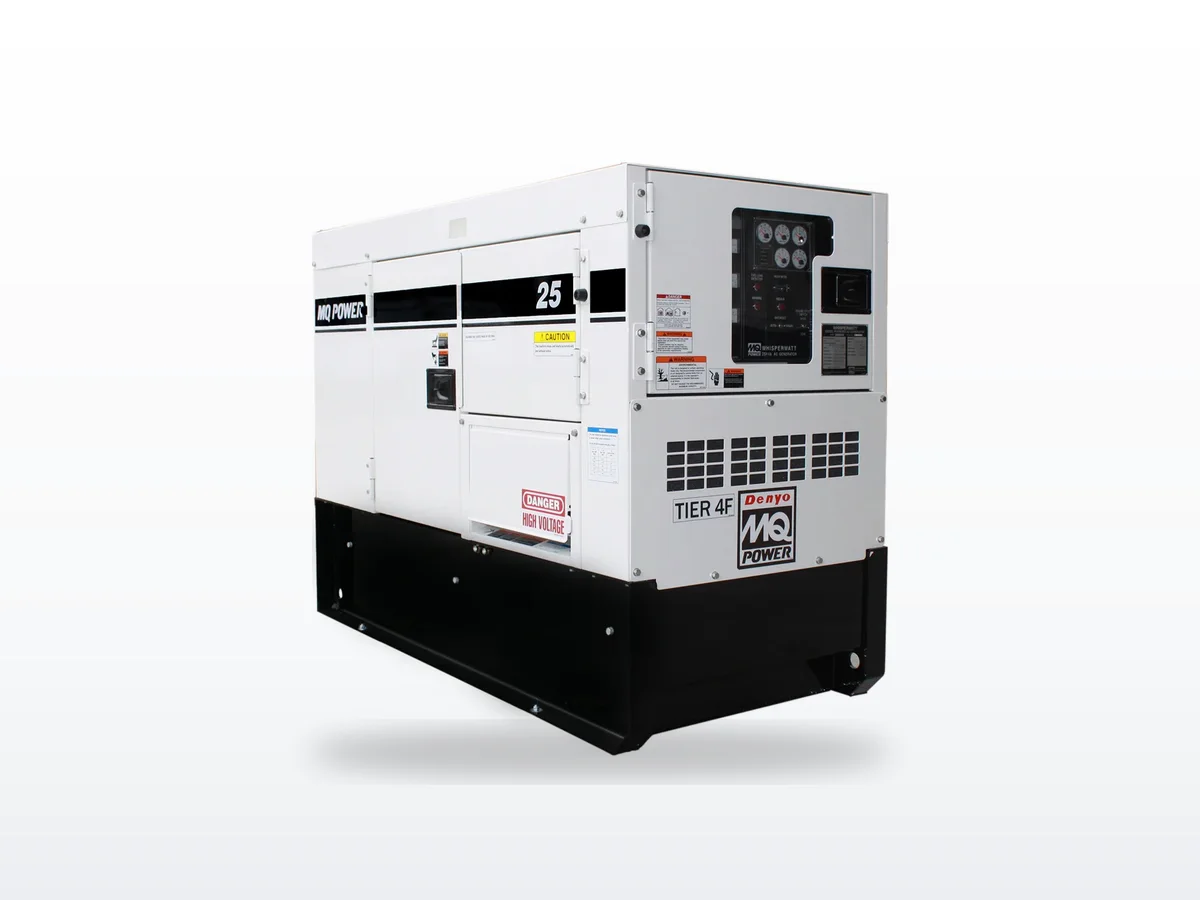
Series Overview#
The MQ Power WhisperWatt Super-Silent Series is the industry-standard portable generator line for noise-sensitive temporary power applications, covering 7 models from 22 to 336 kilowatts of standby capacity. Manufactured by Denyo of Japan — a company that has been engineering portable generators since 1948 — the WhisperWatt Series runs at 65–72 dBA at 23 feet, approximately 15 dBA quieter than a typical open-frame portable generator at equivalent power. That difference represents roughly half the perceived loudness. For construction sites adjacent to occupied buildings, outdoor events, film production, and noise-ordinance-governed deployments, the WhisperWatt is the specification default.
The WhisperWatt lineup uses Isuzu engines for five of seven models (DCA-25, DCA-45, DCA-70, DCA-125, DCA-400) and John Deere engines for two (DCA-150, DCA-300). All models are Tier 4 Final certified. DEF-based SCR aftertreatment is required on most models above the DCA-45 — the DCA-45 uses EGR+DPF only. The Isuzu engines in the WhisperWatt lineup are among the most widely serviced small diesel platforms in North America, with parts availability through Isuzu's independent dealer and service network separate from MQ Power's own distribution.
The brand context matters: WhisperWatt units serve exactly one purpose — portable, temporary power in environments where noise is a constraint. They are not positioned for permanent standby installation, prime power, or applications where the sound attenuation premium is irrelevant.
How to Choose#
The seven WhisperWatt models form three natural subgroups:
22–62 kW (DCA-25, DCA-45, DCA-70, Isuzu):
- DCA-25 (22 kW standby, 20 kW prime, Isuzu 4LE2T): The workhorse of rental fleets. 65 dBA at 23 feet. Multi-voltage output from 120V through 480V. Suitable for construction site power, small events, and film production where modest capacity is sufficient.
- DCA-45 (40 kW standby, 36 kW prime, Isuzu 4LE2X): Steps up power while maintaining 66 dBA. Notably: the DCA-45 uses EGR+DPF only — no DEF required, simplifying logistics for remote sites. Choose when 36 kW prime is needed and DEF supply is a concern.
- DCA-70 (62 kW standby, 56 kW prime, Isuzu BR-4JJ1X): Mid-range workhorse. 65 dBA, requires DEF. The 7.4-gallon DEF tank size and consumption rate should be confirmed in the spec sheet for deployment planning.
100–132 kW (DCA-125, DCA-150, Isuzu and John Deere):
- DCA-125 (110 kW standby, 100 kW prime, Isuzu BR-4HK1X): Requires DEF. 169-gallon fuel tank for extended runtime. Trailer-mounted. The Isuzu 4HK1 at this displacement uses SCR aftertreatment.
- DCA-150 (132 kW standby, 120 kW prime, John Deere 6068HFG05): Transitions to John Deere's 6.8L six-cylinder platform. 319-gallon fuel tank. Opens access to John Deere's full dealer service network. 29.7-gallon DEF tank. Choose when John Deere service access aligns with fleet service preferences or runtime between refueling is a priority.
240–336 kW (DCA-300, DCA-400, John Deere and Isuzu):
- DCA-300 (264 kW standby, 240 kW prime, John Deere 6090HFG06): The large-frame John Deere-powered model. 72 dBA at 23 feet — slightly higher than the smaller models, but still substantially quieter than competitors at this power level. ECU845 controller.
- DCA-400 (336 kW standby, 320 kW prime, Isuzu BG-6WG1X): Flagship WhisperWatt. Returns to Isuzu with the 6WG1X six-cylinder. CARB compliant for California deployments. The choice for the largest portable rental jobs and disaster recovery operations at 300+ kW.
Common Applications#
- Rental fleet: All 7 WhisperWatt models are in active rental fleet service. The sound-attenuated enclosure justifies a price premium over open-frame alternatives for customers in noise-sensitive applications — rental companies consistently report WhisperWatt units as their highest-margin portable product.
- Construction (large-scale and urban): Noise ordinances and neighbor relationships on urban construction sites make the WhisperWatt's 65–72 dBA range a practical necessity rather than a preference. The DCA-300 and DCA-400 serve major construction projects requiring 200–300 kW of temporary power.
- Events: The film and outdoor events industries standardize on WhisperWatt units. At 65 dBA, the DCA-25 and DCA-70 operate below the conversation threshold at typical event staging distances. The DCA-300 and DCA-400 power large-scale outdoor festivals and concerts.
- Emergency standby and disaster recovery: The WhisperWatt's sound attenuation is incidental to its disaster recovery value — the primary attribute is proven temporary power at rental-fleet scale. The DCA-300 and DCA-400 serve hospitals, government facilities, and large commercial operations during extended utility outages.
- Film production: The film industry is among the most noise-sensitive temporary power users. The WhisperWatt DCA-25 through DCA-125 are standard fleet equipment for feature film and television production.
Service & Maintenance#
The WhisperWatt Series has a mixed oil change interval across the lineup: some Isuzu-powered models specify 250-hour intervals while others follow the standard 500-hour interval. Confirm the specific model's interval against the current spec sheet — the higher-output Isuzu configurations at smaller displacements are the candidates for the shorter interval. All models observe a 12-month calendar maximum regardless of hours.
The most significant maintenance issue unique to Tier 4 Final WhisperWatt models is the Diesel Particulate Filter (DPF) regeneration requirement. DPF regen warnings indicate back-pressure buildup from accumulated soot. Passive regeneration occurs during sustained high-load operation; forced regeneration may be required if the unit operates primarily at light loads. A DPF that is not regenerated progressively restricts exhaust flow and eventually causes power derating. Fleet operators should establish a regen protocol for units that see light-load service.
DEF system issues — fault codes, derate warnings, and progressive power derating — are the second-ranked specific failure mode for the WhisperWatt lineup, affecting the DCA-70, DCA-125, DCA-300, and DCA-400. DEF concentration, contamination, and system component wear all trigger fault conditions. Maintain DEF tanks with fresh fluid, avoid mixing DEF and diesel, and inspect DEF injectors and sensors at scheduled service intervals.
Battery no-crank after extended storage is the most common deployment issue (4 of 7 models). Rental fleet units that sit between jobs need battery maintainers to preserve cranking capacity.
Application Guidance#
The MQ Power WhisperWatt Super-Silent Series is purpose-built for temporary power deployments where noise is a constraint — construction sites adjacent to occupied buildings, outdoor events, film and television production, urban emergency response, and any application governed by noise ordinance. The 65–72 dBA rating at 23 feet is the operational differentiator: it is approximately half the perceived loudness of an equivalent open-frame portable, which determines whether a deployment is legally permissible or logistically viable in noise-sensitive environments. All seven models are Tier 4 Final, covering California CARB compliance for construction applications (DCA-400 specifically carries CARB certification). The DCA-300 and DCA-400 serve the largest temporary power needs in the series at 240–336 kW prime — appropriate for major construction, hospital temporary connections, and large-scale events.
This series is not appropriate for permanent standby installation or prime power applications where the sound attenuation premium is irrelevant and lower-cost stationary diesel platforms are a better fit. For permanent outdoor commercial standby in the 22–175 kW range, the Kohler REOZ mobile trailer series offers Tier 4 Final trailer units with Decision-Maker paralleling controls. For applications where noise is not a constraint and the lowest-cost portable diesel is the goal, open-frame alternatives from Airman SDG Series or Atlas Copco QAS Series cover similar power ranges at lower cost. For hybrid or zero-emissions temporary power — where utility grid or battery buffering can reduce generator runtime — the Airman eBOSS Hybrid Series is the relevant alternative to evaluate.