
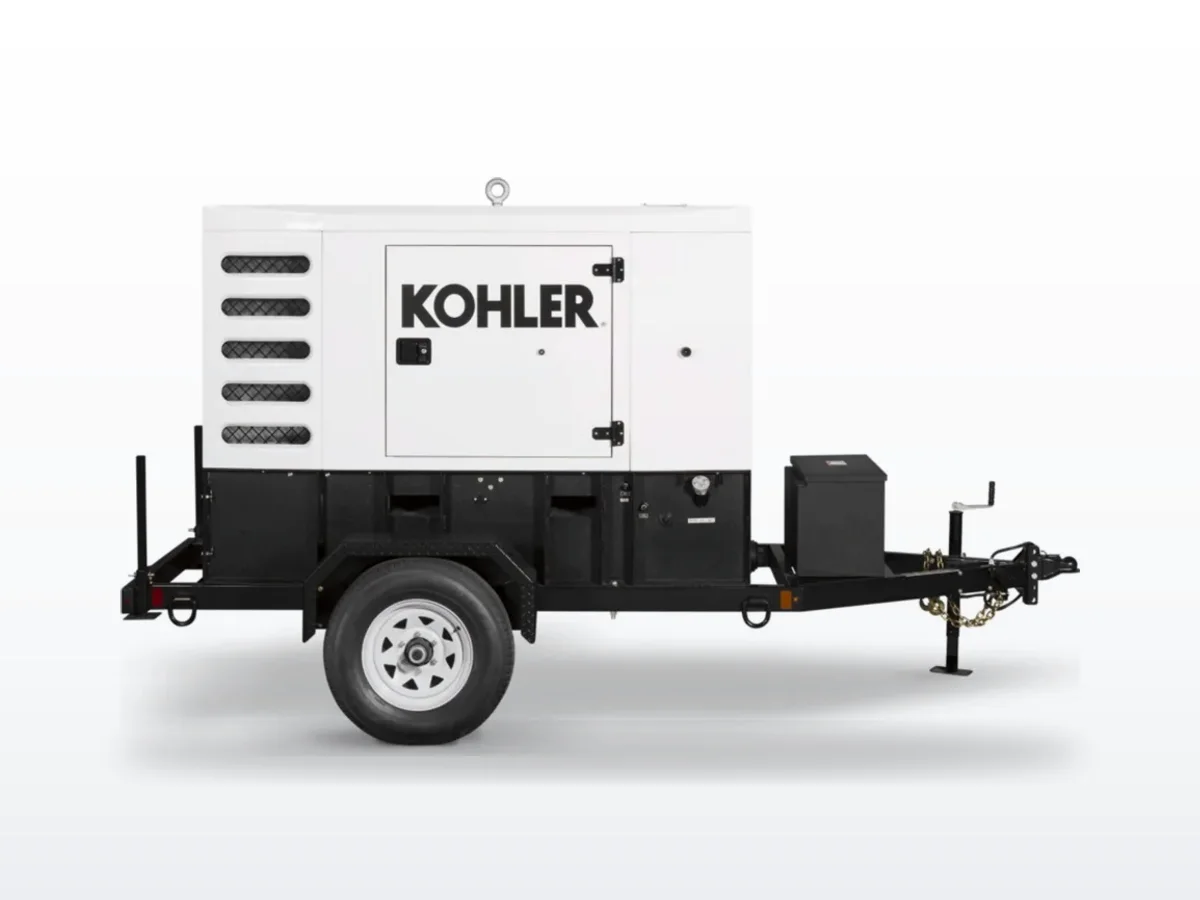
Series Overview#
The Kohler REOZ Series (Diesel Mobile Trailer) covers six models from 30 to 150 kW standby, all EPA Tier 4 Final certified and designed for trailer-mounted mobile deployment. Designated as REOZT4, these generators are engineered for temporary power applications — construction sites, planned maintenance outages, emergency response, special events, and disaster recovery situations where a stationary pad-mounted generator is impractical or unavailable.
The series splits into two distinct engine families. The 35REOZT4, 45REOZT4, and 55REOZT4 use Kohler KDI series engines: the KDI 1903 TCR (1.9L, 4-cylinder), KDI 2504 TCR (2.5L, 4-cylinder), and KDI 3404 TCR (3.4L, 4-cylinder). All three KDI-powered models achieve Tier 4 Final through cooled Exhaust Gas Recirculation and a Diesel Oxidation Catalyst — no Diesel Particulate Filter, no Diesel Exhaust Fluid. This simplicity is a deliberate design choice for mobile applications where DPF regen events and DEF sourcing create operational complications. Moving to 85 kW and above, the 90REOZT4, 145REOZT4, and 175REOZT4 use John Deere 4045HFG04 and 6068HG550 PowerTech engines, which achieve Tier 4 Final via Selective Catalytic Reduction and require DEF.
Voltage configuration differs by power class. The 35–55 kW KDI-powered models output 120/208V and 120/240V (single and three-phase). The 90–175 kW John Deere-powered models add 277/480V three-phase to the available options, making them suitable for commercial building temporary connections and larger facility emergency applications.
The 145REOZT4 and 175REOZT4 share the same John Deere 6068HG550 engine and trailer platform — the primary differentiator is alternator sizing. The 145REOZT4 uses the Kohler 4R13X alternator (Fast-Response X); the 175REOZT4 uses the larger 4S12X to deliver the additional 20 kW output. Both models include the Decision-Maker 3500 paralleling controller for synchronized multi-unit deployments.
How to Choose#
30–47 kW: Kohler KDI-powered models (35REOZT4, 45REOZT4, 55REOZT4). For small commercial and light construction temporary power in the 25–45 kW range, these models deliver Tier 4 Final compliance without the operational overhead of DEF. The 35REOZT4 (30 kW standby, 28 kW prime) and 45REOZT4 (40 kW standby, 36 kW prime) cover single-phase-dominated temporary loads. The 55REOZT4 (47 kW standby, 42 kW prime, KDI 3404 TCR) is the largest Kohler-branded engine option in the trailer series and the best choice before moving to the John Deere platform.
85 kW: 90REOZT4 (John Deere 4045HFG04). The step up to the John Deere platform at 85 kW standby (76 kW prime) brings significantly extended overhaul interval — 15,000 hours versus 8,000 hours on the smaller KDI models. It also introduces the DEF requirement via SCR. If your temporary power application is likely to involve extended runtime (disaster recovery, extended construction), the longer overhaul interval is a meaningful advantage.
130–150 kW: 145REOZT4 and 175REOZT4 (John Deere 6068HG550). For the largest temporary power needs in this series — commercial building emergency backup, hospital campus temporary connections, campus-scale events — the 145REOZT4 (130 kW standby, 117 kW prime) and 175REOZT4 (150 kW standby, 139 kW prime) are the choice. Both support paralleling via the Decision-Maker 3500 controller, allowing two or more units to be deployed together for loads above 150 kW. The 175REOZT4 is the top of the REOZT4 series.
Common Applications#
-
Construction and infrastructure sites. The KDI-powered 35–55 kW models are purpose-built for construction site temporary power: no DPF, no DEF, rugged tow-behind format, and Tier 4 Final compliance for jurisdictions enforcing emission regulations on construction equipment.
-
Planned utility and maintenance outages. Commercial, healthcare, and government facilities use REOZT4 trailer units as temporary standby replacements during scheduled maintenance of permanent stationary generators — enabling preventive maintenance without facility downtime.
-
Emergency response and disaster recovery. The trailer format and three-phase output capability of the 90–175 kW models make them appropriate for emergency deployment to hospitals, government facilities, and water treatment plants following natural disasters.
-
Events and temporary venues. Large events requiring reliable commercial-grade power at remote venues use REOZT4 units where utility service is unavailable or inadequate.
-
Government and military temporary installations. Government facilities and military operations use the 90–175 kW class for forward operating locations requiring three-phase commercial-grade power.
Service & Maintenance#
All six REOZT4 models share a 250-hour oil change interval, with air filter service every 500 hours across the line. The larger John Deere-powered models additionally require fuel filter replacement at 500 hours. Coolant service is scheduled at 3,000 hours for half the models in the series.
The DEF system is the primary maintenance challenge on the John Deere-powered 90–175 kW models. DEF quality alerts and SCR catalyst derate warnings are the most common fault codes observed in mobile deployment — symptoms include power derate, NOx fault codes, and DEF quality alerts. DEF must be kept at appropriate concentration and stored in sealed containers away from heat to prevent degradation. For extended deployments, a DEF supply plan should be established before the unit is dispatched.
The smaller KDI-powered models are free of DEF management complexity, but they are susceptible to DPF-related issues on the John Deere units if Tier 4 aftertreatment maintenance is deferred. Fuel quality degradation is a significant risk for trailer units that sit between deployments — diesel stored in the onboard tank can degrade over 6–12 months. Fuel polishing or tank purge-and-refill protocols should be established for units that see irregular use.
Starting battery condition is the most common cause of failed-to-start events. For trailer units that may sit for months between deployments, battery maintenance chargers (trickle chargers) should be used when the unit is in storage. Battery replacement every two to three years is recommended regardless of state of charge.
Application Guidance#
The Kohler REOZT4 mobile trailer series is the correct specification for temporary power deployments requiring EPA Tier 4 Final compliance in a road-legal trailer format — construction sites under air district oversight, planned maintenance outages at commercial and healthcare facilities, emergency response operations, and large temporary events. The series' split into DEF-free KDI-powered models (35–55 kW) and John Deere SCR/DEF models (90–175 kW) is the primary decision point: if the deployment is remote or short-duration where DEF supply logistics are a friction, the 35–55 kW KDI models are operationally simpler. For longer deployments or larger loads in the 85–150 kW range, the John Deere-powered models' 15,000-hour overhaul interval and higher output justify the DEF supply planning requirement. The 145REOZT4 and 175REOZT4 with Decision-Maker 3500 paralleling controllers can be deployed in pairs for loads above 150 kW.
This series is not appropriate for permanent stationary standby installations — the Kohler REOZ diesel commercial standby series is the pad-mounted permanent equivalent. For temporary power needs below 30 kW or applications where sound attenuation is a priority, the MQ Power WhisperWatt Super-Silent series covers 22–336 kW in a sound-attenuated enclosure at 65–72 dBA — lower noise than the standard REOZT4 enclosure and a better fit for noise-sensitive urban sites. For temporary deployments requiring more than 175 kW from a single mobile unit, the Atlas Copco QAS Series and Airman SDG Series offer larger mobile configurations.