Series Overview#
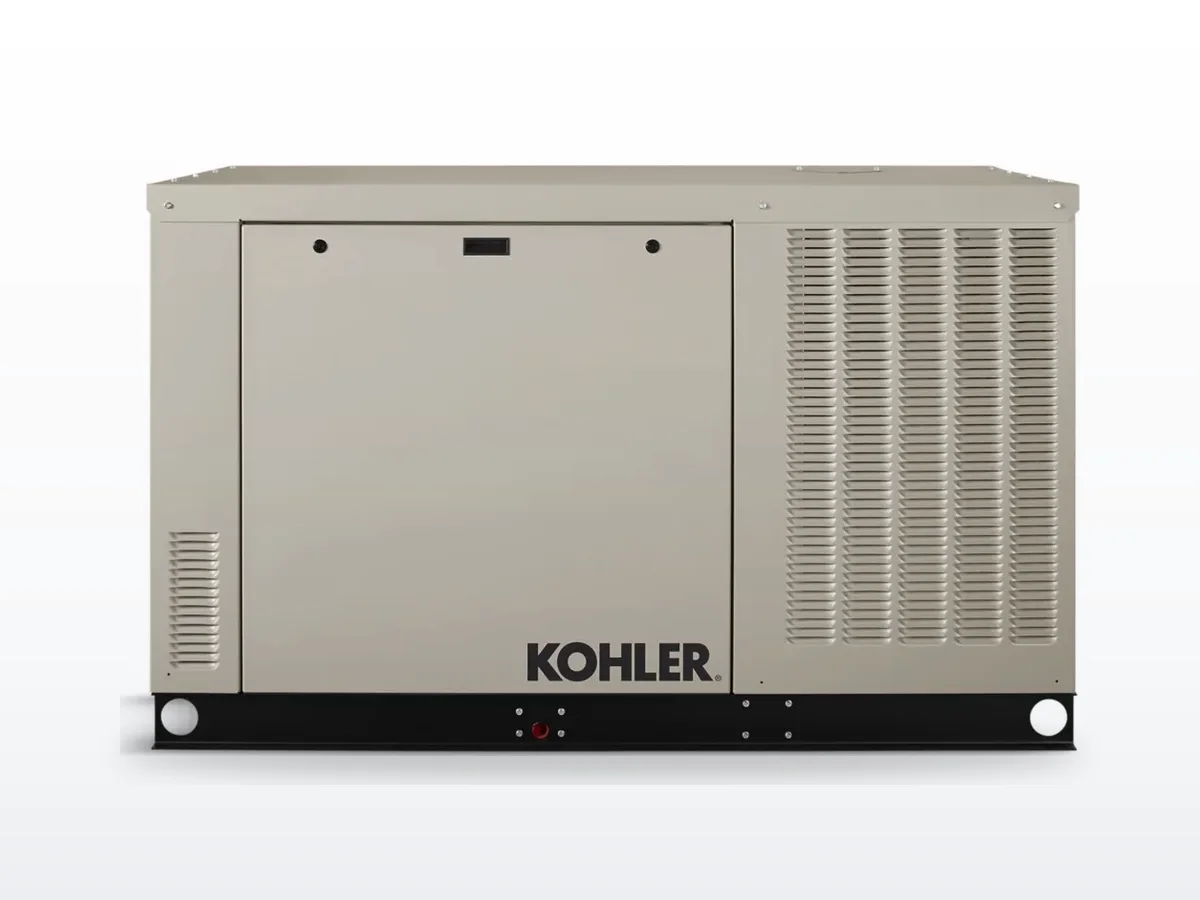
The Kohler RCL Series is the residential liquid-cooled standby generator line from Kohler, spanning 24 to 60 kW across five models. All units run on natural gas or LP propane, output 120/240V single-phase, and use Kohler-manufactured engines with automotive-style liquid cooling. The RCL Series is positioned above the air-cooled RCA Series and is designed for premium residential installations where quieter operation, longer service life, and the ability to sustain load in hot ambient conditions are priorities.
The defining characteristic of the RCL Series versus Kohler's air-cooled RCA line — and versus air-cooled competitors like the Generac Guardian at similar kW ratings — is the liquid cooling system. Liquid-cooled engines operate at more consistent temperatures under varying ambient conditions, produce less radiated heat at the enclosure surface, and typically achieve quieter sound levels than their air-cooled counterparts at comparable power ratings. For estate properties near property lines, in communities with HOA noise restrictions, or in California's hot inland valleys where an air-cooled unit faces thermal derate risk during August outages, these differences are meaningful.
Engine architecture transitions at the 48 kW threshold. The 24RCL, 30RCL, and 38RCL use Kohler's KG2204 (naturally-aspirated) and KG2204T (turbocharged) 2.2L industrial 4-cylinder. The 30RCL and 38RCL use the turbocharged KG2204T for their higher output ratings. At 48 kW and 60 kW, the architecture steps up entirely — the 48RCL and 60RCL use the Kohler KG6208 6.2L naturally-aspirated V8, the same industrial-grade engine block used in Kohler's commercial KG40–KG125 industrial gensets and the 48RCLB/48RCLC/60RCLB current variants. This engine transition at 48 kW means the 48RCL and 60RCL share service parts and engine expertise with commercial industrial units, not just residential units.
All five models are EPA certified for stationary spark ignition emergency standby applications.
How to Choose#
24 kW: 24RCL (KG2204, naturally-aspirated). The entry point of the RCL line. At 24 kW, this unit covers most medium-to-large homes: central single-zone HVAC, full kitchen, home office, and standard lighting. If your home load analysis calculates less than 20 kW at peak residential demand (which covers most 2,500–4,000 sq ft homes), the 24RCL provides appropriate margin.
30 kW: 30RCL (KG2204T, turbocharged). The step up for larger homes with dual-zone HVAC, pool or spa equipment, EV charging, or home workshop loads. If your demand calculation is in the 22–27 kW range, the 30RCL provides headroom without moving to the more expensive 38 kW frame.
38 kW: 38RCL (KG2204T, current variants 38RCLB/38RCLC). A common choice for Silicon Valley and Bay Area premium residential properties: main house plus guest house on one panel, triple-zone HVAC, pool heating, EV charging, and workshop loads. At 38 kW, this unit can carry essentially all loads of a large single-family home without selective load shedding.
48 kW: 48RCL (KG6208 V8, current variants 48RCLB/48RCLC). The engine changes at this model — the KG6208 V8 is a substantially larger and longer-lived industrial engine platform. Typical deployments include 400A electrical service homes, whole-estate backup for properties with multiple structures, and premium home offices with significant server or networking loads. At 48 kW you can run everything simultaneously with margin.
60 kW: 60RCL (KG6208 V8, current variant 60RCLB). The largest unit in the RCL Series, using the same KG6208 V8 as the 48RCL with a larger alternator. This is effectively a small commercial generator in a residential housing. It is the appropriate choice for large estates with main house, guest quarters, pool house, and extensive HVAC loads where the 48 kW unit would operate too close to its limit.
Common Applications#
-
Premium whole-house backup. The RCL Series is the primary Kohler choice for whole-house standby at large single-family homes in the 3,000–8,000 sq ft range. The liquid-cooled platform provides the quieter operation and heat management needed for enclosures installed near living spaces.
-
Home office and mission-critical residential. Homeowners with significant work-from-home infrastructure — servers, networking equipment, video production setups, or medical equipment — require clean stable power that the RCL's permanent-magnet excited alternator provides.
-
Compound and multi-structure properties. Estates with main house plus guest house, ADU, pool house, or barn use the 48RCL and 60RCL to power all structures simultaneously from a single generator, simplifying the electrical installation versus separate smaller units.
-
High-value residential in hot climates. Properties in California's Central Valley, Inland Empire, or Arizona where summer temperatures routinely exceed 100°F benefit from the RCL's liquid-cooled thermal management. An air-cooled generator under sustained full load at 110°F ambient will derate; the RCL's liquid cooling maintains consistent output regardless of ambient temperature within the rated range.
Service & Maintenance#
The RCL Series uses a 24-month oil change interval — the longest in Kohler's residential and commercial gaseous lineups. This extended interval reflects the Kohler KG2204T and KG6208 engine platforms' oil capacity and stability. However, an annual inspection should still be performed regardless of the oil change calendar: check belt condition, coolant level, battery state of health, and run a loaded exercise test.
Battery failure is the dominant cause of failed-to-start events across all five RCL models. All five models show battery-related no-start as the primary historical failure mode. The RCL's weekly self-exercise cycle keeps the battery charged, but batteries still age and lose cold-cranking capacity — particularly in climates with temperature extremes. Replace batteries every two to three years proactively, and include a battery load test (not just a voltage check) in every annual service.
Coolant system issues are the next priority: the coolant level sensor can generate false low-coolant faults on some models; hoses and the thermostat should be inspected at each annual service. The fuel solenoid and regulator have shown moderate failure rates on some RCL models — symptoms are no-start conditions and fuel pressure faults. This should be on the diagnostic shortlist when an RCL fails to start and the battery has been ruled out.
Application Guidance#
The Kohler RCL Series is best suited to premium residential and estate standby where quieter operation, sustained performance in hot ambient conditions, and higher output capacity (24–60 kW) justify the step up from air-cooled alternatives. The liquid-cooled platform eliminates the thermal derate risk that affects air-cooled generators during California's summer outages, making it the correct specification for properties in inland heat zones. The 48RCL and 60RCL, which share the KG6208 V8 engine with Kohler's commercial industrial line, are well-suited to whole-estate applications — main house plus guest house, ADU, or pool house — where a single generator must cover multiple structures simultaneously.
This series is not appropriate for three-phase loads or for commercial applications where three-phase distribution is required; all RCL models output 120/240V single-phase only. For commercial or light industrial gaseous standby that crosses the residential-to-commercial boundary, the Kohler KG Series (40–200 kW, three-phase capable) is the correct next step. For homeowners in moderate climates with loads under 26 kW where liquid cooling is not necessary, the RCA Series (14–26 kW, air-cooled) offers a lower-cost entry point. For larger residential or estate standby requirements on liquid-cooled gaseous platforms from other manufacturers, the Generac SG Series and Cummins C-Series Commercial Gaseous cover the same power range.