Series Overview#
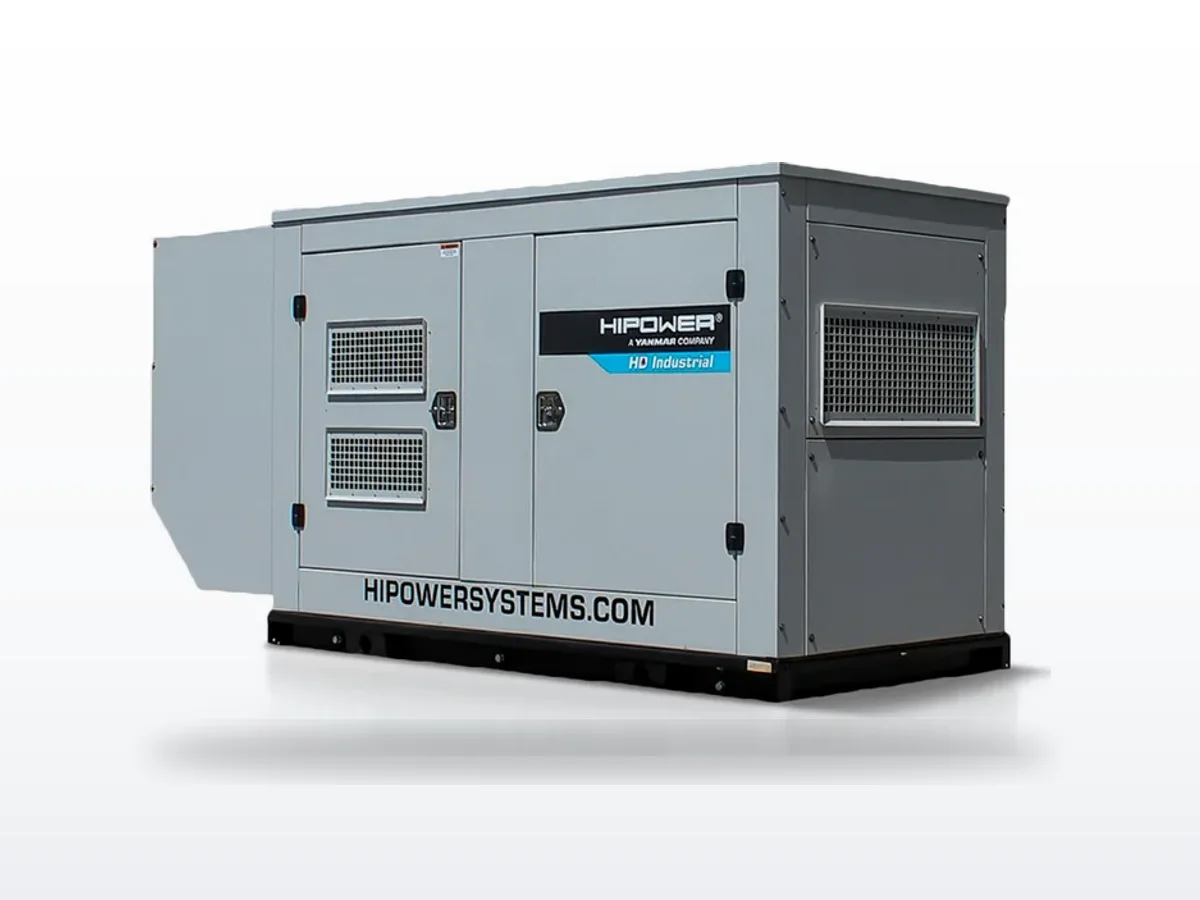
The Hipower HNI Series is the company's flagship natural gas and LPG standby lineup, spanning 30 to 1,000 kW across 17 models. CARB certification across the full range makes the HNI one of the very few non-Big-4 options for large natural gas standby in California — a meaningful differentiator, since most competing manufacturers' gas generator lines top out at 500 kW or require air district variance above 250 kW. The HNI-1000 is among the rare CARB-certified 1 MW natural gas generators available outside of Cat, Cummins, Kohler, and Generac.
The series uses two engine families. The entry range (30–80 kW) is powered by Origin 3.6L spark-ignited engines — naturally aspirated at 30 kW, turbocharged intercooled from 40 kW upward. Above 80 kW, the series transitions to PSI (Power Solutions International) spark-ignited engines: a 5.7L V8 at 100–125 kW, an 8.8L V8 at 150–200 kW, a 13L platform at 250–300 kW, and progressively larger V12 configurations from 450 kW through 1 MW. All models are liquid-cooled, 1800 RPM, 60 Hz. Single-phase output is available in the smaller models (HNI-30 through HNI-80 at 120/240V); above 100 kW, the series is three-phase only at 277/480V.
Natural gas eliminates on-site fuel management: no diesel delivery scheduling, no SPCC compliance plans for large storage tanks, and no fuel degradation during extended standby periods. For California facilities facing air district scrutiny on diesel standby, the HNI's CARB certification under the EPA Stationary Spark Ignition standard enables permit-by-rule for most commercial applications.
How to Choose#
For 30–80 kW (Origin-powered): The HNI-30 through HNI-80 use the Origin 3.6L engine family. The HNI-30 is naturally aspirated; the HNI-40 through HNI-80 add turbocharging and intercooling for higher output from the same displacement. The HNI-80 is the largest Origin-powered unit; above 80 kW, the series moves to PSI.
For 100–200 kW (PSI V8): The HNI-100 and HNI-125 use the PSI 5.7L V8; the HNI-150 steps up to the 8.8L V8 for the additional torque margin needed at 150 kW; the HNI-200 uses the 8.8L high-output variant. Choose this range for commercial standby applications where a PSI V8 service network is established and 100–200 kW covers the load schedule.
For 250–500 kW (PSI 13L and 22L): The HNI-250 and HNI-300 use the PSI 13L turbocharged platform; the HNI-350 also uses a PSI engine in this class. From HNI-450 upward, the series transitions to PSI 21.9L and 22L V12 architectures. This range covers mid-large commercial buildings, data centers, and industrial facilities.
For 650–1,000 kW (PSI V12 large frame): The HNI-650, HNI-800, and HNI-1000 use PSI large-frame 31.8L and unconfirmed larger V12 engines. At this scale, natural gas supply infrastructure engineering is as important as generator selection — confirm gas meter capacity, regulator sizing, and supply line pressure at full load before specifying.
Phase and voltage: Single-phase (120/240V) is available for HNI-30 through HNI-80. All models support 277/480V three-phase. Confirm whether the installation requires single-phase or three-phase service before selecting a model.
Common Applications#
- Commercial standby (12/17 models rated): Mid-size and large commercial buildings — office campuses, medical office buildings, hospitality, retail — are the core market for the HNI. Natural gas eliminates fuel management overhead, and CARB certification removes air permit complexity in California.
- Industrial standby (12/17 models rated): Manufacturing and industrial operations with established natural gas service use the HNI to eliminate diesel logistics at the 100 kW+ scale where diesel tank installation and SPCC compliance become burdensome.
- Data centers (9/17 models rated): Edge data centers and mid-tier facilities with natural gas service increasingly evaluate the HNI for backup power where diesel standby faces emissions scrutiny. The HNI-650 and HNI-1000 cover larger edge and enterprise data center requirements.
- Light-commercial (5/17 models rated): Restaurants, small offices, and retail anchors in the 30–80 kW Origin-powered range where natural gas service is already on-site and diesel storage would require a tank and permit.
Service & Maintenance#
All 17 HNI models share a common maintenance schedule: oil change at 1,000 operating hours or 12 months; air filter at 500 hours; spark plug replacement at 1,000 hours. The 1,000-hour oil interval is the most notable advantage over diesel units in similar output classes, which typically require changes at 250–500 hours.
Three failure patterns recur across the HNI fleet. Gas pressure regulators are subject to inlet pressure drift from utility supply fluctuations — test regulator output pressure at every service event and verify that the output remains within the engine manufacturer's specified range. This is the most frequently occurring issue across the series (documented on 6 models) and is often misdiagnosed as an engine problem. Spark plug erosion from natural gas combustion deposits is universal to all spark-ignited gas generators — replace all plugs on schedule at 1,000 hours without exception; at higher output models (800 kW and 1 MW), running on worn plugs causes significant derating and risks combustion irregularity. Ignition module misfires (documented on 3–5 models) appear as cylinder dropout under load — diagnose with per-cylinder coil output testing rather than replacing the full ignition system blindly.
Application Guidance#
The Hipower HNI Series is purpose-built for buyers who need CARB-certified natural gas or LPG standby across a wide output range — 30 to 1,000 kW — from a single non-Big-4 manufacturer. At the upper end (650–1,000 kW), the HNI is one of very few CARB-certified natural gas generator lines available outside Cat, Cummins, Kohler, and Generac, making it the primary non-Big-4 option for California facilities that need large gas standby without air district variance. The dual-fuel (natural gas and LPG) capability across all 17 models gives it flexibility for sites where utility gas is seasonal or unreliable. Natural gas eliminates diesel storage, SPCC compliance obligations, and fuel delivery logistics across the entire range — a material operational advantage at the 500 kW+ scale where diesel tank installation becomes a significant project cost.
The HNI is not appropriate for applications requiring diesel fuel (remote sites without gas infrastructure, fuel-independent mobile power, or critical applications where gas supply continuity is a risk factor). For those applications, the Hipower HDI Series (60–2,000 kW diesel, Tier 2/3) or Hipower HMW Series (270–2,230 kW diesel, Tier 4 Final) cover equivalent output ranges. The HNI's stationary-only design also makes it unsuitable for rental or temporary power — the Hipower HRNG Series (66–940 kW trailer-mounted natural gas) is the mobile counterpart. For competing large stationary gas, the Blue Star PSI Industrial Gaseous and Kohler KG Series are the primary comparables above 500 kW.