Overview#
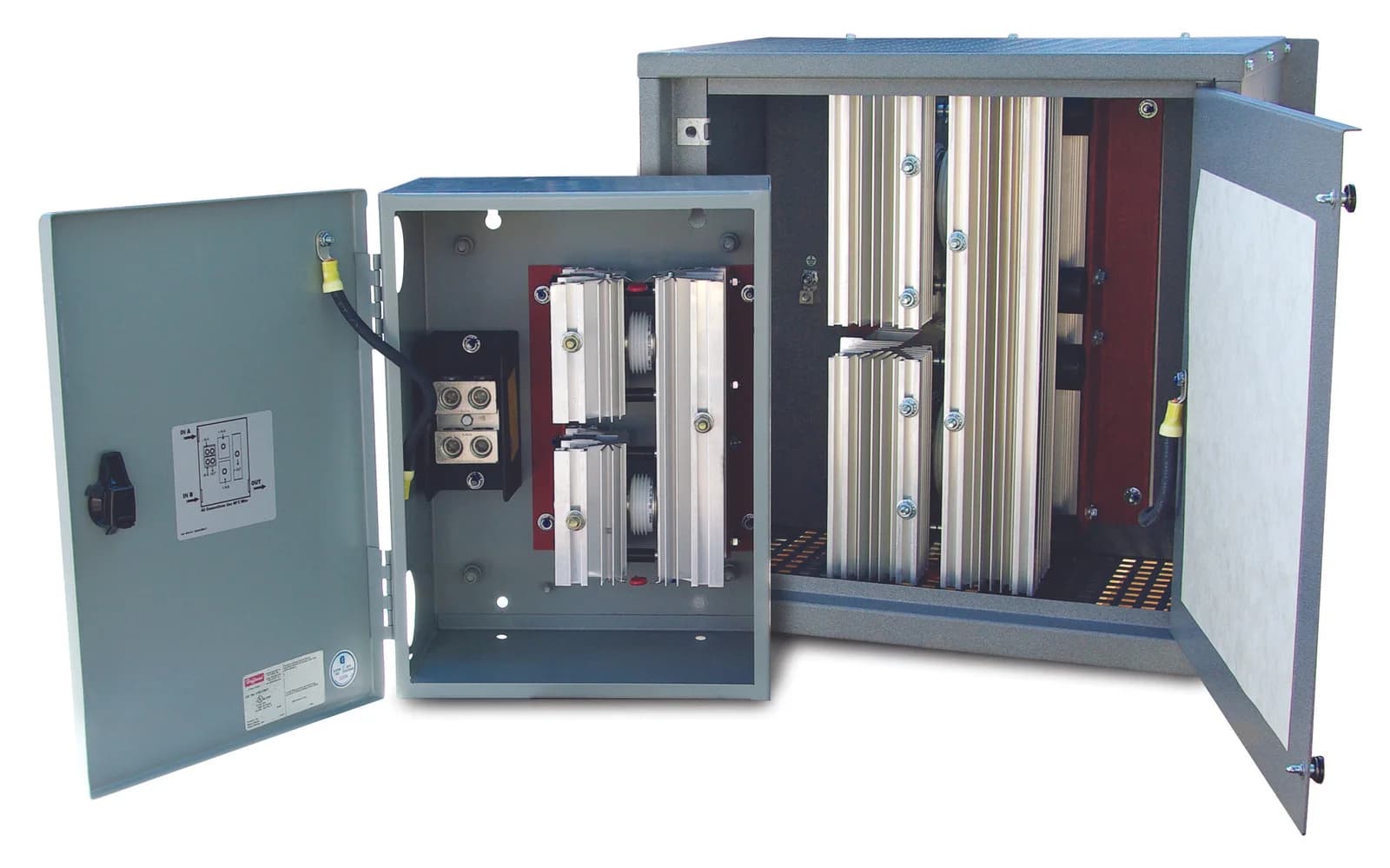
The SENS Best Battery Selector (BBS) is the simplest and most reliable way to add DC redundancy to a generator starting system. It couples two independent battery banks to the engine starter, ensuring the generator starts even if one battery bank fails completely.
The elegance of the BBS is in what it doesn't have: no moving parts, no control electronics, no microprocessor, no software, no configuration. It uses solid-state diodes to automatically route starting current from the stronger battery while isolating the weaker one. There is nothing to fail, nothing to maintain, and nothing to misconfigure.
Model lineup#
| Model | Peak current | Continuous | Typical application |
|---|---|---|---|
| BBS-800 | 1,250A | 45A | Small/mid generators (50-500 kW) |
| BBS-800S | 1,250A | 45A | Same as 800 — compact form factor |
| BBS-1600 | 2,500A | 50A | Mid/large generators (500-1500 kW) |
| BBS-4800 | 6,400A | 150A | Large-frame generators (1500+ kW) |
All models operate at 12-120VDC nominal (up to 148VDC actual battery voltage).
Why redundancy matters#
A standby generator with a single battery bank has a single point of failure. If that battery sulfates during months of float charging, develops an internal short, or loses a cell, the generator will not start during an outage. The BBS eliminates this risk by ensuring that one bad battery cannot prevent the generator from starting.
The failure mode it prevents is specific and common: a failing battery with high internal resistance draws current from the good battery through the starter wiring, dragging both banks below cranking voltage. The BBS's diode isolation prevents this reverse current path entirely.
Our service experience#
We recommend the BBS on every mission-critical generator installation — hospitals, data centers, water treatment, and any NFPA 110 Level 1 system. It's the lowest-cost, highest-impact reliability upgrade available. We've seen installations where a BBS prevented a no-start that would have been catastrophic (hospital during a PG&E PSPS event). The unit requires zero maintenance — we visually inspect the heatsink during annual PM and move on.