
Series Overview#
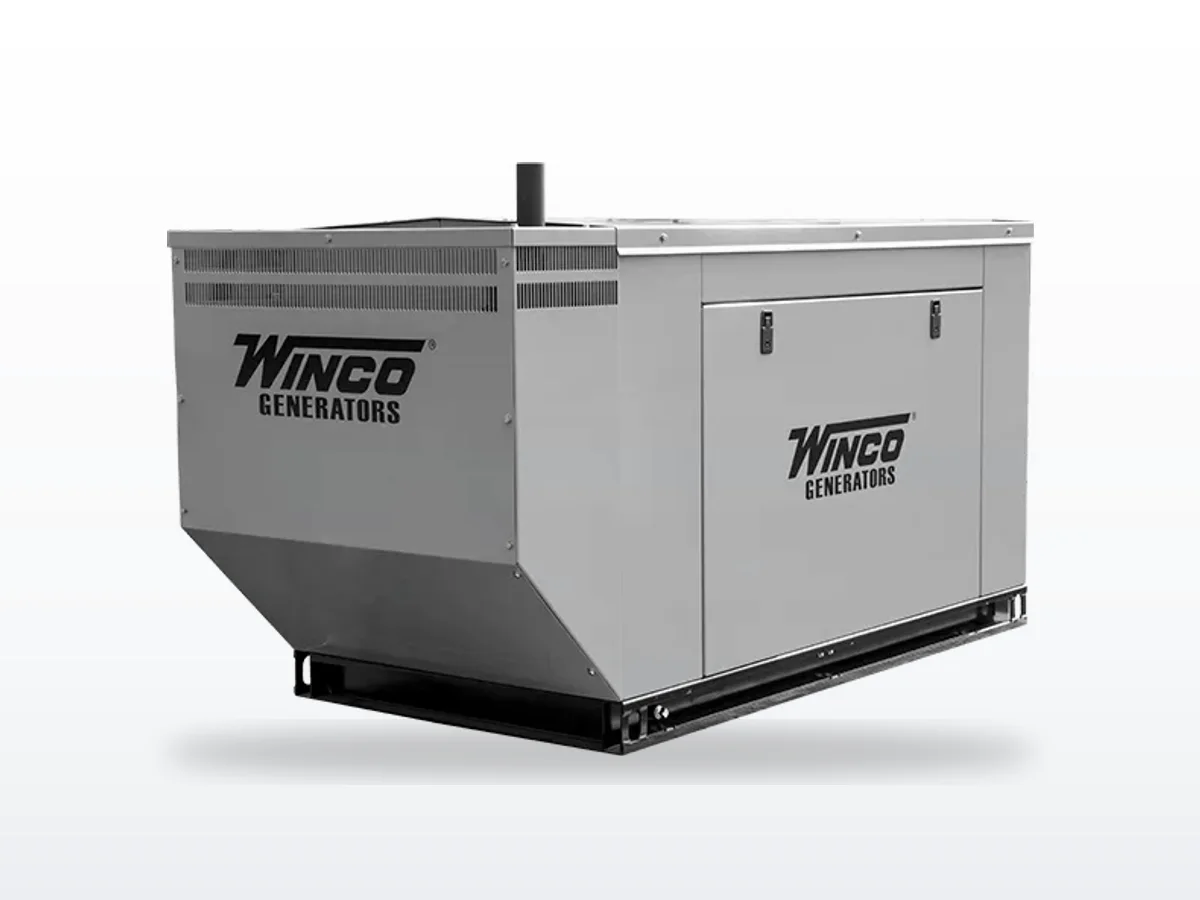
The Winco DR Series is Winco's enclosed diesel standby generator line, offering 9 models from 13 to 175 kilowatts of standby capacity. Built 100% in Le Center, Minnesota by a company manufacturing generators since 1927, the DR Series is an outdoor-ready, permanently installed standby line with weather-protective enclosures and sub-base fuel tanks on most models. All units carry EPA Tier 4 Final or Tier 4 Interim certification — the cleanest diesel emissions tier for stationary generators — and use Stamford alternators throughout the range.
The series uses two engine families. The entry-level DR12I4 and DR20I4 are powered by Isuzu three- and four-cylinder diesel engines with Tier 4 Interim certification. Beginning with the DR35F4, Winco transitions to FPT Industrial engines: the N45 4.5-liter turbocharged platform covers the DR35F4 through DR90F4, the N67 6.7-liter inline-six covers the DR100F4 and DR130F4, and the C87 8.7-liter inline-six powers the flagship DR175F4. All FPT-powered models carry Tier 4 Final certification.
The DR Series is exclusively focused on commercial standby applications — permanent outdoor installation backing buildings where the utility supply cannot be interrupted during outages. Winco does not position the DR Series for prime power, demand response, or portable use. The combination of Tier 4 emissions compliance, all-weather enclosure, and American manufacturing makes the DR Series a competitive option for commercial and institutional standby projects where domestic origin and compliance certainty are priorities.
How to Choose#
The nine models in the DR Series span three distinct engine families, and the selection is straightforward once the load requirement is established:
13–20 kW (DR12I4–DR20I4, Isuzu): Entry-level single-phase standby. These are the only single-phase-only models in the series and the only units with Tier 4 Interim (rather than Final) certification. Appropriate for small commercial buildings, agricultural applications, or residential-adjacent uses where three-phase service is not present.
35–90 kW (DR35F4–DR90F4, FPT N45 4.5L): The core of the DR Series commercial range. The DR35F4 and DR45F4 offer both single-phase and three-phase output; the DR65F4 and DR90F4 are three-phase only. All are Tier 4 Final. This range covers the majority of small-to-mid commercial standby applications.
100–130 kW (DR100F4–DR130F4, FPT N67 6.7L): Platform step-up to the six-cylinder engine for three-phase commercial loads requiring 100 kW or more. Both models are three-phase 277/480V only. The DR130F4 uses a Stamford HCI 444 alternator frame, which is a step up in alternator class from the lower-rated models.
175 kW (DR175F4, FPT C87 8.7L): The flagship of the DR Series — the highest output, largest engine, and largest physical footprint. Three-phase 277/480V only. At 175 kW, this is the upper boundary of Winco's enclosed diesel standby line. If the load requirement exceeds 175 kW, a different platform must be specified.
For voltage: if the facility has single-phase 120/240V service, the DR12I4 through DR45F4 can accommodate it. If the facility has three-phase 277/480V service, the DR35F4 and above cover the range.
Common Applications#
- Commercial office and retail buildings: The DR Series is rated for commercial standby across all 9 models. Permanent outdoor installation with the enclosed enclosure suits any building with a utility pad or mechanical yard. The sub-base fuel tank eliminates the need for a separate above-ground or underground fuel storage installation on smaller models.
- Agricultural and rural commercial operations: The entry-level Isuzu-powered models at 13–20 kW serve rural facilities where three-phase service is unavailable but diesel reliability is essential — pump houses, grain facilities, and agricultural processing operations.
- Institutional buildings: Schools, municipal offices, and government facilities with commercial three-phase service and standby requirements in the 35–175 kW range. Tier 4 Final compliance simplifies permitting in jurisdictions with clean air restrictions.
- Healthcare clinics and medical offices: Smaller medical facilities with standby requirements that do not rise to the level of NFPA 99 essential electrical system complexity. A DR Series unit in the 65–100 kW range can cover HVAC, lighting, and basic life-safety circuits.
Service & Maintenance#
All DR Series models share a straightforward service schedule: oil changes every 500 hours or 12 months, fuel filter replacement every 500 hours or annually, and air filter service every 500 hours or annually. These intervals should be treated as annual minimums regardless of runtime for standby generators that accumulate few hours.
The three most common failure modes are consistent across all 9 DR Series models: fuel filter degradation from stale diesel in standby tanks, battery capacity loss from insufficient float charging, and transfer switch contact oxidation from inactivity. None of these are engine failures — they are standby-mode infrastructure issues. A weekly exercise cycle (typically 20–30 minutes under at least 30% load) is the single most effective preventive measure. Exercise keeps transfer switch contacts clean, verifies battery cranking capacity, and circulates fresh diesel through fuel filters.
Annual battery testing under load is strongly recommended. Standby generators are frequently the victim of battery failure during actual utility outages — the battery has been float-charged for years but has insufficient cranking capacity when it matters. Test under load and replace proactively at 36–48 months.
Application Guidance#
The Winco DR Series is purpose-built for permanent outdoor commercial standby at 13–175 kW — the enclosed all-weather housing and sub-base fuel tank on most models make it a self-contained installation ready for a utility pad without additional fuel storage infrastructure. USA manufacture in Le Center, Minnesota, Tier 4 Final FPT Industrial engines across the 35–175 kW range, and Stamford alternators position it as a competitive option for commercial and institutional projects where domestic origin, compliance certainty, and low ongoing parts cost are selection priorities. The FPT N67 and C87 platforms on the DR100F4–DR175F4 give the upper range of this series a well-supported large-displacement engine with broad North American parts availability. For small-to-mid commercial standby (35–90 kW), the DR35F4 through DR90F4 cover most institutional and retail standby requirements in a straightforward enclosed package.
This series is not appropriate for indoor generator room installations — the Winco DE Series (20–40 kW open-frame) serves that use case. The DR Series tops out at 175 kW; for standby requirements above that threshold, brands with broader commercial-scale diesel lines are the appropriate options — the Kohler REOZ diesel commercial standby series covers 80–510 kW with John Deere and Kohler engines and Decision-Maker commercial controls, and the Cummins D-Series addresses similar power ranges. For gaseous fuel alternatives, the Winco PSS Home Standby series covers residential applications up to 17 kW on natural gas or LP, but commercial-scale gaseous standby in this power range is not a Winco product category.