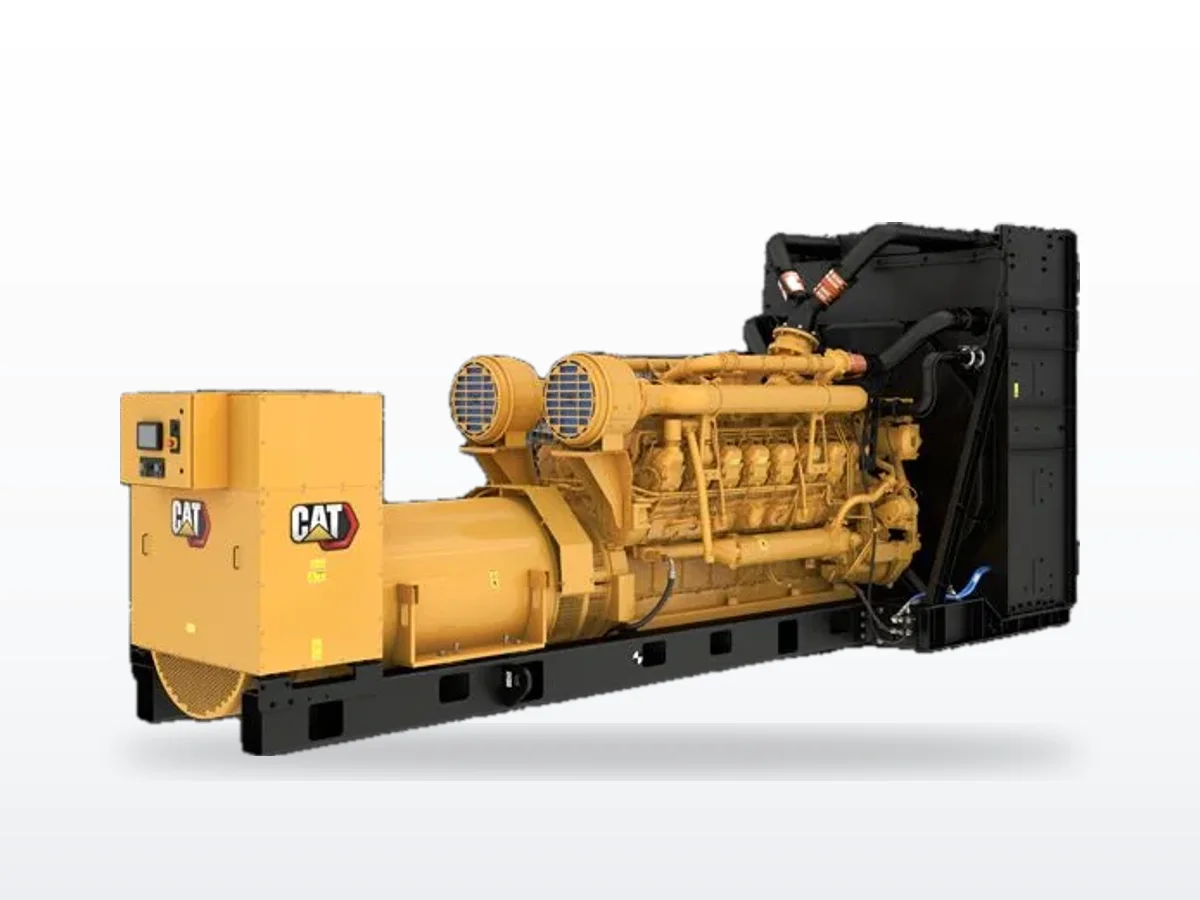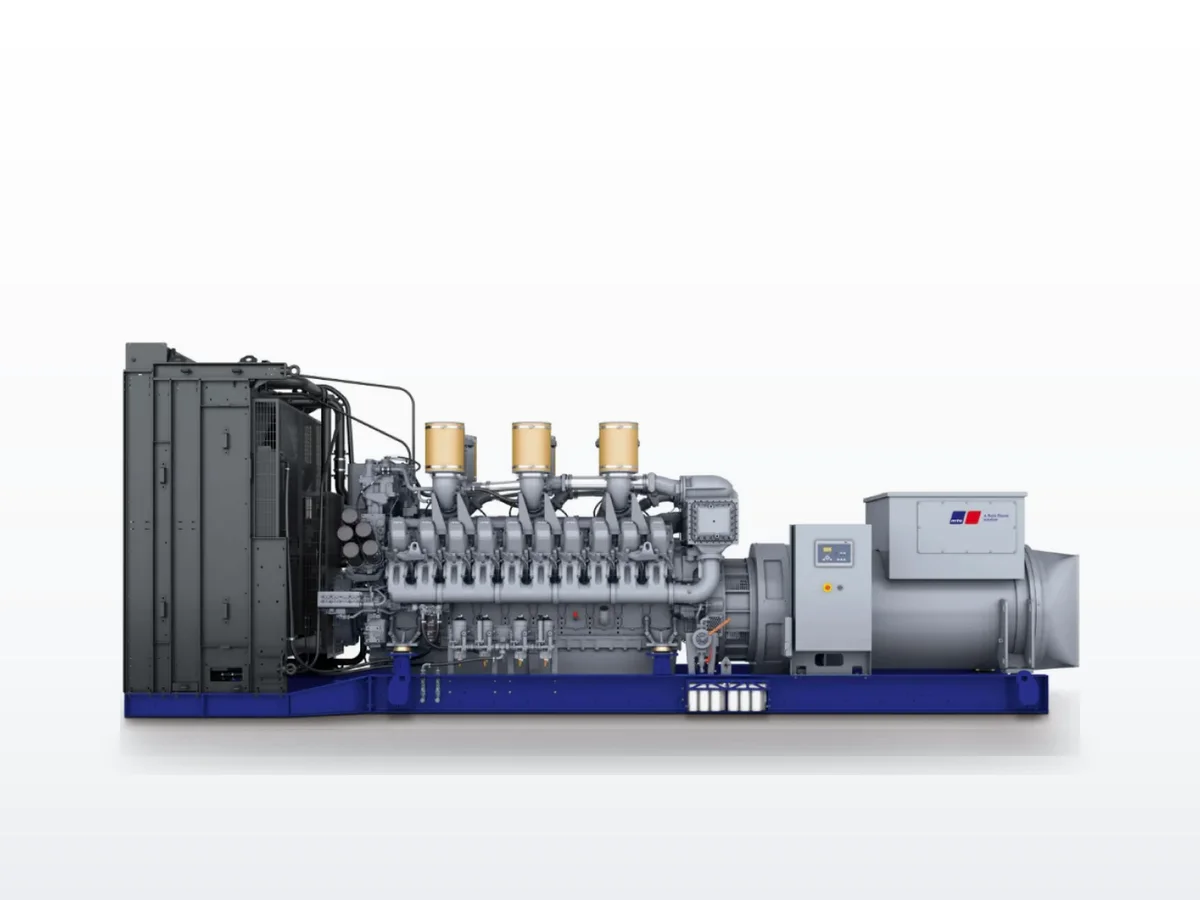
MTU · Series 4000 Diesel

MTU 16V4000 DS2500

2500 kW standby · Diesel · Liquid-cooled

2,500 kW standby diesel generator from MTU (Rolls-Royce). 76.3L V16 engine, EPA Tier 2 + SCAQMD, 380-13,800V. Maximum output from the 16-cylinder Series 4000 platform.

Standby power
2500 kW
Voltage options
380V, 416V, 440V, 480V, 600V, 4160V, 12470V, 13200V, 13800V
Frequency / Phase
60 Hz · 3-phase
Engine
MTU 16V4000G94S · 76.3L
EPA / Emissions
Tier 2
Data Centershospital-largehigh-riseCommercialManufacturingparalleling-arraywater-treatment
Configure & QuoteDownload spec sheet

Overview#

The MTU 16V4000 DS2500 is the flagship of the Series 4000 diesel generator lineup from Rolls-Royce Power Systems. At 2,500 kWe standby, it extracts the maximum output from the proven 76.3-liter V16 platform — the ceiling of what the 16-cylinder architecture delivers before stepping up to the 20V4000 frame for 2,800-3,250 kW applications.

The 16V4000G94S engine (ECU9-generation, replacing the legacy G63 designation) runs at the highest specific output in the Series 4000 family. The same bore (170mm) and stroke (210mm) shared across all Series 4000 variants means parts commonality with the DS2000 and DS2250, but the DS2500's tune pushes the platform to approximately 3,350 bhp — near the metallurgical limit of the 16-cylinder block. This positions the DS2500 as a standby-only rating: no prime or DCCP continuous rating is published, reflecting the higher thermal and mechanical loading.

For facilities requiring 2.5 MW of standby power from a single genset — data centers, large hospital campuses, industrial complexes, and water treatment plants — the DS2500 provides that capacity without the physical size increase of a 20-cylinder engine. EPA Tier 2 + SCAQMD compliance, medium-voltage capability to 13,800V, and NFPA 110 Level 1 acceptance cover the regulatory requirements of the most demanding installations.

When to specify the DS2500 vs paralleled smaller units#

The 2.5 MW single-genset decision involves trade-offs. A single DS2500 provides maximum standby capacity in minimum floor space — one genset, one foundation, one set of switchgear connections. For sites where physical space is the constraint (rooftop installations, dense urban environments, retrofit projects), the DS2500 offers 2.5 MW in the same footprint as the 2 MW DS2000.

However, the DS2500's standby-only rating means it cannot serve continuous-duty applications. For data centers requiring DCCP certification, two options exist: parallel DS2250 units (2,045 kW each, 4,090 kW aggregate) or a single DS2500 at standby with acceptance that continuous loading must stay below the Uptime Institute DCCP threshold. Most hyperscale facilities choose the former for redundancy; single-tenant mission-critical facilities may accept the latter for simplicity.

The 45C ambient rating (vs 50C on the DS2000/DS2250) is another consideration. In hot climates, the DS2500 may require supplemental cooling or ambient temperature monitoring to prevent thermal derating. For Northern California installations where design-day temperatures rarely exceed 40C, this is not a concern.

Competitive landscape at 2,500 kW#

At 2.5 MW, the DS2500 competes directly with the Caterpillar 3516C at maximum output (2,500 kW standby), the Cummins QSK60 at its peak standby rating, and the top of the Kohler KD Series. The 20V4000 platform from MTU itself also overlaps, offering 2,500-3,250 kW from a 20-cylinder frame for sites that prefer continuous-duty ratings at this power level.

Caterpillar's 3516C at 2,500 kW uses a slightly larger displacement (78.6L) and benefits from the most extensive generator dealer network in North America. The MTU's advantage is the three-model platform standardization (DS2000/DS2250/DS2500 share parts) and the SCAQMD compliance without aftertreatment. For California installations, the absence of DPF/SCR eliminates a significant maintenance and reliability variable.

Our service experience#

The DS2500 runs the 16V4000 platform at maximum output, and we see that reflected in reduced intervals between major overhaul components. Where the DS2000 typically reaches 15,000 hours before top-end inspection, the DS2500's higher thermal loading drives that milestone closer to 12,000 hours. Turbocharger bearing condition monitoring becomes more critical — we recommend borescope inspection of turbine wheels at every 4,000-hour service interval rather than waiting for the standard 8,000-hour schedule.

Fuel consumption at full load (approximately 179 gal/hr) means base tank sizing is a critical specification decision. A 24-hour runtime requirement at full load needs 4,296 gallons — typically requiring an external day tank or belly tank larger than the standard integral base fuel cell. We recommend designing for 72 hours of fuel autonomy per NFPA 110 Level 1 requirements: 12,888 gallons of on-site fuel storage with secondary containment.

The 45C ambient rating requires careful coordination with mechanical engineers. Radiator airflow requirements are substantial at full load, and the fan parasitic load at maximum engine output can exceed 120 hp. In enclosed installations, ensure ventilation louver sizing accounts for both combustion air and radiator discharge air with adequate separation to prevent recirculation.
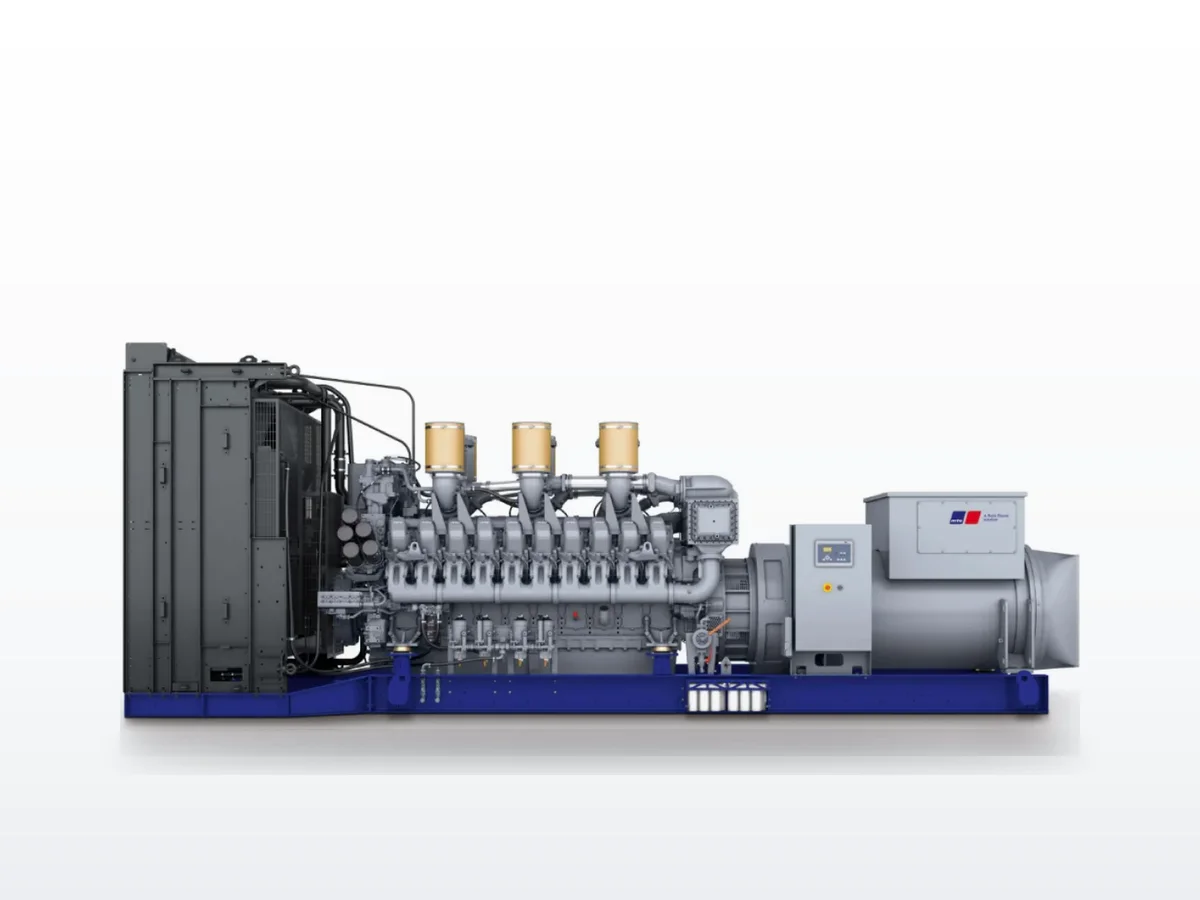
Engineering specifications

Physical

Length
259.6 in
Width
96.3 in
Height
133.5 in
Dry weight
47,154 lb

Acoustic

Enclosure
Open

Fuel system & runtime

Fuel use @ full load
179 GPH
Fuel use @ 75% load
136 GPH
Fuel use @ 50% load
96 GPH

Certifications & compliance

  • NFPA 110 / Level 1 / Type 10
  • UL 2200

Documents & downloads

Spec sheets & manuals

Ready to order this model?

Configure your MTU 16V4000 DS2500

Lock the enclosure, fuel system, transfer switch, and add-ons — we'll confirm pricing, availability, and lead time within one business day. Prefer a free-form quote? That option is still here.

Estimate runtime for the MTU 16V4000 DS2500

Adjust load percent and tank size to estimate runtime. Pre-filled with this model's spec where available.

Estimate runtime on this tank

Estimated runtime

1.4 hours(0.1 days)

Fuel consumption ≈ 138.09 GPH at 75% load. Estimate based on industry-typical 1800 RPM standby curves (≈0.07 GPH/kW at full load). Actual consumption varies by engine, ambient temperature, fuel quality, and tuning.

Service intervals

Manufacturer-recommended intervals for the MTU 16V4000 DS2500 under standby duty. Field intervals may differ based on load profile, ambient conditions, and fuel quality.

Oil & filter
Every 500 hours or 12 months
Air filter
Every 1000 hours
Fuel filter
Every 500 hours
Major overhaul
12,000 hours
Load bank test
Every 12 months

Common failure modes

What we've seen fail on this platform. Use as a service-planning reference, not a diagnostic — actual failure modes depend heavily on duty cycle and maintenance history.

ComponentSymptomTypical hoursSeverity
Centrifugal oil filterFilter bypass warning, elevated oil pressure differential7,000+moderate
Intercooler/aftercooler system (maximum thermal load)Reduced boost pressure, elevated charge air temps, power derating8,000+moderate
Common rail fuel injectors (16 cylinders at max output)Rough running, white/black smoke, power imbalance between cylinders12,000+severe
Turbocharger bearings and wastegate actuatorsBoost overshoot or undershoot, oil consumption increase, audible whine10,000+severe
Starting batteries (4x Group 8D, 24VDC)Slow cranking, failure to start, low CCA8,000+minor
Exhaust flex connectors (elevated stack temperatures)Exhaust leak, cracking at bellows, backpressure increase10,000+minor

Parts cross-reference

starting Battery
4x Group 8D (24VDC, 2,800 CCA total)

Frequently Asked Questions

What is the power rating of the MTU 16V4000 DS2500?
The MTU 16V4000 DS2500 is rated at 2,500 kWe standby at 60 Hz. This is the maximum output available from the 16-cylinder Series 4000 platform. The DS2500 is primarily a standby-rated unit — continuous and prime ratings are not published for this configuration, as the engine operates near its maximum output at 2,500 kW. For continuous-duty applications at this power level, paralleled DS2000 or DS2250 units are recommended.
What engine powers the MTU 16V4000 DS2500?
The DS2500 uses the MTU 16V4000G94S engine (current generation) or 16V4000G63 (legacy designation) — a 76.3-liter, 16-cylinder V-configuration diesel producing approximately 3,350 bhp at 1,800 RPM. It features common rail fuel injection, electronic isochronous governing (ADEC), 16.5:1 compression ratio, and is EPA Tier 2 + SCAQMD certified. The G94S designates the ECU9-generation engine control unit with SCAQMD compliance.
How does the DS2500 compare to the DS2000 and DS2250?
The DS2500 extracts the maximum output from the 76.3L V16 platform. All three models share the same bore, stroke, displacement, and physical footprint — the difference is engine tune and thermal loading. The DS2500 runs at the highest specific output, which means higher thermal stress, slightly reduced overhaul intervals (12,000 vs 15,000 hours), and the standby-only rating (no published prime/DCCP). Choose the DS2500 when you need maximum standby capacity from a single frame; choose the DS2000 or DS2250 when continuous-duty rating is required.
What is the ambient temperature rating for the MTU 16V4000 DS2500?
The DS2500 is typically rated at 45C ambient (113F) rather than the 50C offered on the DS2000 and DS2250. At maximum engine output, the cooling system requires the slightly lower ambient ceiling. Installations in environments that regularly exceed 45C may need to de-rate to DS2250 output levels. The 40C ambient variant offers slightly higher output margin for installations in temperate climates.
Can the MTU 16V4000 DS2500 run on renewable fuels?
Yes. Like all Series 4000 gensets, the DS2500 is approved for hydrotreated vegetable oil (HVO) and Gas-to-Liquid (GtL) fuels meeting EN15940. These drop-in renewable fuels reduce lifecycle carbon emissions up to 90% compared to fossil diesel, without hardware modification or performance derating.

Compatible equipment

More in the Series 4000 Diesel

Rolls-Royce Power Systems megawatt-class diesel — 1250 to 2500 kW on MTU 4000-series V-engines for data centers and mission-critical facilities.

Similar models

MTU

MTU 16V4000 DS2250

2,250 kW standby / 2,045 kW DCCP — true 2 MW continuous from 76.3L V16. Same footprint as DS2000/DS2500, EPA Tier 2 + SCAQMD.

2.3 MW standby · Diesel · Liquid-cooled

2,250 kW standby / 2,045 kW prime diesel generator from MTU (Rolls-Royce). 76.3L V16 engine, EPA Tier 2 + SCAQMD, 380-13,800V. Mid-range 16-cylinder Series 4000 for data center and mission-critical applications.

Tier 23-phasedata-centerhospital-large

MTU

MTU 20V4000 DS2800

2,800 kW diesel standby — MTU 20V4000 95.4L V20. Medium/high-voltage to 13.8kV, ADEC ±0.25%, 20K-hr overhaul, 186 gph.

2.8 MW standby · Diesel · Liquid-cooled

2800 kW diesel standby generator with MTU 20V4000G83 95.4L 20-cylinder V common-rail engine, EPA Tier 2, 380V–13.8kV including medium voltage, ADEC governor, 7626 x 3099 x 3569 mm, 62,056 lb.

Tier 23-phasecommercial-standbyindustrial-standby
Caterpillar Cat 3516C 2.5 MW liquid-cooled standby generator

Caterpillar

Cat 3516C

2500 kW diesel with CAT 3516C V-16. EPA Tier 4 Final. Best resale in class. Paralleling for multi-MW arrays.

2.5 MW standby · Diesel · Liquid-cooled

2500 kW diesel standby generator with Cat 3516C V-16 engine. The largest Cat genset platform for mission-critical data centers and industrial power.

Tier 23-phasedata-centerhospital-large

Need service or parts for the MTU 16V4000 DS2500?

We service every major OEM and stock genuine parts for the most common models.