
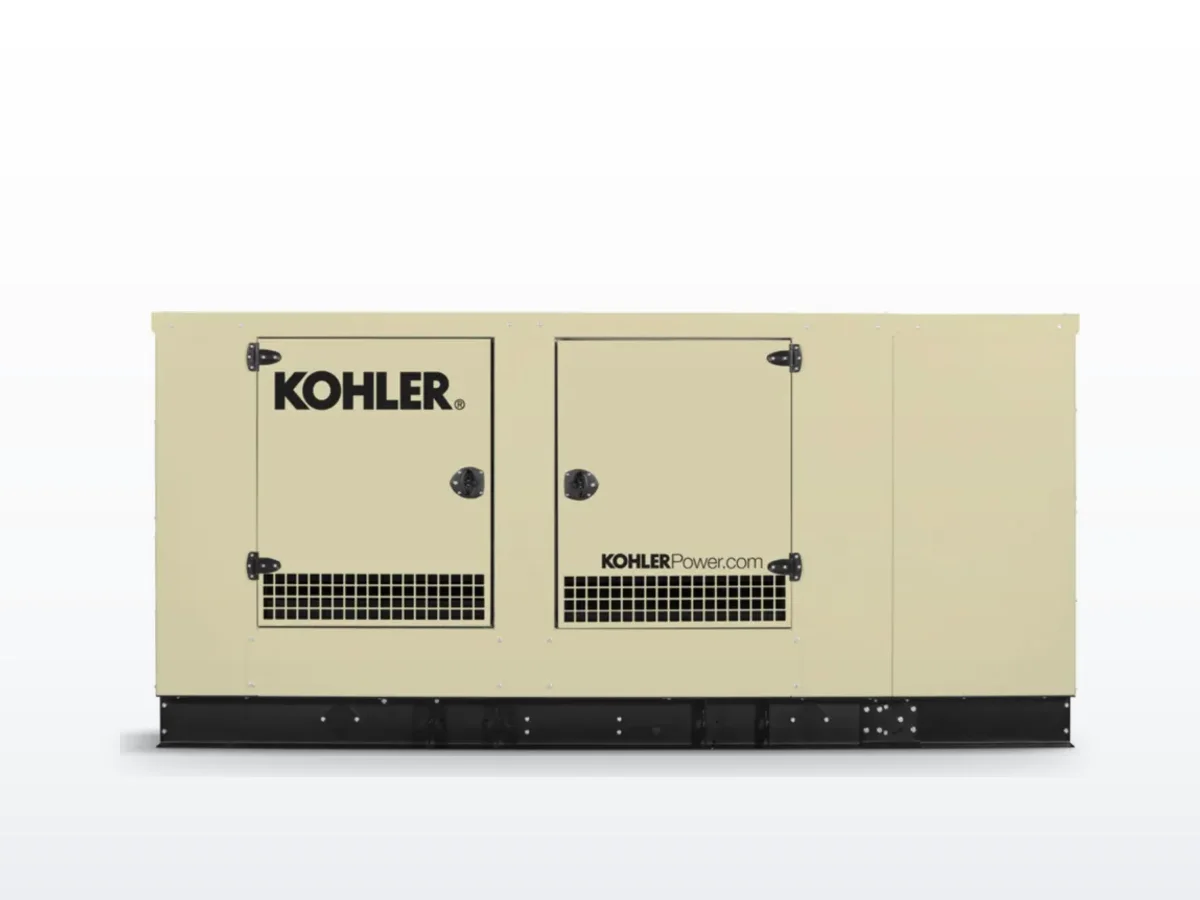
Series Overview#
The Kohler RZX Series is the open-frame (skid-mounted) industrial LPG generator line from Kohler, spanning 190 to 400 kW standby across six models. These units use the same Doosan and PSI/Doosan engine platforms as the enclosed REZX Series — the fundamental difference is the configuration: RZX generators are delivered without an enclosure, designed for installation inside dedicated generator rooms, mechanical buildings, or industrial structures that provide weather protection.
The open-frame design offers installation advantages in situations where the mechanical room is purpose-built for the generator. Without an enclosure, the unit is easier to install, service, and integrate with building mechanical systems. It also reduces the installed footprint slightly compared to an enclosed equivalent. However, it requires that the installation location provide adequate combustion air, exhaust routing, and access for maintenance — design considerations that the enclosed REZX handles internally.
Engine platform selection follows output class. The 180RZXB and 200RZXB use the Doosan D111TIC. The 250RZXB steps up to the D146L. The RZXD models — 300RZXD, 350RZXD, and 400RZXD — use PSI/Doosan engines: D183L at 300–350 kW and D219L at 400 kW. The RZXB-to-RZXD transition also brings PSI/Doosan's broader dual stationary/mobile emergency certification, though for fixed indoor installations this distinction is rarely a primary selection criterion.
All six RZX models operate at 1800 RPM and support 120/208V or 277/480V three-phase output. LPG is the only fuel type available in this series — for natural gas in an open-frame configuration, other Kohler product lines should be consulted.
How to Choose#
190–260 kW: RZXB models with Doosan D111TIC and D146L. The 180RZXB (rated 190 kW standby) and 200RZXB use the D111TIC, while the 250RZXB (260 kW) steps up to the D146L. Select based on your load calculation after demand factor analysis. If your calculated load sits between 170 and 200 kW, the 200RZXB provides adequate standby margin without oversizing.
300 kW: 300RZXD. The step from RZXB to RZXD at 300 kW brings the PSI/Doosan D183L engine. If your load requirement is in the 250–280 kW range and you prefer not to use the full 300 kW unit, revisit the 250RZXB before committing to the next engine class — oversizing gaseous generators by more than 25% can cause wet-stacking-equivalent rich-fuel symptoms at sustained light loads.
350–400 kW: RZXD models. The 350RZXD (355 kW, D183L) and 400RZXD (400 kW, D219L V12) complete the lineup. The 400RZXD represents the upper boundary of the RZX Series — for requirements above 400 kW in an open-frame configuration, the REZXD enclosed series goes to 500 kW and would typically be the better choice if a weatherproof enclosure is acceptable.
Common Applications#
-
Commercial buildings with dedicated generator rooms. Office buildings and mid-rise commercial properties that have existing mechanical rooms with adequate combustion air and exhaust infrastructure commonly specify RZX open-frame units for their lower installed cost versus the enclosed equivalent.
-
Healthcare facilities with indoor mechanical spaces. Hospitals and medical office buildings that meet code requirements for indoor generator installation (NFPA 110 Level 1 or 2) use RZX generators integrated directly into their mechanical infrastructure.
-
Education campuses. Universities and large school campuses with centralized utility plants housing multiple mechanical systems frequently install open-frame generators alongside other building systems in dedicated rooms.
-
Large retail facilities. Anchor retail tenants and large-format stores with on-site LPG supply and existing mechanical infrastructure use RZX generators for refrigeration and HVAC backup.
-
Light industrial operations. Manufacturing facilities and light industrial buildings where the generator can be housed within the main structure use the open-frame configuration to simplify integration with building-mounted electrical distribution.
Service & Maintenance#
The RZX Series uses 250-hour oil change intervals — half the interval of diesel units in comparable power classes. For a generator exercising weekly and running occasional outages, this typically equates to annual or near-annual oil changes. Given the low runtime typical of emergency standby generators, the annual calendar-based trigger is usually the binding constraint.
Spark plug replacement every 500 hours is the most time-sensitive maintenance item in this series. Spark plugs are the primary failure mode for misfire codes, cylinder dropout, and rough idle in the RZX fleet — symptoms that typically appear at or slightly beyond the 500-hour threshold. In practice, many facilities defer this work and then experience misfires during the next actual outage. Treat spark plug service as a hard interval, not a soft guideline.
Turbocharger seal wear typically manifests around 10,000 hours: oil in the intake, blue smoke, and reduced boost pressure. The fuel pressure regulator and vaporizer are the next significant wear items at approximately 8,000 hours — hard starting and erratic idle are the typical indicators. Starting batteries should be replaced every two to three years regardless of apparent health, as a battery failure is the most common cause of failed exercise tests across the RZX fleet.
Application Guidance#
The Kohler RZX Series is purpose-built for indoor mechanical room installations requiring LPG standby power in the 190–400 kW range. The open-frame skid configuration is the right choice when the facility already has a dedicated generator room with adequate combustion air supply, exhaust routing, and code-compliant fuel system infrastructure — skipping the enclosure reduces installed cost and simplifies integration with building mechanical systems. The Doosan and PSI/Doosan engine platforms are well-supported in North America, and the RZXD models (300–400 kW) carry broader EPA certification that covers stationary and mobile emergency applications, which can simplify permitting in some jurisdictions. All six models are three-phase only at 120/208V or 277/480V — LPG is the exclusive fuel type across the series.
This series is not appropriate when outdoor installation is required — the Kohler REZX Series is the enclosed weatherproof equivalent with identical engine platforms covering 190–500 kW, adding the 450REZXD and 500REZXD models not available in the open-frame RZX line. Natural gas standby in this power range is not served by the RZX; the 300REZXC (enclosed natural gas) or the CAT DG Series are the appropriate alternatives. For facilities evaluating whether to specify an indoor RZX or an outdoor REZX, the determining factor is whether the mechanical room meets NFPA 37 and NFPA 110 installation requirements for fuel-fired equipment — if it does, the RZX is the lower-cost path; if not, the enclosed REZX pad installation is the compliant solution. Above 400 kW, the REZX Series continues to 500 kW; beyond that, the Kohler Industrial Gaseous 500REZK covers the 500 kW natural-gas-only upper boundary.