Series Overview#
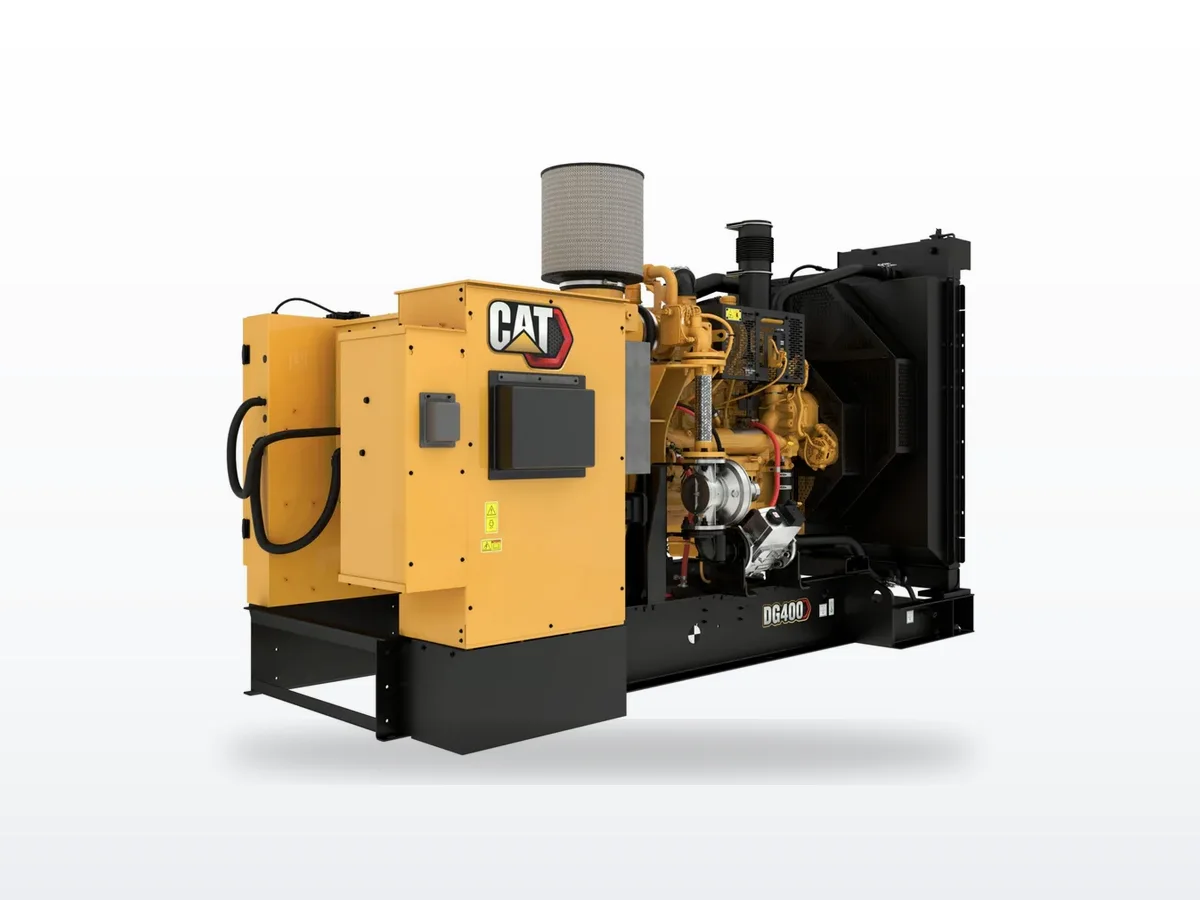
The Cat DG Series covers 200 to 400 kW on natural gas and propane across two models: the DG200 (200 kW standby / 157 kW prime) and the DG400 (400 kW standby / 350 kW prime). The defining characteristic of the DG Series is its EPA certification for both emergency and non-emergency stationary applications — unlike conventional emergency standby generators, DG Series units can operate in demand response programs, peak shaving applications, and other non-emergency use cases without violating emissions permit conditions. This dual-certification significantly expands the operational and economic use cases beyond traditional backup power.
The DG200 is built on a 10.3-liter V8 turbocharged-aftercooled engine with electronic spark ignition, while the DG400 uses the Cat CG18 inline-6 with ADEM A4 electronic controls and air-to-air aftercooling. Both models accept natural gas as the primary fuel; the DG200 additionally supports propane vapor operation at reduced output ratings. All DG Series configurations support 277/480V and 346/600V three-phase outputs alongside lower-voltage single-phase options.
For commercial facilities and light industrial properties evaluating natural gas generators, the DG Series sits in a practical middle ground: larger than residential whole-home generators, smaller than the Cat G3500 Series cogeneration platforms, and uniquely positioned for the demand response and non-emergency use case that most standby generators cannot access.
How to Choose#
DG200 vs DG400: The DG200 serves 200 kW applications with a V8 engine in a more compact package that also accepts propane. The DG400 at 400 kW uses the CG18 inline-6 — a larger displacement platform with air-to-air aftercooling. If your load is comfortably below 300 kW and propane fuel capability is a requirement, the DG200 is the appropriate choice. If you need 300–400 kW from a natural gas unit, the DG400 is the clear selection.
Emergency standby vs demand response: If the unit will operate exclusively for utility outage backup and monthly load testing, any EPA-compliant natural gas generator serves that need. The DG Series' non-emergency certification becomes meaningful when you want to participate in utility demand response programs, peak pricing arbitrage, or behind-the-meter dispatch programs that require operating hours beyond emergency backup limits. Verify your utility's demand response program requirements against the DG Series certification before specifying.
Prime power applications: Both models carry prime power ratings (DG200 at 157 kW prime, DG400 at 350 kW prime). For applications requiring extended continuous operation — planned outages, temporary power, or remote sites — prime ratings define the unit's sustained output capability and should be the basis for sizing, not standby ratings.
Voltage: Both models share the same voltage range. For municipal applications where 277/480V three-phase is standard, both models are directly compatible. The 208/120V and 240/120V options cover single-phase and three-phase commercial distribution systems.
Common Applications#
-
Commercial standby with demand response: Commercial properties — office buildings, retail developments, and light industrial tenants — that want natural gas backup power and the ability to participate in utility demand response programs specify the DG Series for its dual-certification. Revenue from demand response participation can offset the cost premium over a conventional emergency-only generator.
-
Demand response programs: Utility and grid operator demand response programs require dispatchable generation that can be called upon to reduce net load on the distribution system. The DG Series' non-emergency EPA certification enables enrollment in these programs without operating hour restrictions.
-
Prime power: Remote facilities, municipal water treatment sites, and light industrial operations that need a reliable natural gas generator for extended planned power needs specify the DG Series on its prime power rating.
-
Light industrial standby: Light manufacturing and industrial properties that prefer natural gas over diesel for fuel management simplicity and avoid diesel storage permitting specify the DG400 for the 300–400 kW standby class.
-
Municipal applications: Government facilities, pump stations, and municipal service buildings that operate on natural gas distribution systems specify DG Series generators to align generator fuel with existing site infrastructure.
Service & Maintenance#
The DG Series shares Cat's standard natural gas generator service schedule: oil changes every 500 hours or 12 months, and air filter service every 1,000 hours. For units that participate in demand response programs and accumulate significant annual hours, the 500-hour oil change interval means more frequent service visits than a conventional standby generator — budget service costs accordingly if the unit runs 1,000+ hours per year in demand response operation.
Five failure modes are documented across the DG Series. Spark plug misfiring is the most common issue on both models, appearing at approximately 2,000 hours — replace plugs as complete sets on schedule to prevent rough running, hard starting, and elevated emissions. Fuel regulator issues on the DG200 (rich/lean hunting, unstable speed) develop at approximately 10,000 hours and require carburetion or regulator adjustment. Ignition coils on the DG200 can develop intermittent misfire symptoms at approximately 15,000 hours. Battery degradation on the 12V starting system causes the majority of failed-start events during actual outages — test batteries semi-annually and replace on a scheduled cycle. The air-to-air aftercooler on the DG400 requires monitoring for elevated charge air temperatures; high inlet temperatures cause detonation risk and power derate that indicates the aftercooler needs cleaning or replacement.
For units enrolled in demand response programs with high annual hours, track both calendar time and operating hours to ensure service intervals are not deferred. The ADEM A4 sensors on the DG400 can develop fault codes and derate events at approximately 20,000 hours — document sensor history and plan for sensor inspection at major service intervals.
Application Guidance#
The CAT DG Series is purpose-built for commercial facilities and light industrial properties that need natural gas standby power in the 200–400 kW range with the option to participate in utility demand response programs or run prime power applications. The dual EPA certification for emergency and non-emergency stationary operation is the defining feature — it is what separates the DG Series from conventional emergency standby generators and makes it economically valuable for facilities that can offset capital cost through demand response revenue. The DG200's propane capability adds a useful fuel flexibility option for facilities without natural gas service, and its compact V8 package suits constrained installation sites. The DG400 on the CG18 inline-6 with ADEM A4 controls is a modern platform with current EPA certification superior to the legacy G-Series 3400 architecture.
This series is not appropriate when diesel fuel is acceptable and the fuel-management simplicity of gaseous fuel is not a priority — the CAT C-Series diesel generators at comparable output (C7 at 200 kW, C15 at 500 kW) provide higher output ceilings, broader voltage options, and a more established dealer service history. For natural gas requirements above 400 kW, the CAT G-Series (G3406 at 300 kW, G3412 at 512 kW) extends the range, and the Kohler REZX Series and Cummins N6 commercial gas are the primary alternatives at 200–500 kW on gaseous fuel. Buyers who do not need the non-emergency certification should compare total installed cost against the DG Series' premium, as the non-emergency operating authorization only adds value when demand response enrollment is actually planned and the utility program is accessible.