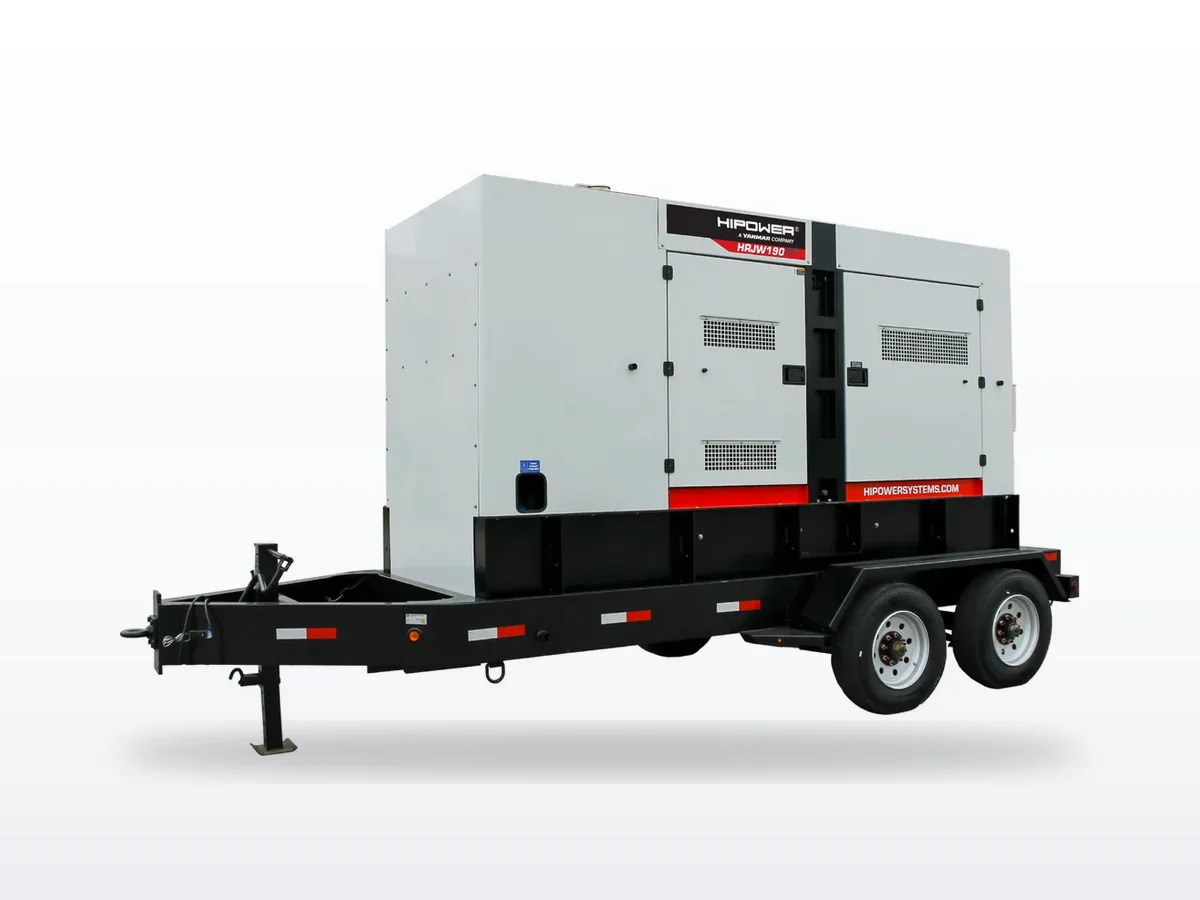
Series Overview#
The Hipower HRJW Series is a nine-model line of John Deere-powered trailer-mounted diesel generators covering 60 to 286 kW across three engine families. All models are built in Olathe, Kansas on Stamford alternators and mounted on trailer frames for highway towing, making the HRJW the primary John Deere mobile option in Hipower's rental and construction-targeted lineup. The series is rated for rental fleet, construction site, and emergency temporary power applications across all nine models.
The engine platform steps with output. The HRJW-75 through HRJW-145 (60–116 kW standby) use the John Deere 4045 four-cylinder 4.5-liter platform — the same engine family as the stationary HJW-55 through HJW-130 — in a trailer-mounted format. These compact units are towable by a standard full-size pickup and suitable for smaller construction sites, outdoor events, and emergency response. At 166 kW, the HRJW-190 transitions to the John Deere 6068 six-cylinder 6.8-liter engine, adding cylinder count for the torque demands of the 150–200 kW class. The HRJW-310 and HRJW-325 (248 and 286 kW) use the John Deere 6090 nine-liter six-cylinder — the same engine family as the stationary HJW-225 through HJW-410 — delivering the series' largest output in a trailer-mobile format.
The HRJW shares its engine platform with the stationary HJW series, which means John Deere dealer service and parts are available across the same network — an operational advantage for rental operators maintaining mixed stationary and mobile fleets.
How to Choose#
By output tier: The HRJW-75 through HRJW-145 (60–116 kW) cover small-to-mid construction site temporary power and event power. These are the most towable units in the series — tow vehicle requirements are modest with the 4.5L four-cylinder engine package. The HRJW-190 and HRJW-240 (166 and 211 kW) step into mid-large temporary power requiring the six-cylinder engine's torque output. The HRJW-310 and HRJW-325 (248 and 286 kW) are the largest-output HRJW units, sized for large construction sites and industrial temporary power.
Voltage requirements: The four-cylinder models (HRJW-75 through HRJW-145) support both 120/240V and 277/480V. The six-cylinder models (HRJW-190 and above) are 277/480V only. Confirm site service voltage before specifying, as 120/240V-only sites require the compact models.
Fleet standardization: Rental operators standardizing on John Deere engine service can maintain HRJW mobile units alongside stationary HJW units through the same John Deere dealer network — a logistical advantage over maintaining a mixed multi-brand fleet.
Common Applications#
- Rental fleet: All nine models are rated for rental fleet deployment. The John Deere engine platform provides wide parts and service coverage, reducing downtime when units are serviced between deployments.
- Construction site temporary power: The full range covers 60 to 286 kW of towable construction power, from single-trade job sites (HRJW-75) to major commercial construction requiring 250+ kW of temporary service (HRJW-310, HRJW-325).
- Emergency temporary power: Emergency response scenarios — utility outages, natural disasters, critical facility failures — where towable power must be on-site within hours are the core emergency use case for the HRJW series across all nine models.
Service & Maintenance#
All nine HRJW models share: oil change at 250 hours or 12 months; fuel filter at 500 hours; air filter at 500 hours. The 250-hour oil interval is appropriate for the mixed rental and construction duty cycle.
Three failure modes are consistent across the full series. Trailer road and tail lights are subject to corrosion and wiring damage from outdoor storage between deployments — inspect all lighting connections and lenses before each deployment; inoperative trailer lights are a DOT compliance issue for highway towing. Fuel filters in rental service are contaminated by portable fuel dispensing equipment at job sites; the 500-hour fuel filter interval should be shortened to 250 hours for units in active rental service where fuel source quality is variable. Starting batteries deep-discharge during storage between deployments; connect a battery maintainer whenever the unit is not in active service to prevent the dead-battery call at the next deployment.
Application Guidance#
The Hipower HRJW Series is purpose-built for rental fleet and construction site temporary power requiring trailer-mounted John Deere diesel in the 60 to 286 kW class — nine models spanning the compact 4045 four-cylinder through the 6090 nine-liter six-cylinder, all highway-towable with Stamford alternators. The John Deere engine platform is the series' defining operational advantage: agricultural and construction equipment dealers provide national parts and service coverage, making the HRJW a natural choice for rental operators who maintain John Deere-powered equipment fleets and want consolidated service relationships. Emergency response deployments — where a unit must be on-site within hours and serviced quickly between calls — benefit from this parts network depth.
The HRJW is not Tier 4 Final confirmed, which limits its use on California CARB-regulated job sites and regulated air districts requiring current-tier mobile equipment. For those applications in the 286–352 kW range, the Hipower HRFW Series on FPT Industrial Tier 4 Final engines is the appropriate specification. Below 60 kW, the Hipower HRIW Series (Isuzu, 22–110 kW, Tier 4 Final) covers compact pickup-towable construction power with confirmed emissions compliance. Above 286 kW on the trailer side, the Hipower HRVW Mobile Series (Volvo Penta, 544–1,210 kW) picks up large-frame requirements. For competing mobile diesel in this class, the Airman SDG Series and Atlas Copco QAS Series are the primary rental market alternatives.