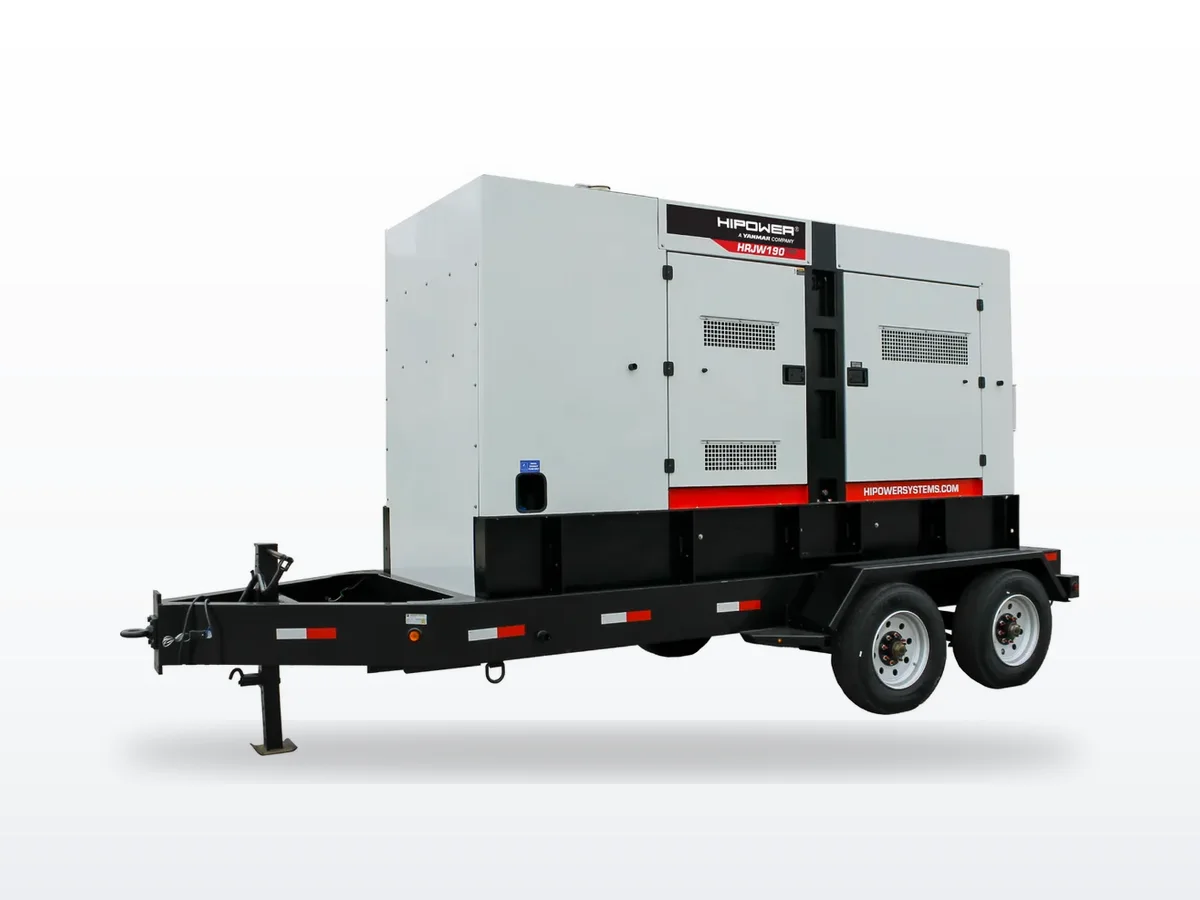
The Hipower HRJW-190 is a 166 kW standby (152 kW prime) rental-ready trailer-mounted diesel generator built in Olathe, Kansas. Powered by a John Deere 6.8L inline-6 turbocharged diesel engine from the 6068HF285 family and paired with a Stamford alternator, this is the first unit in the HRJW lineup to use the larger six-cylinder engine. EPA Tier 3 certified, the HRJW-190 serves construction sites, large outdoor events, and emergency deployment scenarios requiring 150-170 kW of towable temporary power.
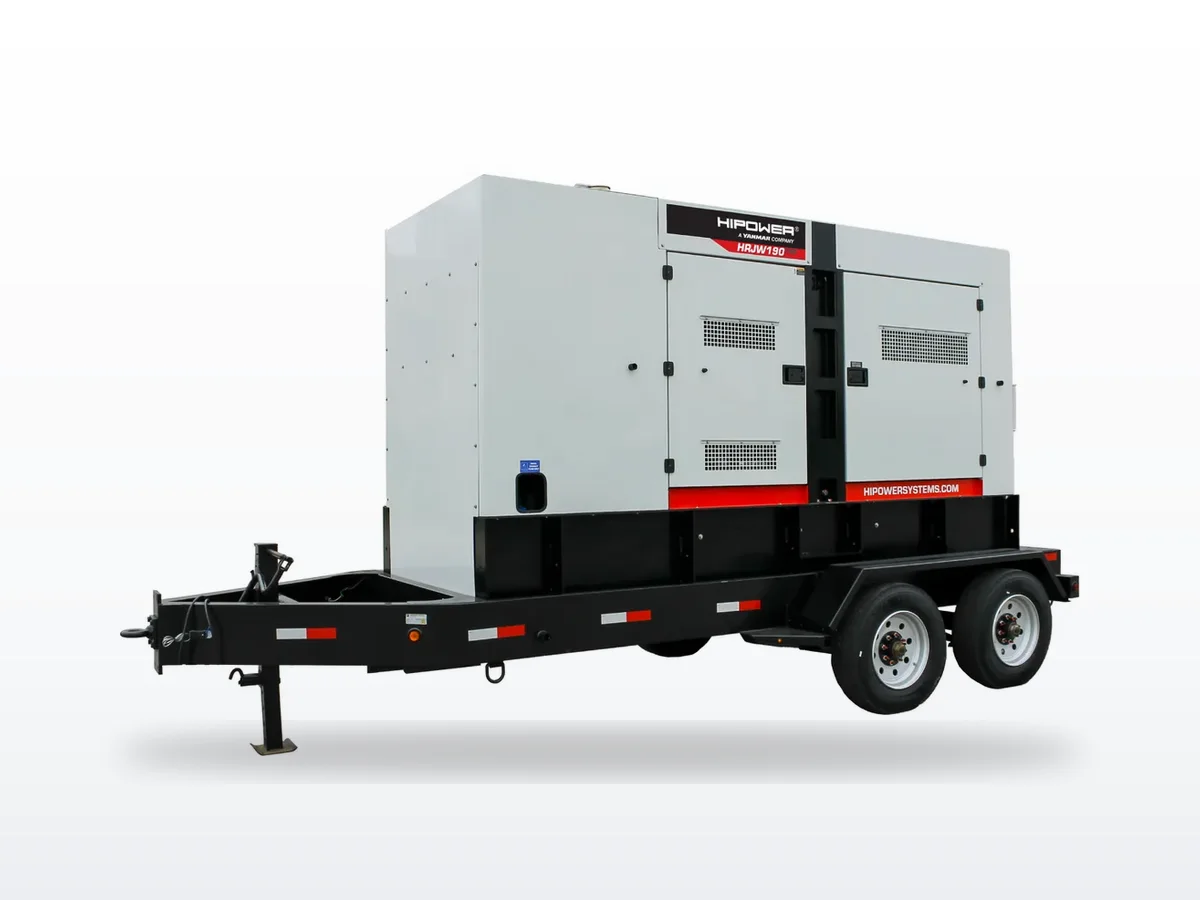
The HRJW-190 is trailer-mounted with DOT-compliant road and tail lights, safety chains, and a front jack stand. The lockable sound-attenuated enclosure secures the machine between deployments and reduces ambient noise. An integrated diesel fuel tank eliminates external tank logistics for shorter deployments, and the onboard hours meter enables accurate maintenance scheduling across a rental fleet. Remote start provisions allow the unit to be brought online from a safe standoff distance on active job sites.
At 166 kW, the HRJW-190 typically rides on a tandem-axle trailer to distribute weight appropriately — confirm trailer configuration for your specific unit before planning transport and tow vehicle selection. Tandem-axle units require a heavier tow vehicle but provide more stability at highway speed.
The step from 4.5L inline-4 to 6.8L inline-6 at the 190 kVA size class gives the HRJW-190 substantially more torque headroom, which translates to better load-acceptance performance on job sites where loads vary rapidly. The John Deere 6068 engine family is widely deployed in construction equipment, agricultural machinery, and marine applications — parts and qualified service are available from John Deere dealers throughout Northern California.
At 75% load, the HRJW-190 consumes approximately 11.6 gallons per hour based on the 0.07 gal/hr/kW Tier 3 reference. Verify against OEM spec sheet data for fuel supply planning on extended deployments.
Rental service demands the same compressed maintenance schedule as the smaller HRJW units: oil and fuel filter changes at 250-hour intervals rather than the 500-hour standby cadence. The 6.8L engine has a larger oil sump than the 4.5L units — confirm oil volume from the service manual to ensure the correct quantity is used at each oil change. Fuel filter changes at 250 hours guard against contamination from portable job-site diesel dispensing.
Trailer lighting inspection before each deployment and battery maintenance during storage periods remain standard practices that prevent the most common rental fleet service calls.
OnPoint deploys HRJW units in the 150-170 kW class for larger commercial construction projects and event power where a single 100 kW unit is undersized but a 250 kW unit would be oversized and inefficient. The John Deere 6.8L engine's field track record in construction applications gives our customers confidence in runtime reliability. Tier 3 pricing on HRJW-190 units offers significant cost savings versus Tier 4 Final alternatives for projects where emissions tier is not a hard constraint. Contact us for current availability and deployment details.
Request a quote
Get pricing & lead time on the Hipower HRJW-190
Tell us about the application — kW, voltage, application, install timeline — and we'll respond within one business day with budgetary pricing, lead time, and any sizing notes.
Adjust load percent and tank size to estimate runtime. Pre-filled with this model's spec where available.
Estimate runtime on this tank
Estimated runtime
22.3 hours(0.9 days)
Fuel consumption ≈ 8.96 GPH at 75% load. Estimate based on industry-typical 1800 RPM standby curves (≈0.07 GPH/kW at full load). Actual consumption varies by engine, ambient temperature, fuel quality, and tuning.
Service intervals
Manufacturer-recommended intervals for the Hipower HRJW-190 under standby duty. Field intervals may differ based on load profile, ambient conditions, and fuel quality.
Oil & filter
Every 250 hours or 12 months
Air filter
Every 500 hours
Fuel filter
Every 500 hours
Major overhaul
≈ 20,000 hours
Common failure modes
What we've seen fail on this platform. Use as a service-planning reference, not a diagnostic — actual failure modes depend heavily on duty cycle and maintenance history.
Component
Symptom
Typical hours
Severity
Trailer lighting
Road/tail lights corrode from outdoor storage — inspect before each deployment
2,000+
minor
Fuel filter
Contamination from portable fuel dispensing at job sites — change at 250 hours in rental service
250+
minor
Starting battery
Deep discharge during storage between deployments — use battery maintainer when not in service
4,380+
minor
Frequently Asked Questions
What are the standby and prime ratings for the HRJW-190?
The HRJW-190 is rated at 166 kW standby and 152 kW prime. These are the nominal kW ratings; the '190' designation refers to the kVA class (190 kVA at 0.8 power factor). Confirm with the spec sheet for your specific unit.
What does 'rental-ready' mean on the HRJW-190?
Rental-ready means the HRJW-190 is trailer-mounted with DOT road and tail lights, safety chains, and a front jack stand. The lockable sound-attenuated enclosure, integrated fuel tank, hours meter, and remote start provisions allow rapid deployment to construction sites or events without additional equipment.
What engine does the HRJW-190 use?
The HRJW-190 uses a John Deere 6.8L inline-6 turbocharged diesel engine from the 6068HF285 family, running at 1,800 RPM. This is a larger displacement engine than the 4.5L 4045 family used in the smaller HRJW units, providing more torque and thermal headroom for the 150-170 kW output range.
How often does the HRJW-190 require service during a rental deployment?
In rental service, plan on oil and fuel filter changes every 250 hours. The 6.8L inline-6 has a larger oil capacity than the 4.5L units, so confirm the oil volume from the service manual before scheduling maintenance. Air filter inspection at 500 hours. Trailer lights and battery before each deployment.
Does the HRJW-190 meet California emissions requirements?
The HRJW-190 is EPA Tier 3 certified — it predates Tier 4 Final requirements. For California projects in air districts requiring Tier 4 Final off-road diesel, a newer unit would be required. Contact us to assess applicability for your specific project and location.
How does the HRJW-190 compare to a Doosan G150 or Atlas Copco QAS 150?
The HRJW-190 at 166 kW standby is slightly larger than a G150 or QAS 150, making it a better fit when loads are expected to peak near 150 kW. The John Deere 6.8L engine is common across multiple OEM platforms in this size range, giving comparable dealer support. Hipower's US assembly and Stamford alternator pairing differentiate it from import-assembled competitors.
Similar models
Hipower Systems
Hipower HFW-160
FPT N67 at its 160 kW apex — EPA Tier 4 Final, single- and three-phase, US-built for demanding commercial and industrial standby in California-regulated environments.
160 kW standby · Diesel · Liquid-cooled
Industrial standby for mid-size manufacturing, multi-tenant office, and healthcare facilities requiring 160 kW with EPA Tier 4 Final certification.
160 kW standby diesel generator with FPT N67 inline-6 engine and Stamford alternator. EPA Tier 4 Final. US manufactured in Olathe, Kansas.
155 kW diesel standby generator. John Deere 6068HF285 family engine, Stamford UCI 274 alternator. EPA Tier 3. US manufactured in Olathe, Kansas.
Tier 33-phasecommercial-standbyindustrial-standby
Hipower Systems
Hipower HFW-180
FPT C87 inline-6 steps up displacement to 8.7L at 180 kW — EPA Tier 4 Final, US-built, with the thermal headroom to handle demanding industrial standby loads.
180 kW standby · Diesel · Liquid-cooled
Industrial standby for manufacturing facilities, large office buildings, and data center support requiring 180 kW three-phase with full California emissions compliance.
180 kW standby diesel generator with FPT C87 8.7L inline-6 engine and Stamford alternator. EPA Tier 4 Final. US manufactured in Olathe, Kansas.