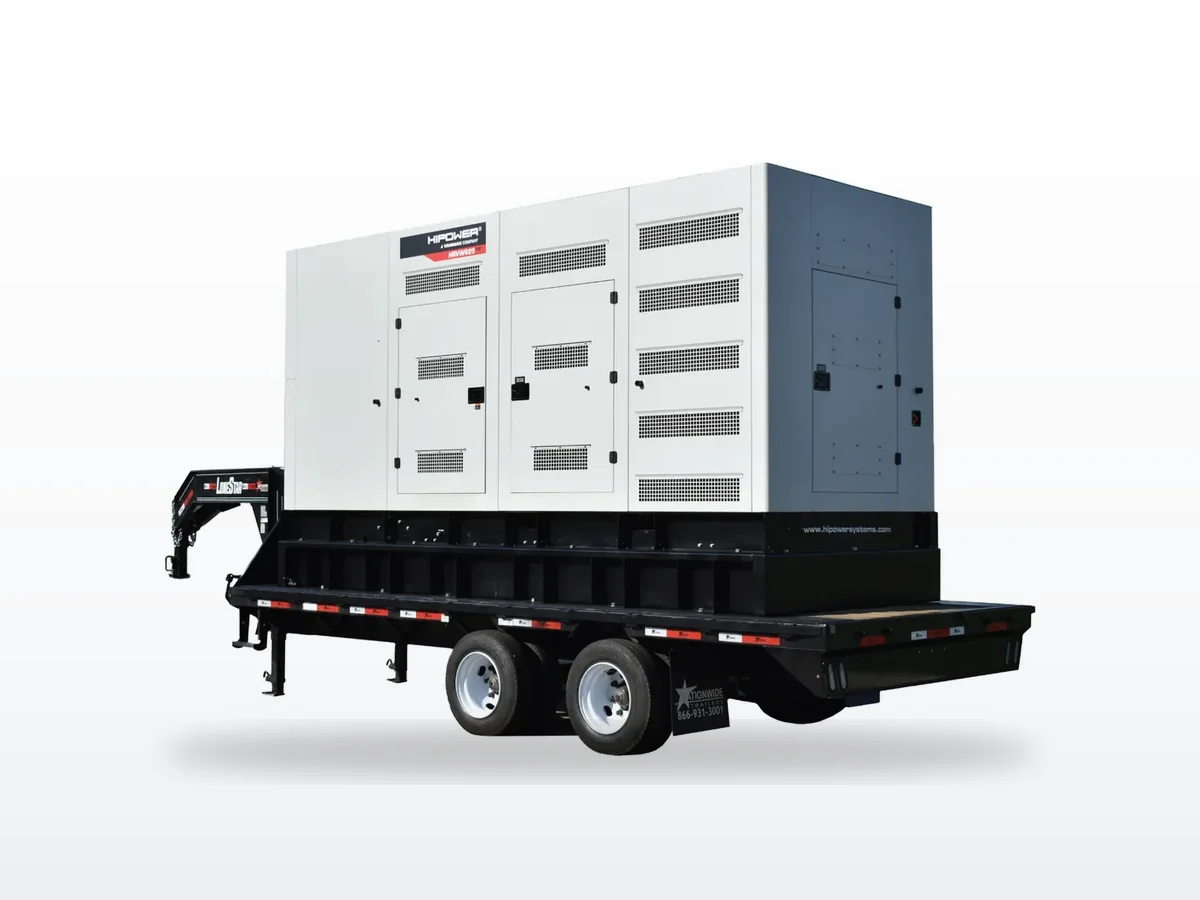
Series Overview#
The Hipower HRVW Mobile Series is the company's large-format trailer-mounted diesel generator line, covering 544 to 1,210 kW (625 to 1,375 kVA) across four models. All units use Volvo Penta diesel engines — inline six-cylinder turbocharged platforms engineered specifically for generator duty — built into trailer-mounted packages that are highway-towable and deployable at any site accessible by road. The series targets Northern California data centers requiring emergency or bypass power, major construction projects with large temporary power demands, and high-capacity rental fleet applications.
The lineup divides cleanly into two engine tiers. The HRVW-625 (544 kW standby / 500 kW prime) and HRVW-685 (605 kW standby / 550 kW prime) use Volvo Penta TAD1353GE-family engines — 13.0-liter inline six-cylinders with a power density well-matched to the 500–600 kW class. The HRVW-1250 (1,088 kW standby / 1,000 kW prime) and HRVW-1375 (1,210 kW standby / 1,100 kW prime) step up to Volvo Penta TWD1644GE-family engines — 16.1-liter units delivering over 1 MW of standby capacity from a highway-mobile platform.
Hipower assembles the HRVW at its 515,000 sq ft facility in Olathe, Kansas. Enclosures, fuel tanks, and controls are in-house built — the same vertical integration as Hipower's stationary line. All units operate at 277/480V three-phase, 60 Hz. The 250-hour oil and fuel filter service interval reflects the more intensive duty cycle typical of rental and temporary deployment.
How to Choose#
By standby capacity: The two lower models — HRVW-625 and HRVW-685 — are the right starting point for deployments requiring 500–600 kW. The 61 kW difference between them (544 vs. 605 kW standby) is meaningful for applications with tightly calculated load schedules; spec the HRVW-685 where margin above 544 kW is needed. For over-1-MW requirements, the HRVW-1250 and HRVW-1375 are the only options in the series — the HRVW-1375 delivers 1,210 kW standby, 10% more headroom than the HRVW-1250's 1,088 kW.
Prime vs. standby rating: Both lower and upper models publish separate standby and prime ratings (e.g., 544 kW standby / 500 kW prime for the HRVW-625). For extended temporary power deployments running continuously for days, the prime rating is the correct load limit to design against.
Voltage: All HRVW units output 277/480V three-phase only. If the deployment site requires a different voltage, a step-down transformer will be needed — confirm this before dispatch.
Service access: Rental operators deploying these units across multiple sites should plan 250-hour oil and fuel filter changes. For high-utilization deployments, this interval arrives quickly; budget accordingly for consumables and service time between jobs.
Common Applications#
- Data center emergency and bypass power: All four HRVW models are rated for data center applications. A single HRVW-1375 delivers 1,210 kW standby — enough to back a large compute hall or campus while permanent generators are serviced or replaced.
- Large construction project temporary service: The HRVW series provides construction-grade power at a scale — 544 to 1,210 kW — that matches the transformer banks and large crane loads of major commercial construction projects, where a single large unit is simpler to manage than multiple smaller ones.
- High-capacity rental fleet: The HRVW lineup fills the large end of rental fleet capacity, where demand for 500 kW+ temporary power occurs at planned outages, switchgear replacement projects, and emergency utility coverage events.
- Temporary power for industrial planned outages: Industrial facilities conducting annual maintenance shutdowns and requiring continued process or facility power can deploy HRVW units as drop-in temporary sources sized to critical load schedules.
Service & Maintenance#
All four HRVW models share a 250-hour oil change and fuel filter interval (or 6 months, whichever comes first), with air filter service at 500 hours. These shorter intervals versus stationary units reflect the harsher fueling and operating environments typical of rental and construction deployment.
Three failure patterns are common across the HRVW fleet. Trailer couplers experience accelerated wear from repeated hookup and release cycles — grease the coupler and visually inspect it before every deployment. Fuel filters are prone to contamination from portable job-site fueling operations, which introduces water and particulates that can shorten filter life well under 250 hours; if fuel quality at a deployment site is suspect, shorten the change interval accordingly. Starting batteries are at risk of deep discharge during storage between deployments; a battery maintainer should remain connected whenever the unit is not in service. On highway tows, inspect trailer wheel bearings, brake condition, and all lighting connections at every redeployment.
Application Guidance#
The Hipower HRVW Mobile Series is purpose-built for large-frame trailer power in the 544 to 1,210 kW range — Volvo Penta inline six-cylinder diesel, highway-towable, with 277/480V three-phase output and 250-hour service intervals suited to high-utilization rental deployment. The series targets Northern California data centers, major commercial construction projects, and large planned-outage rental events where a single trailer delivering over 1 MW of standby capacity simplifies logistics versus managing multiple 300–400 kW units. The HRVW-1375 at 1,210 kW standby (1,100 kW prime) is the largest-output unit in Hipower's mobile diesel lineup.
The HRVW does not carry a confirmed EPA emissions tier designation — rental operators and specifiers who need documented Tier 4 Final compliance at the 1 MW class should specify the Hipower HRMW-1150 instead, which uses the MTU 16V2000 (Tier 4 Final, CARB) at 1,150 kW standby and a 500-hour service interval more appropriate for lower-turnover fleet operations. Below the HRVW's 544 kW floor, the Hipower HRFW Series (FPT, 286–352 kW, Tier 4 Final) and Hipower HRJW Series (John Deere, 60–286 kW) cover the smaller trailer generator classes. For competing large-frame mobile diesel from established rental manufacturers, the Atlas Copco QAS Series is the primary alternative at comparable output levels.