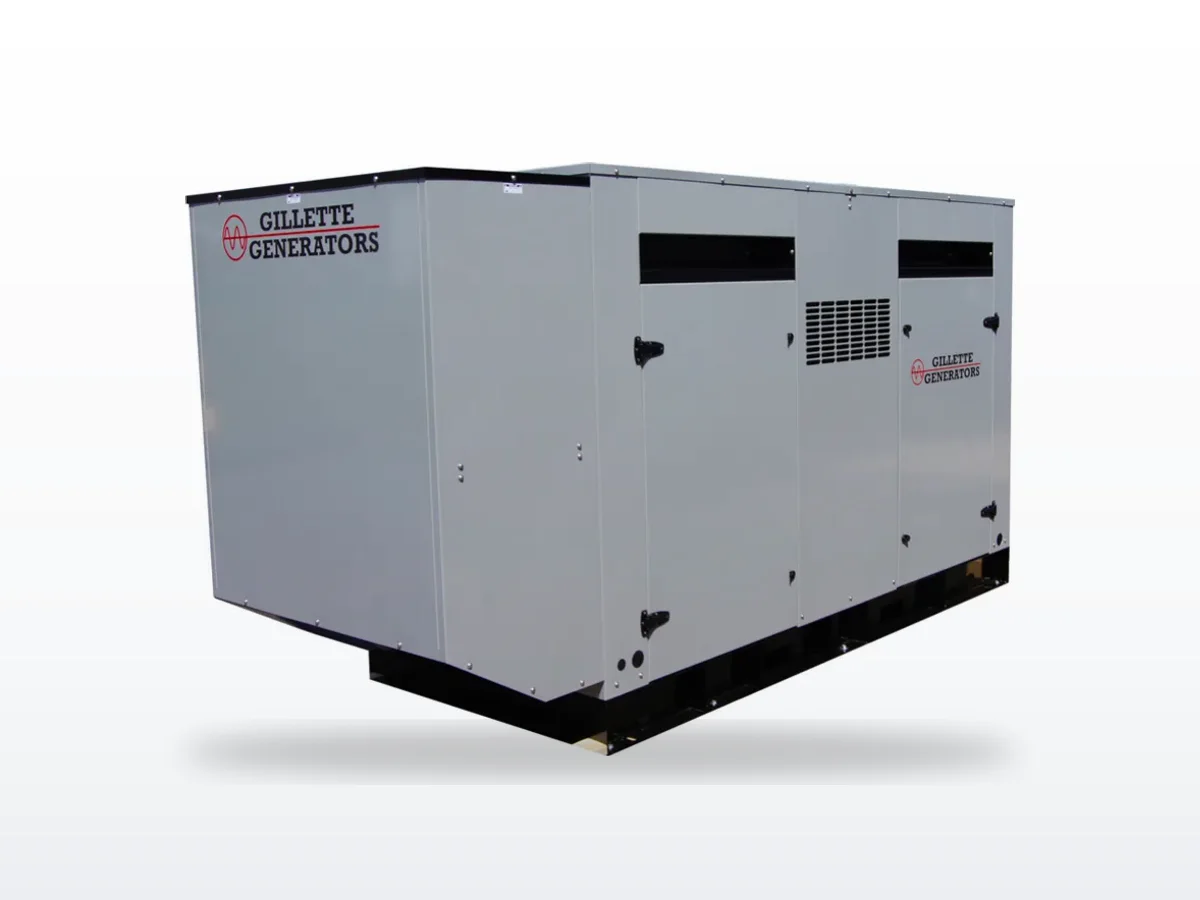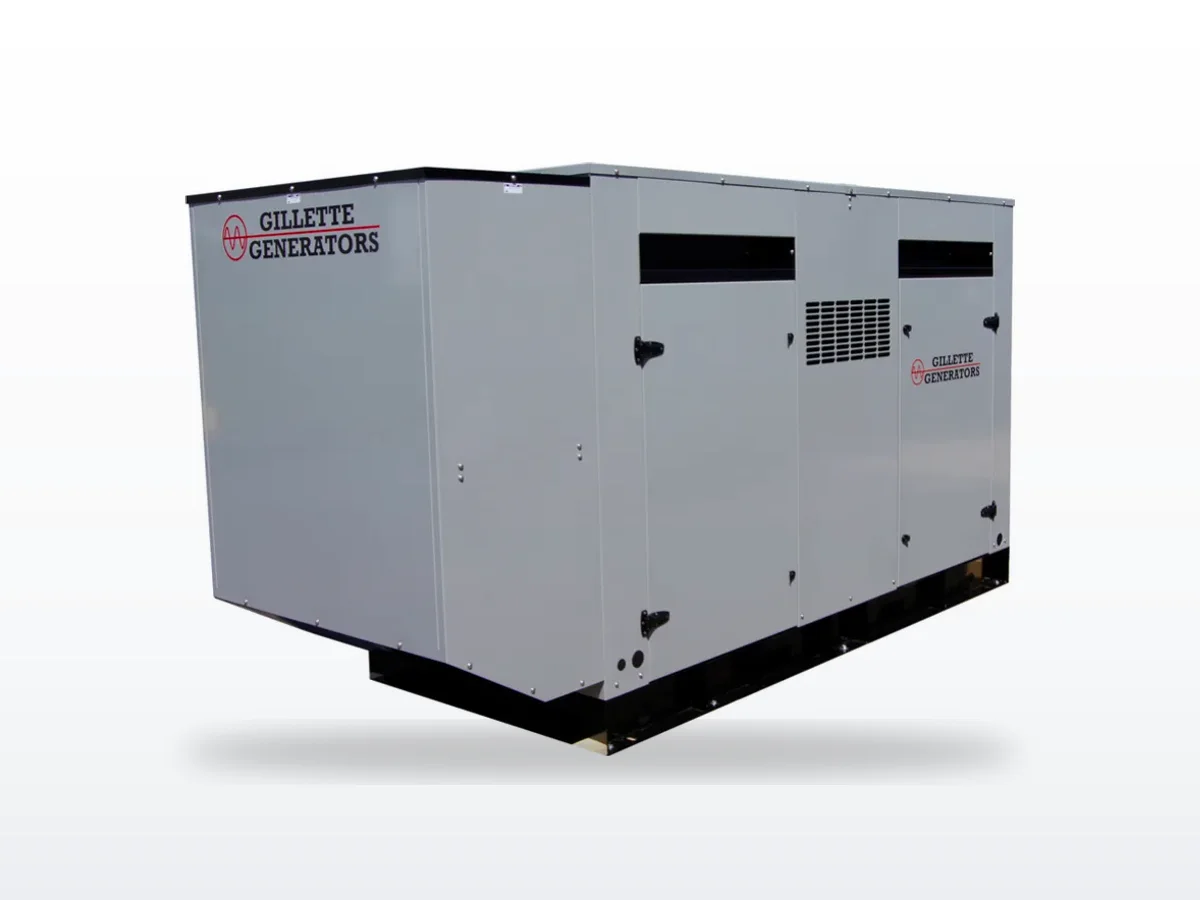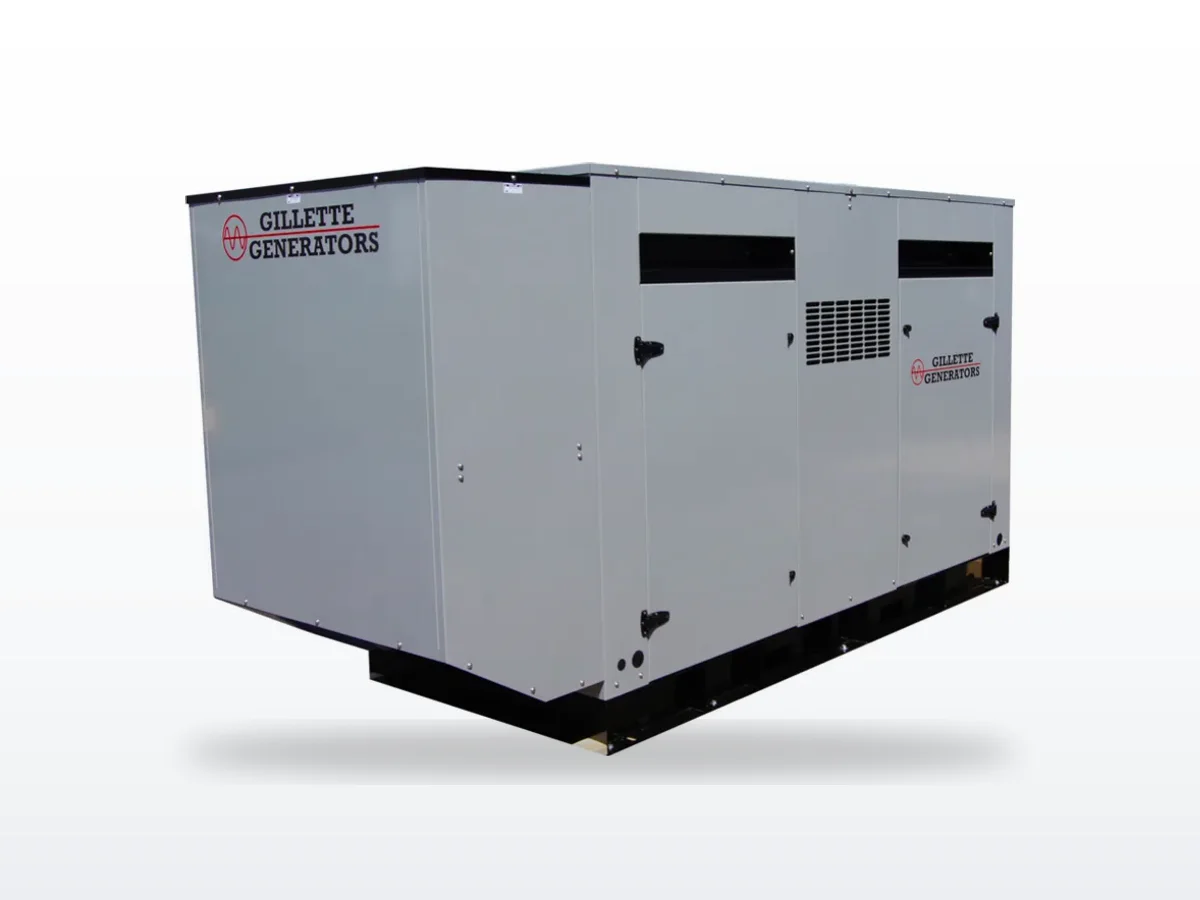
The Gillette SPD-1000 is a 100-kilowatt stationary diesel standby generator — the midpoint of the SPD Perkins series. It achieves 100 kW from the same 4.4L Perkins 1104D block as the 60 kW SPD-600, adding charge air cooling to the turbocharger for 67% more output. Stamford UCI274D alternator (larger frame than the UCI224 used at 60 kW), DSE 7420 MKII controller.
At 100 kW diesel, this serves larger commercial and institutional sites without gas service: municipal buildings, wastewater treatment plants, medium telecom installations, and commercial buildings in areas with limited gas infrastructure.
The SPD-600 and SPD-1000 demonstrate how turbocharging and charge air cooling extract dramatically different output from the same displacement:
Spec
SPD-600
SPD-1000
Engine
1104D-E44TG1
1104D-E44TAG2
Aspiration
Turbo only
Turbo + charge air cooling
Standby kW
60
100
Mechanical bhp
95.7
161
Weight (open)
1,814 lbs
2,330 lbs
Fuel (100%)
4.7 gal/hr
7.56 gal/hr
The TAG2 variant's charge air cooler is the key differentiator — it cools compressed intake air before it enters the cylinders, increasing air density and enabling a higher fueling rate at the same displacement. This is the same principle behind the PSI gas engine tiers (SP-960 naturally aspirated vs. SP-1500 turbocharged).
Perkins 1104D commonality with the broader market#
The Perkins 1104D is used across dozens of generator brands in the 60-125 kW diesel range. This means:
Parts are universally available — not limited to Gillette's supply chain
Any qualified diesel technician familiar with the 1104D can service this unit
Common rail fuel system knowledge transfers from other brands using the same engine
This broad market deployment is a genuine advantage for fleet operators who may service generators from multiple manufacturers.
We service the Perkins 1104D platform across multiple generator brands in our territory — the same engine in different packages. At 100 kW with charge air cooling, the engine runs at a higher thermal load than the 60 kW variant, so charge air cooler condition and intercooler hose integrity are important inspection items. Fuel quality management remains the #1 maintenance priority for standby diesel installations.
Tell us about the application — kW, voltage, application, install timeline — and we'll respond within one business day with budgetary pricing, lead time, and any sizing notes.
Adjust load percent and tank size to estimate runtime. Pre-filled with this model's spec where available.
Estimate runtime on this tank
Estimated runtime
34.3 hours(1.4 days)
Fuel consumption ≈ 5.83 GPH at 75% load. Estimate based on industry-typical 1800 RPM standby curves (≈0.07 GPH/kW at full load). Actual consumption varies by engine, ambient temperature, fuel quality, and tuning.
Service intervals
Manufacturer-recommended intervals for the Gillette SPD-1000 under standby duty. Field intervals may differ based on load profile, ambient conditions, and fuel quality.
Oil & filter
Every 500 hours or 12 months
Coolant change
Every 6000 hours
Air filter
Every 1000 hours
Fuel filter
Every 500 hours
Major overhaul
≈ 20,000 hours
Load bank test
Every 12 months
Common failure modes
What we've seen fail on this platform. Use as a service-planning reference, not a diagnostic — actual failure modes depend heavily on duty cycle and maintenance history.
Component
Symptom
Typical hours
Severity
Fuel quality / contamination
Hard starting, filter clogging, reduced power
4,380+
moderate
Charge air cooler
Reduced output, elevated intake temperatures
10,000+
moderate
Battery
Failed to start, slow crank
8,760+
minor
Frequently Asked Questions
How does the SPD-1000 achieve 100 kW from the same 4.4L displacement as the 60 kW SPD-600?
The SPD-1000 uses the Perkins 1104D-E44TAG2 — the 'TAG2' designation indicates a higher-output variant with charge air cooling (TCAC) in addition to turbocharging. The SPD-600 uses the 1104D-E44TG1 (turbo only, no CAC). Adding charge air cooling increases air density and allows 67% more output (161 bhp vs 95.7 bhp) from the same displacement.
How does the SPD-1000 compare to the SPJD-1000?
Both are 100 kW diesel standby units. The SPD-1000 uses a Perkins 1104D 4.4L I4, while the SPJD-1000 uses a John Deere 4045HF285 4.5L I4. Very similar displacement and architecture — the choice comes down to engine brand preference and local dealer availability. The Perkins uses common rail injection; the John Deere uses Stanadyne rotary.
What fuel consumption should I plan for?
7.56 gal/hr at full load (100 kW). At 75% load: 6.21 gal/hr. At 50%: 4.54 gal/hr. With a 200-gallon sub-base tank at 75% load, expect approximately 32 hours of runtime.
What alternator step-up occurs at 100 kW?
The SPD-1000 moves from the Stamford UCI224 frame (used on SPD-300 and SPD-600) to the larger UCI274D frame. The UCI274 is a heavier, higher-current alternator rated for the thermal demands at 100 kW — same frame used on the SPJD-1000.