
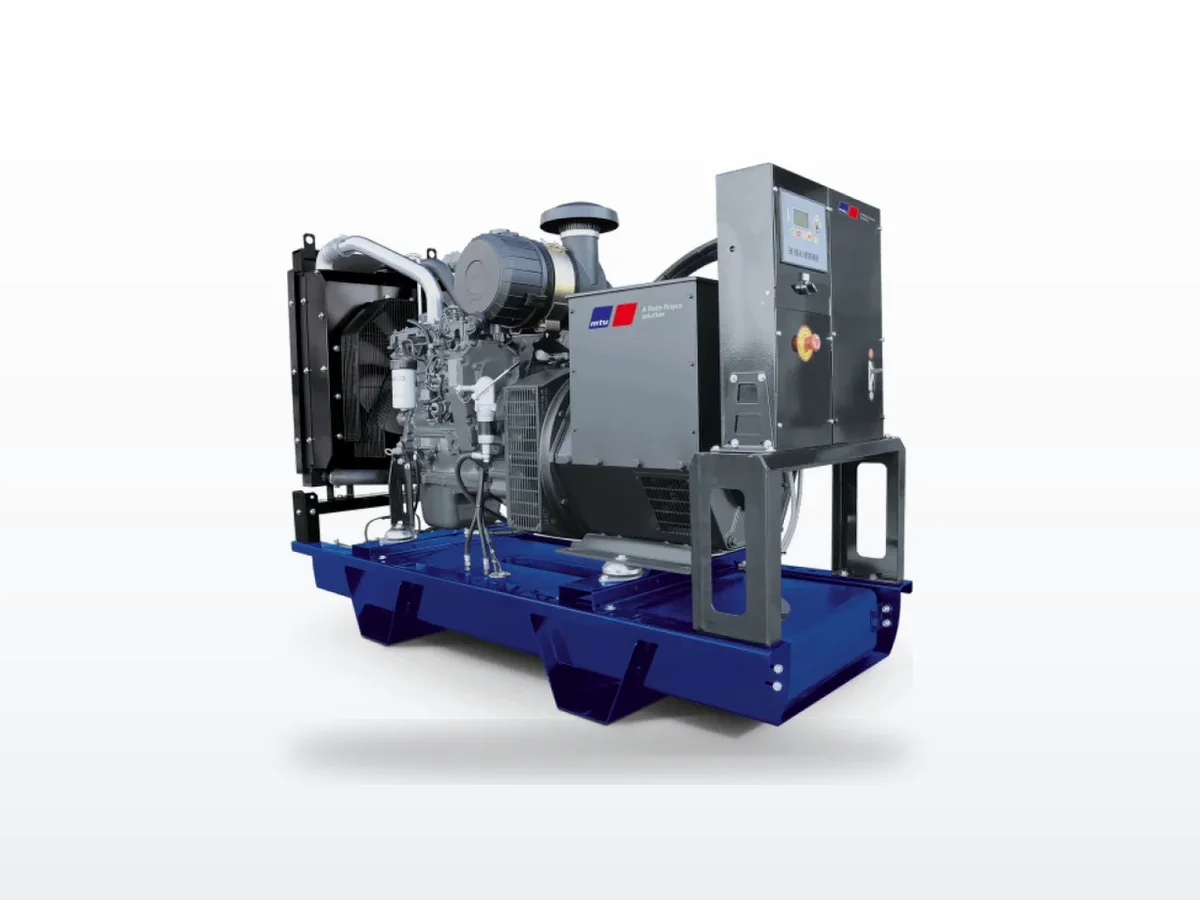
Series Overview#
The MTU 6R0113 Series consists of two diesel generator models — the DS150 (150 kW standby, 135 kW prime) and the DS200 (200 kW standby) — both built on the John Deere 6068, a 6.8-liter, 6-cylinder inline turbocharged and aftercooled diesel. Both carry EPA Tier 3 and SCAQMD certifications and are available in single-phase and three-phase configurations from 120/240V through 347/600V. The 6R0113 Series is the first MTU R-series platform to use a 6-cylinder inline architecture, delivering the improved vibration characteristics and thermal headroom that distinguish it from the 4-cylinder 4R0113 below.
The DS150 and DS200 share the same 6068 block but use different calibrations — the DS200's 6068HFG85 runs at significantly higher output (235 kWm versus 177 kWm), which has measurable implications for thermal management, service intensity, and component wear rates at extended hours. Both use the JDEC electronic control unit with SAE J1939 communication, providing electronic isochronous governing at plus or minus 0.25% speed regulation.
The 6R0113 Series occupies the sweet spot between the light-commercial 4R0113 (50–100 kW) and the MTU proprietary-engine platforms that begin at the 6R0150 Series (250–300 kW). For sites that require John Deere engine parts availability and dealer network coverage, the 6R0113 is the highest-output R-series option before transitioning to MTU's own 1600-series engines.
How to Choose#
DS150 (150 kW standby, 135 kW prime, John Deere 6068HF285): The conservative calibration on the 6068 platform. Produces 177 kWm from 6.8 liters — moderate specific output with good thermal headroom. The DS150 has a smaller water pump (180 L/min vs 265 L/min for the DS200) and less heat rejection to the aftercooler, reflecting the lower thermal load. Choose when the load study produces a standby requirement between 120 and 150 kW. The lower calibration typically translates to longer component life on thermally stressed items like injectors, turbocharger bearings, and charge air cooler seals.
DS200 (200 kW standby, John Deere 6068HFG85): Maximum output from the 6068 platform. The HFG85 calibration extracts 235 kWm from the same 6.8-liter block — the engine is working meaningfully harder at any load point. The aftercooler sees 57 kW of heat rejection versus 32 kW on the DS150, which underscores the importance of charge air cooler condition monitoring on the DS200. Choose when the load study requires between 150 and 200 kW standby. Monitor thermally stressed components more closely on high-hour DS200 units.
Both models share the same physical footprint (112 x 48 inches) and weight class (~3,469 lb dry). The choice is driven purely by standby power requirement.
Common Applications#
- Healthcare standby: Regional hospitals and medical centers with life-safety standby between 120 and 200 kW. Both models accept full rated load in one step per NFPA 110, and the 6-cylinder inline architecture provides the smooth, low-vibration operation that healthcare facilities demand. OSHPD pre-approval is available for California installations.
- Commercial standby: Mid-size commercial buildings — hotels, office towers, retail centers — with standby requirements in the 150–200 kW range. SCAQMD certification makes both models suitable for the most restrictive air quality jurisdictions.
- Data center edge: Edge data centers and network operations centers under 200 kW. The JDEC electronic isochronous governor provides the plus or minus 0.25% speed regulation that sensitive IT loads require.
- Light industrial: Manufacturing plants, warehouse distribution centers, and process facilities with critical systems under 200 kW.
Service & Maintenance#
Both models follow John Deere service intervals: oil and filter changes every 250 hours or 12 months. Air filter service at 1,000 hours. Major overhaul at 20,000 hours. The 6-cylinder inline configuration delivers inherently smoother operation than 4-cylinder alternatives, reducing vibration fatigue on mechanical connections and enclosure hardware over long service life.
Charge air cooler (critical): The highest-consequence failure mode on the 6R0113 platform. Coolant ingestion into the intake manifold from a failed charge air cooler can cause hydrostatic lock and catastrophic engine damage. Inspect for coolant seepage at the cooler end caps and intake connections at every service interval. Immediate shutdown is required if white smoke or coolant loss is observed during operation.
Fuel injectors: The 6068 turbocharged engines use electronically controlled fuel injection. Rough idle, black smoke, and uneven cylinder contribution are symptoms of injector degradation, commonly caused by poor fuel quality. Maintain fuel filters and water separators rigorously.
JDEC governor and J1939 wiring: The electronic governor performs reliably, but intermittent J1939 wiring harness connections can produce fault codes without obvious root cause. Inspect all ECU harness connectors during annual service. John Deere ServiceAdvisor diagnostic software is required for definitive fault isolation.
Application Guidance#
The MTU 6R0113 Series is purpose-built for the 150–200 kW standby class where inline-6 vibration characteristics, SCAQMD compliance, and John Deere parts availability are material requirements. The 6068 platform is one of John Deere's most widely deployed generator-drive engines, with a global parts and service network that extends well beyond MTU's own distributor coverage.
Below 150 kW, the MTU 4R0113 Series covers 50–100 kW on the John Deere 4045 4-cylinder. Above 200 kW, the MTU 6R0150 Series moves to larger inline-6 engines at 250–300 kW, and the MTU 6R0225 DS400 covers 400 kW. At 200 kW, the MTU 8V1600 DS350 also becomes a consideration for sites that anticipate load growth and want headroom. Sites considering natural gas at this power level should evaluate the MTU Onsite Energy Gas lineup — the GS150 and GS200 provide equivalent standby output without diesel fuel storage. Buyers comparing the 6R0113 against Cummins D6 Series at 150–200 kW should weigh the John Deere vs Cummins dealer coverage in their specific market and whether SCAQMD certification is required.