
Series Overview#
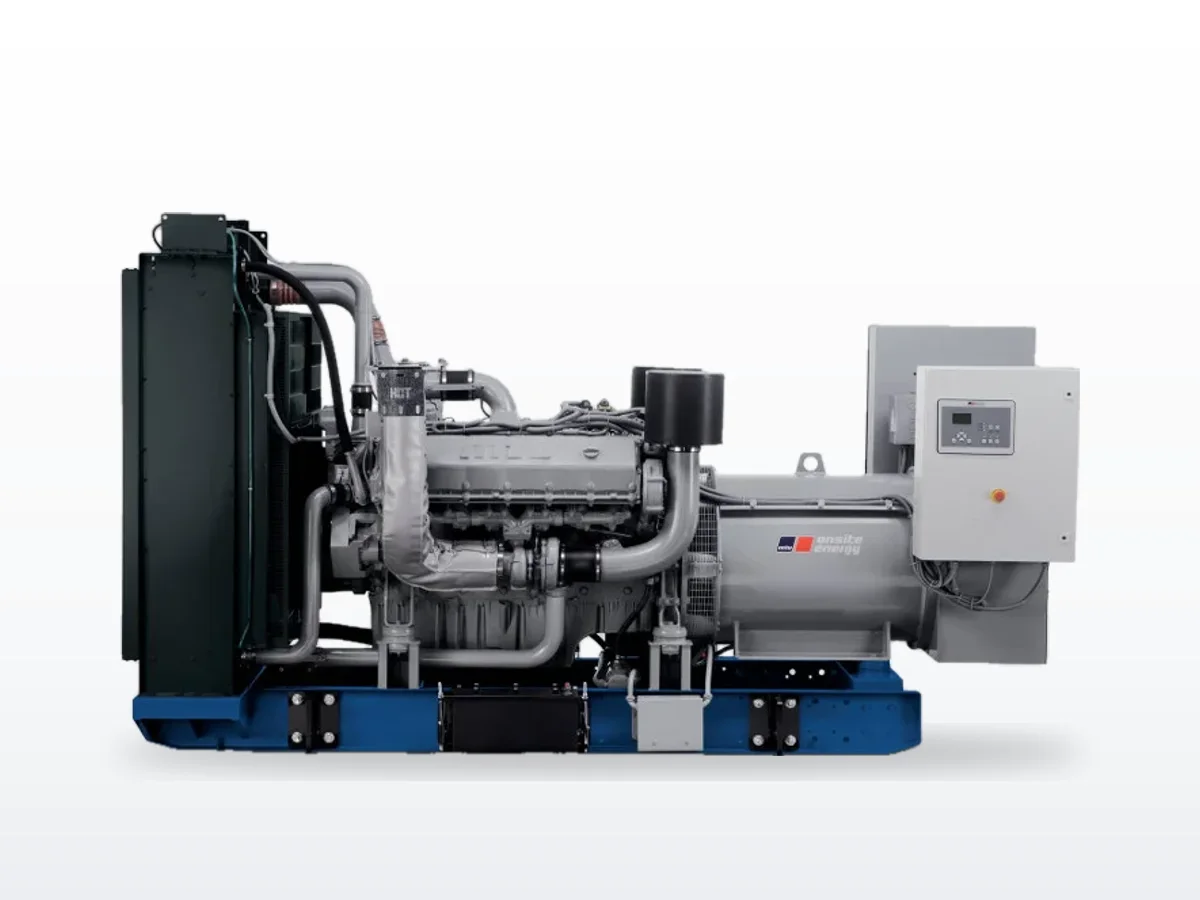
The MTU 8V1600 Series consists of a single model — the DS350 at 350 kW standby (325 kW prime) — built on the MTU 8V1600G70S, a 14.0-liter, 8-cylinder V-configuration turbocharged and charge-air-cooled diesel engine with common rail fuel injection. This is the entry point to MTU's proprietary 1600-series engine platform, marking the transition from the John Deere-powered R-series generators to MTU's own purpose-built power generation engines.
The 8V1600G70S uses the ADEC (Advanced Diesel Engine Control) electronic isochronous governor, delivering plus or minus 0.25% speed regulation — a step up from the JDEC governors in the R-series. The engine carries EPA Tier 3 certification and is available in all standard North American voltages from 208V to 600V three-phase. The prime rating of 325 kW makes the DS350 suitable for installations where occasional prime power duty is anticipated alongside standby.
Standard equipment includes a unit-mounted radiator rated for 50 degrees C ambient, 24V electric start (1,050 CCA), brushless 4-pole PMG alternator, and the MTU digital control panel with CANBus ECU communications and NFPA 110 compatibility. The move from 12V (R-series) to 24V starting reflects the higher compression and cranking requirements of the 1600-series engine.
Common Applications#
- Commercial standby: Large commercial buildings — major retail complexes, mid-size hotels, corporate campuses — with standby requirements in the 300–350 kW range. The DS350 bridges the gap between the R-series ceiling at 400 kW (6R0225 DS400) and provides an alternative with the MTU proprietary engine platform.
- Industrial standby: Manufacturing plants, food processing facilities, and distribution centers with critical three-phase loads between 250 and 350 kW.
- Data center standby: Mid-size data centers and colocation facilities where the PMG alternator's motor-starting capability and tight voltage regulation support UPS transfer loads. The ADEC governor's plus or minus 0.25% speed regulation meets the frequency stability requirements of sensitive IT equipment.
- Municipal facilities: Government buildings, public safety centers, and water/wastewater facilities requiring reliable standby at 350 kW with NFPA 110 compliance.
Service & Maintenance#
The 8V1600 Series follows MTU service intervals: oil and filter changes every 500 hours, with major overhaul at 20,000 hours. The 500-hour oil change interval (versus 250 hours on the R-series) is an operational advantage for high-hour standby installations.
Common rail fuel injectors: The 1600-series engine uses high-pressure common rail injection. Carbon fouling from extended idle cycles or off-specification fuel is the primary injector failure mode. Maintain fuel quality rigorously — use only OEM-specified Diesel #2 with appropriate sulfur content. Clean fuel filters at every service interval and perform injector cleaning on the OEM schedule.
ADEC engine controller: The ADEC is a sophisticated engine management system that provides precise fuel metering, speed regulation, and comprehensive fault logging. However, ECU connector corrosion in coastal or high-humidity environments can cause intermittent fault codes and shutdown events. Plan for annual connector inspection and dielectric grease application on all ECU harness connectors.
24V starting battery: The transition from 12V (R-series) to 24V adds battery management complexity. The 1,050 CCA specification must be met — test both batteries in the series configuration at every service interval. A single weak battery in a 24V configuration can prevent starting even when the other battery tests acceptable.
Application Guidance#
The MTU 8V1600 DS350 is positioned at the transition point between the John Deere-powered R-series and the larger MTU 1600-series platforms. At 350 kW, it occupies the same power class as the R-series 6R0225 DS400 (400 kW on a John Deere 6090 engine) — sites choosing between these two platforms should consider whether they prefer John Deere dealer service access (6R0225) or the MTU proprietary engine platform with ADEC electronic control (8V1600).
Below 350 kW, the MTU 6R0150 Series covers 250–300 kW on John Deere engines. Above 350 kW, the MTU 10V1600 DS500 adds two cylinders for 500 kW, and the MTU 12V1600 Series reaches 750–900 kW on the V12 variant. Sites preferring gas fuel at this power level should evaluate the MTU Onsite Energy Gas GS350 on the Doosan 18.3L V10. Buyers comparing the DS350 against the CAT C-Series (C15 at 500 kW) or Cummins QSX15 should weigh the MTU power density advantage — 350 kW from 14.0 liters is compact — against the broader CAT and Cummins dealer networks in most North American markets.
