
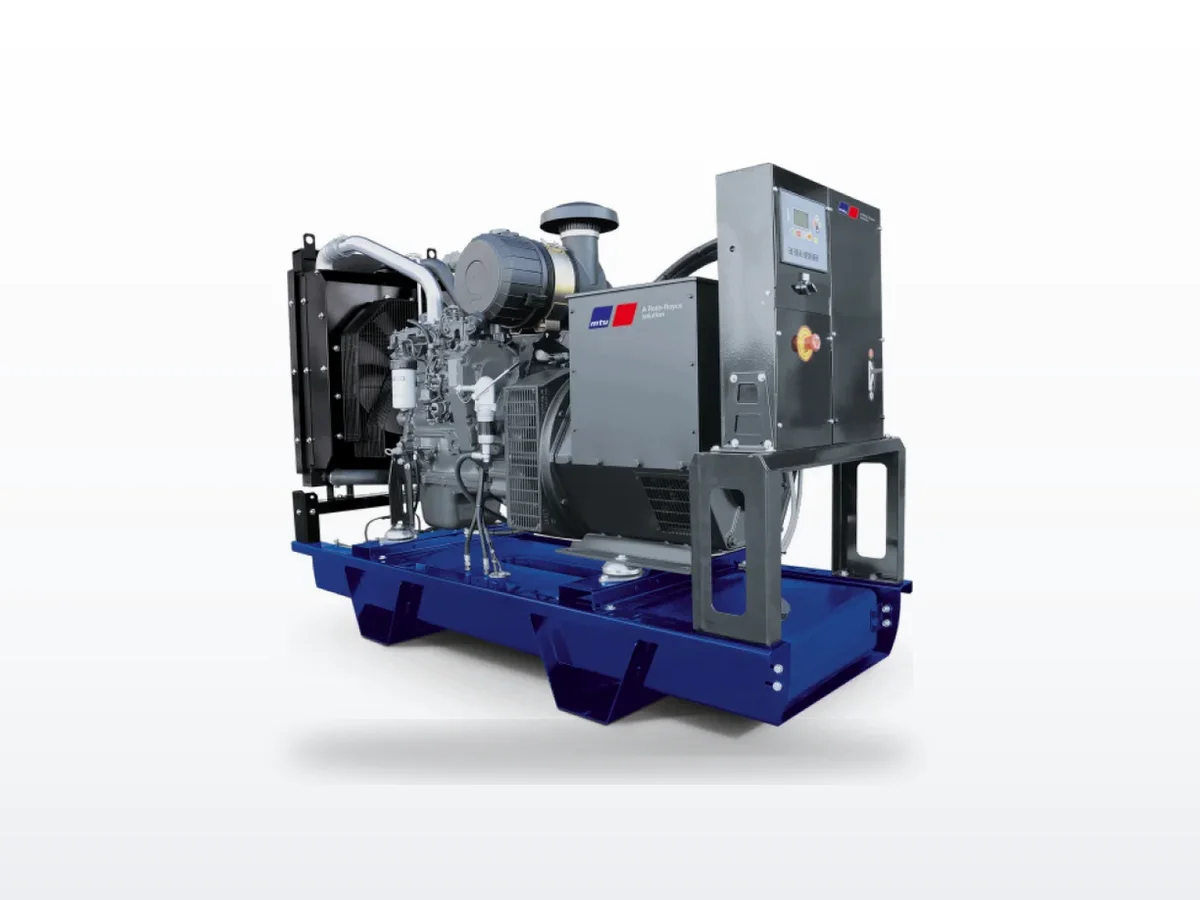
Series Overview#
The MTU 6R0150 Series consists of two diesel generator models — the DS250 (250 kW standby, 230 kW prime) and the DS300 (300 kW standby, 275 kW prime) — built on John Deere's 9.0-liter inline six-cylinder engine platform. The DS250 uses the John Deere 6090HF484 with common rail fuel injection; the DS300 uses the 6090HFG86 at a higher output calibration. Both carry EPA Tier 3 and SCAQMD certifications for stationary emergency standby operation. The 6R0150 is one of the few MTU product lines with documented single-phase availability — the DS250 is offered in 120/208V and 120/240V single-phase configurations in addition to three-phase options from 208V through 600V.
MTU provides the full generator system packaging around the John Deere engine — enclosure, alternator, control system, and overall generator system engineering. This approach combines MTU's system-level certification and control capability with the well-established John Deere 9.0L service and parts network, giving facilities in areas with strong John Deere dealer coverage dual service access: MTU's own service infrastructure for generator-system items and the John Deere dealer network for engine-level support.
The 6R0150 Series fills the 250–300 kW standby class in MTU's lineup, positioned below the 6R0225 DS400 (400 kW, also John Deere powered) and above the smaller residential and light-commercial platforms. For facilities in the 225–300 kW standby range who want MTU packaging and certification at this capacity class, the 6R0150 is the appropriate MTU specification.
How to Choose#
The primary selection driver between the two models is the standby power requirement from the load study.
DS250 (250 kW standby, 230 kW prime, John Deere 6090HF484): The DS250 is appropriate when the load study produces a standby requirement between 200 and 250 kW. It is also the correct choice when the facility requires single-phase output — the DS250's 120/208V and 120/240V single-phase configurations are not available in the DS300. For facilities without three-phase utility service or with a three-phase service that includes a substantial single-phase load component, the DS250's configuration range provides options the DS300 does not.
DS300 (300 kW standby, 275 kW prime, John Deere 6090HFG86): The DS300 is appropriate when the load study requires between 250 and 300 kW standby. The 6090HFG86 calibration runs at higher output than the DS250's 6090HF484 — the engine is working at higher specific output at any given load point. For applications where three-phase service is standard and the load study calls for the additional 50 kW of headroom, the DS300 is the straightforward choice.
Both models are Tier 3 certified. In jurisdictions where Tier 4 Final is required for new stationary emergency installations, neither model will meet the AHJ requirements — confirm emissions tier applicability before specifying.
Common Applications#
- Commercial standby: Office buildings, retail centers, hotels, and multi-tenant commercial facilities with standby requirements in the 200–300 kW range. The wide voltage range — including single-phase on the DS250 — accommodates the full range of commercial service configurations found in smaller commercial buildings.
- Healthcare: Medical offices, outpatient surgery centers, and smaller hospitals with essential electrical system standby requirements at the 250–300 kW class. The John Deere 9.0L platform's proven reliability supports the demanding NFPA 110 test requirements healthcare facilities must satisfy.
- Multi-family residential: Large apartment complexes and residential high-rise buildings with life-safety and common-area standby requirements. The DS250's single-phase availability is relevant for residential buildings where the emergency distribution is partially single-phase.
- Municipal and industrial: Government buildings, water treatment facilities, and light industrial operations with three-phase standby requirements in the 250–300 kW range. The John Deere dealer service network provides practical parts and service access in areas with limited MTU direct service coverage.
- High-rise buildings: Mid-size commercial and residential towers with integrated building standby systems. The DS300's 275 kW prime rating is the governing specification when the generator serves load more than emergency-only cycles.
Service & Maintenance#
The 6R0150 Series follows the standard MTU service schedule: oil and fuel filter changes every 500 hours or 12 months, coolant change at 4,000 hours, air filter service every 1,000 hours. Four specific failure modes are documented for this platform:
John Deere fuel injector wear: Nozzle tip wear from extended standby low-load cycles is the primary moderate-severity failure mode on the 9.0L John Deere platform, documented at approximately 10,000 hours. Standby generators operating primarily at light load during weekly exercise cycles accelerate injector tip wear relative to units that see higher average load factors. Injector condition assessment at 10,000 hours is the appropriate preventive measure.
Cooling hose seepage: Seepage at clamp connections from thermal cycling is documented at approximately 5,000 hours. Inspect hose clamps and hose condition at each oil change service and re-torque any loose clamps to prevent progression to active coolant leaks.
Coolant heater failure: The block heater maintains coolant temperature to support fast cold-weather starts. Heater element failure causes slow cranking and extended start times in cold ambient conditions. Confirm coolant heater circuit function — heater energized, thermostat active — at each annual service. This is a low-cost preventive check that avoids the highest-consequence failure mode for standby generators: failure to start during a utility outage.
Starting battery voltage sag: 24VDC battery bank voltage that reads acceptable at rest but drops below the starter motor threshold under cold-crank load is the documented battery failure mode. Annual capacity testing under load — not resting voltage measurement alone — is required. Replace the full battery bank proactively at 48 months regardless of resting voltage test results.
Application Guidance#
The MTU 6R0150 Series is purpose-built for the 250–300 kW diesel standby class with the unique advantage of single-phase availability on the DS250 — making it one of the few mid-range diesel generators in this output class with documented single-phase 120/208V and 120/240V configurations. Facilities in the 200–300 kW standby range that want MTU's system-level packaging and certification with the serviceability of the widely-supported John Deere 9.0L engine platform are the primary buyers. The dual service network — MTU for generator-system items, John Deere dealers for engine-level support — is a practical advantage in regions with limited MTU direct service coverage but strong John Deere dealer presence. Both models carry EPA Tier 3 and SCAQMD certification for stationary emergency standby; confirm with the project AHJ whether Tier 3 satisfies local emissions requirements before specifying for new installations in jurisdictions that require Tier 4 Final.
This series is not appropriate when Tier 4 Final compliance is required — neither the DS250 nor DS300 can meet that standard, and the Kohler REOZ Tier 4 Final models (30REOZK4, 40REOZK4, 80REOZJ4, 125REOZJ4, 150REOZJ4) or CAT C-Series Tier 3 models (C7.1, C9, C13) should be evaluated. For standby requirements below 250 kW, the Kohler REOZ commercial standby series has models at 80–200 kW on John Deere engines. At 400 kW, the MTU 6R0225 DS400 is the next step up in the MTU lineup before transitioning to the proprietary MTU-engined platforms in the 12V1600 and Series 4000 families.