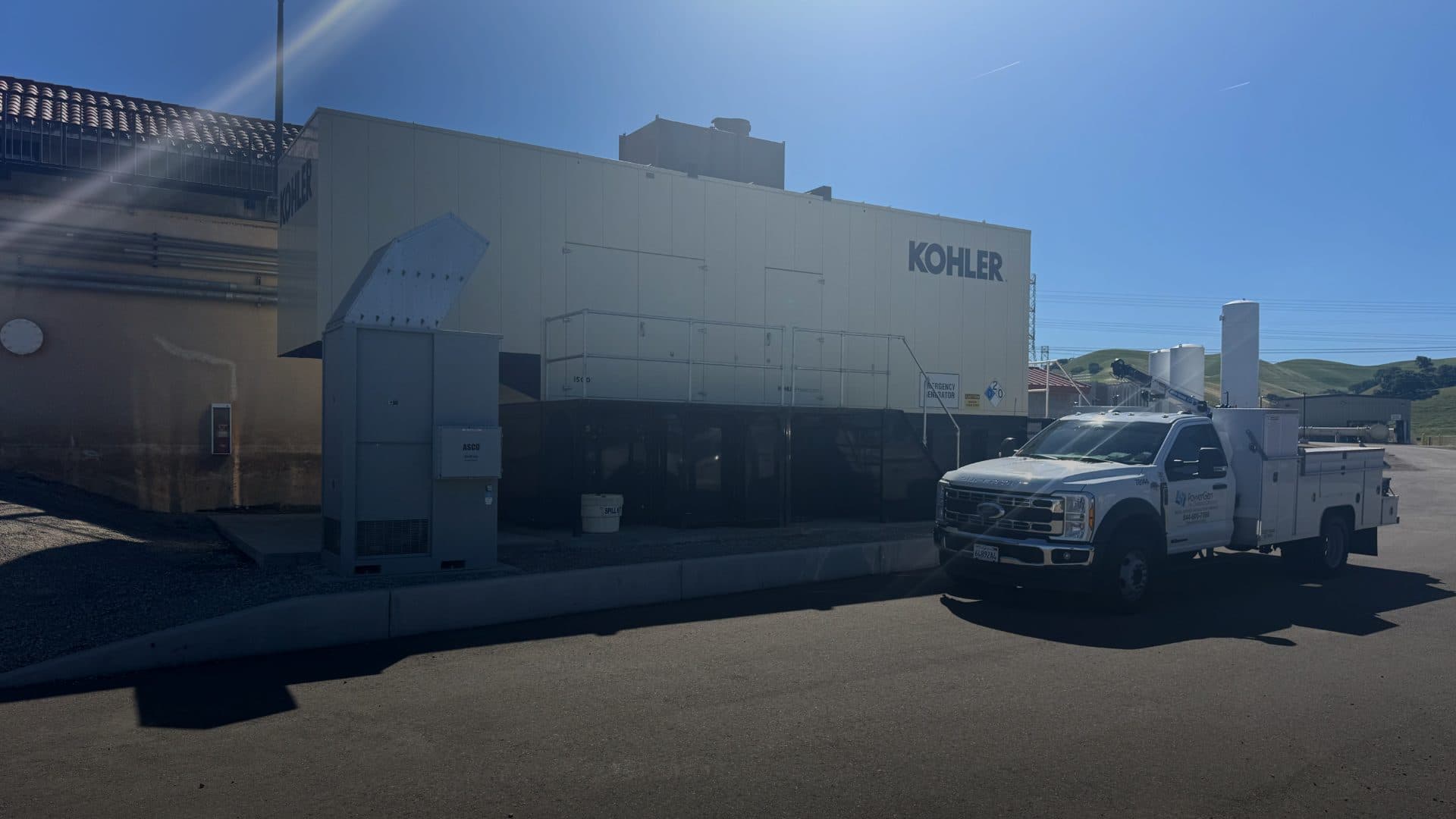
Multi-Station Generator Readiness Program Keeps Fire Stations Powered Through PSPS Season
An ongoing maintenance and readiness program across seven fire stations in Northern California's highest-risk PSPS zones ensures backup power is always operational when wildfire season triggers utility shutoffs.
Background
The core challenge was not mechanical — it was logistical. This agency operates fire stations spread across more than 250 miles of Northern California, from the Sierra foothills to the Central Coast, many in remote areas with limited road access during fire season. Each station had procured and maintained its own generator independently, a legacy reflected in the seven separate billing entities that still exist today. No two stations have the same setup. The fleet spans different sizes, different vintages, different makes and models — from portable single-phase engines to larger fixed diesel installations. The agency needed a service organization that could self-organize across that entire footprint: plan routes through rugged territory, manage scheduling across a massive geographic area, and coordinate technicians without the agency having to micromanage every service call.
The arrival of routine Public Safety Power Shutoffs starting in 2019 raised the stakes dramatically. Fire stations in PSPS zones are first responders during the exact wildfire events that trigger utility shutoffs. A station losing power during an active fire — losing dispatch communications, equipment bay doors, breathing apparatus compressors, fuel pumps — is not a hypothetical risk. It is a direct threat to emergency response capability. "It will probably start" is not an acceptable readiness posture for life-safety systems in wildfire zones. The agency needed to know where every generator stood, what had been done, what still needed to happen, and what the readiness status was across all stations — especially heading into fire season. Thorough documentation and clear reporting became as important as the wrench work itself.
What ultimately led the agency to consolidate under OnPoint and PowerGen was the combination of operational discipline and technical range. The value of the program is as much in the organization and project management as in the mechanical service — coordinating preventive maintenance, emergency response, and seasonal readiness across a geographically dispersed fleet of highly diverse equipment requires a provider that can handle complex logistics end to end. Geographic reach across Northern California, experience spanning residential-class portables through industrial diesel platforms, and the ability to deliver consistent documentation and accountability across every station made the consolidation possible.
The Challenge
A state fire protection agency operates stations scattered across some of Northern California's most wildfire-prone terrain. Their facilities span three distinct regions: the Sierra foothills — including stations near Nevada City, Garden Valley, and Grass Valley — the Central Coast near Cuesta Pass, and San Benito County near Paicines.
These locations are not accidental. Fire stations are positioned where fire risk is highest, which means they sit squarely in the zones where utilities are most likely to call Public Safety Power Shutoffs. The Sierra foothill stations in particular fall within PG&E's highest-risk PSPS corridors. When the grid goes down to prevent wildfire ignition, these are the stations that need power most — for emergency dispatch, radio communications, equipment readiness, and coordination with other agencies.
The agency's challenge was not responding to a single emergency. It was ensuring that generators at seven separate facilities — each with its own equipment, its own usage patterns, and its own maintenance needs — would start and run reliably whenever called upon. A generator that fails during a PSPS event at a remote fire station is not an inconvenience. It is a failure of emergency infrastructure.
Each station operates as a separate billing entity, reflecting the decentralized nature of the operation. The agency's training center has different power demands than a remote foothill station. Portable units like the Ford ESG-642 engine serve different roles than larger fixed installations. A one-size-fits-all maintenance approach would not work.
Our Approach
Establishing the Multi-Site Program
We built a maintenance program that treats all seven stations as a coordinated system while respecting the differences between sites. Each facility received an initial assessment covering generator condition, load requirements, fuel systems, transfer switch operation, and site-specific environmental factors.
The Sierra foothill stations face particular challenges. Elevation, temperature swings, and exposure to smoke and ash during fire season all affect generator performance. Radiator screens clog faster. Fuel quality degrades differently at altitude. Battery capacity drops in cold weather. The maintenance protocols for these stations account for conditions that a coastal facility never encounters.
The training center, with its larger fixed generators supporting classroom facilities and simulation equipment, follows a different service cadence than the remote stations running smaller portable units for communications and dispatch backup.
Ongoing Maintenance and Service
The program includes scheduled preventive maintenance visits and on-call service response. Service tickets across the network include both routine maintenance and service calls for issues identified between scheduled visits.
Each maintenance visit covers the fundamentals that determine whether a generator will start on the day it matters: oil and filter condition, coolant levels and quality, battery voltage and terminal condition, fuel system integrity, transfer switch operation, and a load test to confirm the unit can actually carry the facility's critical circuits.
For the portable units — generators in the Ford ESG-642 class, single-phase 120/240V engines sized for communications equipment and essential station loads — maintenance also includes inspection of transport hardware, connection cables, and weatherproofing, since these units may be repositioned between events.
Pre-Season Readiness
Before each PSPS season, every station in the program receives a readiness verification visit. This is not the same as routine maintenance. It is a confirmation that each generator is ready for extended, unattended operation during a multi-day shutoff event — the scenario these stations actually face.
The readiness check includes extended run time under load, fuel supply verification, coolant system pressure testing, and confirmation that station personnel know the startup and transfer procedures. The goal is to eliminate every possible failure mode before the first PSPS notice arrives.
The Results
The program has established reliable backup power across all seven stations spanning three geographic regions of Northern California. The key outcomes are structural, not episodic:
- Seven stations with verified generator readiness — each with maintenance history, known load profiles, and documented procedures
- Three regions covered — Sierra foothills (the highest-risk PSPS corridor in California), Central Coast, and San Benito County
- Ongoing service program with both scheduled maintenance and on-call response for the full network
- Station-specific protocols that account for the different equipment, environments, and operational demands at each site
The seven separate billing entities reflect real operational independence — each station manages its own budget and its own equipment — while the unified maintenance program ensures consistent readiness across the network.
Key Takeaways
PSPS preparedness is not an event response problem. It is a maintenance and readiness problem. The agencies that lose power during shutoffs are not the ones without generators — they are the ones whose generators were not maintained, tested, and verified before the event arrived.
For any organization with facilities in PSPS-prone areas, the pattern here is instructive. The Sierra foothills, Central Coast, and inland valleys of Northern California will continue to experience utility shutoffs as long as wildfire risk persists. The utilities have been clear about this. A multi-site maintenance program that keeps generators ready year-round costs a fraction of what emergency mobilization costs when a station goes dark during a critical event.
The fire protection agency's approach — treating generator maintenance as essential infrastructure, not as an afterthought — is a model for any organization operating critical facilities in wildfire country.
Have a Similar Challenge?
Contact OnPoint Generators for a free consultation. We'll design a backup power solution tailored to your facility.