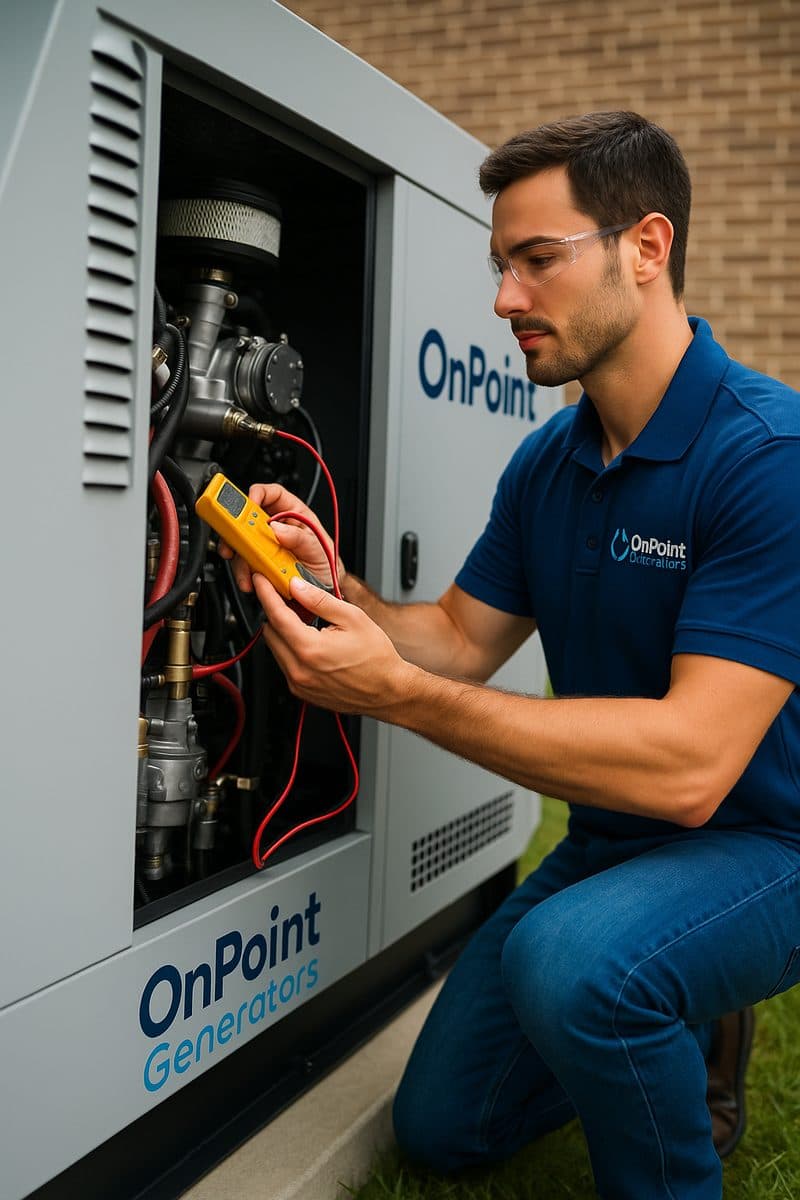
Municipal Utility Consolidates Generator Maintenance Across 30+ Units and Two Divisions
A Northern California municipality with 30+ generators spread across water treatment and wastewater treatment facilities — spanning 8+ engine manufacturers and three decades of equipment — consolidated under a single preventive maintenance program to meet EPA and NPDES compliance requirements.
Background
This municipality was sitting on a massive deferred maintenance backlog. Two separate city departments — Water and Wastewater — had been managing their own backup power equipment independently for over three decades, and with tight municipal budgets, generators that only ran during outages were easy to deprioritize. The fleet had grown to include 10 different engine manufacturers, from a 1970s-era CAT D398 to current-production John Deere 6135HF485 units, with voltage configurations ranging from 480V three-phase down to 208V single-phase. Multiple vendors had rotated through over the years, each covering the brands they knew, but there was no functioning preventive maintenance program tying it all together. Units that appeared operational on the surface had degraded components underneath — contaminated fuel sitting in tanks for years, expired batteries, worn transfer switch contacts, coolant hoses one heat cycle from failure. The backlog was not just large; much of it was invisible, because no one had done the honest assessment needed to surface the full scope of the problem.
The municipality needed more than a vendor who could turn wrenches on diverse equipment. They needed a partner who would look at the entire fleet with clear eyes, tell them exactly how deep the hole was, and then help them climb out of it within the realities of municipal budget cycles. That meant a triage-style approach: identify what was safety-critical and needed immediate attention, what could safely wait one budget cycle, and where creative cost-saving measures — rebuilding rather than replacing, sourcing quality used parts for vintage equipment, extending component life through proper fluid management — could stretch limited dollars further. The goal was not to replace everything at once but to strategically address the most critical risks first while keeping costs within what a public utility can actually approve.
We were selected because we could deliver on both fronts: the multi-brand technical depth to maintain everything from Wisconsin portables to CAT industrials under one program, and the strategic discipline to prioritize a deferred maintenance backlog that had accumulated over years. We got their routine preventive maintenance program back on track — which stopped the backlog from growing — and then worked through the deferred items methodically, reducing the backlog dramatically through cost-conscious, prioritized execution. One vendor, one maintenance standard, one set of records, and a fleet that went from uncertain to audit-ready.
The Challenge
This Northern California municipality operates two critical utility divisions — Water and Wastewater — with generator fleets that have grown organically over more than three decades. Between the two divisions, the fleet totals over 30 generators from 10 different engine manufacturers: CAT, Cummins, John Deere, Detroit Diesel, Perkins, Volvo Penta, FPT/Iveco, Ford, Generac, and Wisconsin.
The equipment diversity tells the story of decades of capital budgets, changing procurement standards, and evolving facility needs. The Water Division runs units like a Detroit 08VF163051, multiple John Deere 6090HF484s, a Cummins VTA28G1, a CAT C6.6, and a CAT G342 natural gas unit. The Wastewater Division fleet is even more varied — from large Cummins VTA28-G5 and CAT 3412 diesel units down to four identical Wisconsin VH4D1 small portables used at lift stations.
Voltage configurations span 480V three-phase (the majority), 240V three-phase, and 208V single-phase — with ASCO automatic transfer switches on several of the smaller units. This isn't a fleet that was spec'd from a single catalog. It's the accumulated result of 30+ years of facility expansions, grant-funded upgrades, and emergency replacements.
Before we took over the program, maintenance was fragmented. Different vendors serviced different facilities. Some units were on quarterly schedules; others were serviced only when they failed. For a municipality subject to EPA regulations, NPDES discharge permits, and state drinking water standards, a generator failure during a power outage isn't an inconvenience — it's a compliance event. A wastewater treatment plant that loses backup power during a storm risks an unpermitted discharge. A water treatment facility that goes dark risks a boil-water advisory.
The municipality needed a single provider who could maintain the entire fleet — regardless of manufacturer, age, or voltage configuration — under a consistent, auditable program.
Our Approach
Fleet Assessment
We inventoried every unit across both divisions: engine make and model, alternator, transfer switch type, voltage and phase configuration, fuel system, control panel type, and current condition. We collected whatever service records existed from prior vendors.
The assessment confirmed what the fleet composition already suggested:
- No two facilities had identical equipment. The Water Division alone runs John Deere, CAT, Cummins, Detroit, Perkins, and Iveco engines across a dozen units. The Wastewater Division adds Volvo Penta, Ford, Generac, and Wisconsin to the mix.
- Voltage diversity required configuration-specific procedures. The fleet includes 480V three-phase industrial units, 240V three-phase units, and Ford-powered 208V single-phase generators with ASCO automatic transfer switches — each with different testing and maintenance protocols.
- The natural gas unit required separate expertise. The Water Division operates a CAT G342 natural gas generator — a fundamentally different fuel system, combustion profile, and maintenance cadence than the diesel fleet.
- The portable fleet was undocumented. The four Wisconsin VH4D1 portables in the Wastewater Division had no maintenance records at all. These small air-cooled engines are simple, but they still need oil changes, valve adjustments, and carburetor service — especially when they're expected to run lift stations during outages.
Unified Maintenance Program
We built a single program covering the entire fleet, with manufacturer-specific service procedures for each engine platform:
Monthly: Exercise every generator under load. Test every ATS with actual power transfer. Document load levels, voltage, frequency, coolant temperature (liquid-cooled units), oil pressure, and transfer/retransfer times. For the Wisconsin portables: start, run under load, verify output voltage and frequency.
Quarterly: Oil and coolant analysis on all liquid-cooled units. Air filter inspection. Battery load testing. Fuel system inspection — diesel fuel polishing where warranted on standby units with low run hours. Control panel function verification.
Annual: Full load bank testing at rated capacity. Comprehensive fluid replacement. Belt and hose inspection. Exhaust system inspection. ATS contact inspection and replacement as needed. The natural gas unit gets spark plug replacement, ignition timing verification, and gas train inspection on its own schedule.
Every service visit produces a standardized report — same format regardless of whether the unit is a 1990s-era CAT D398 or a current-production John Deere 6135HF485. The municipality's operations staff can pull compliance documentation for any facility, any unit, at any time.
Division-Specific Scheduling
Water treatment and wastewater treatment operate on different maintenance windows. Wastewater facilities often have redundant pumping capacity that allows a generator to be taken offline for service during normal operations. Water treatment facilities have tighter windows — service is typically scheduled during low-demand periods.
We coordinate maintenance across both divisions so that critical facilities in the same geographic area are never serviced simultaneously. If a storm hits while one generator is down for maintenance, the adjacent facility still has backup power.
The Results
The consolidated program now covers 30+ generators across both divisions under a single maintenance standard:
- Every unit — from the largest Cummins VTA28 to the smallest Wisconsin portable — is on a documented maintenance schedule with manufacturer-appropriate service intervals.
- ATS testing is performed under actual load transfer conditions, not simulation mode. The ASCO switches on the Ford generators and every other transfer switch in the fleet are verified to transfer and retransfer reliably.
- The municipality has a single point of contact for all generator maintenance across both divisions. One vendor, one documentation standard, one deficiency tracking system.
- Compliance documentation is audit-ready at all times. When state or federal regulators request evidence that backup power systems are maintained at water and wastewater facilities, the records are available immediately — not reconstructed from multiple vendor files.
Key Takeaways
Municipal utility fleets are uniquely challenging because they grow organically. Equipment gets added over decades as facilities expand, grants fund upgrades, and emergency replacements get installed with whatever is available. The result is a fleet that no single OEM dealer can fully service.
The value of a consolidated, manufacturer-agnostic maintenance program isn't just operational efficiency. For municipal utilities, it's compliance infrastructure. Every generator in a water or wastewater facility exists for one reason: to keep the plant running when the grid fails. A maintenance program that treats that responsibility consistently — across every brand, every voltage, every facility — is what turns a collection of generators into a reliable backup power system.
Have a Similar Challenge?
Contact OnPoint Generators for a free consultation. We'll design a backup power solution tailored to your facility.