Portfolio-Wide Generator Maintenance for 50+ Luxury Properties on the Monterey Peninsula
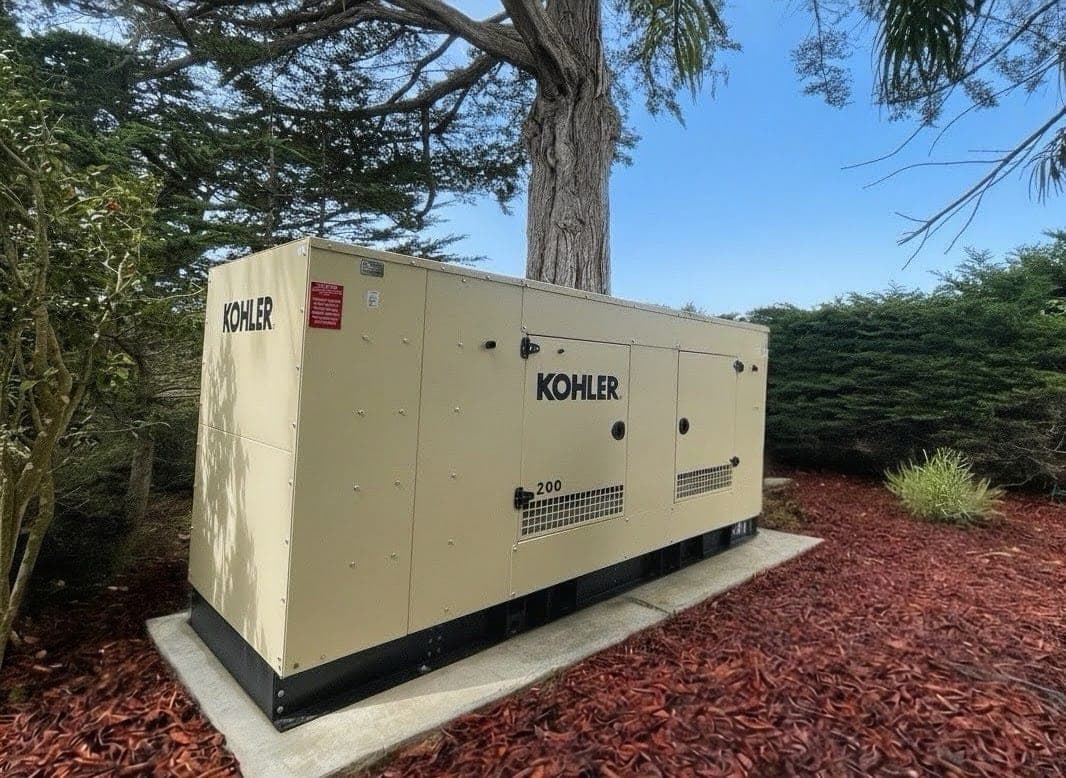
A prestigious real estate firm managing over 50 high-value properties along California's Monterey Peninsula partnered with us for comprehensive standby generator maintenance across their entire portfolio — from 20 kW residential units to a 200 kW diesel estate system.
Background
Before consolidating under a single maintenance provider, the 50+ properties in this portfolio had no unified generator service program. Each property — spread from 17 Mile Drive through Pebble Beach, Carmel, and Carmel Valley — managed its own generator independently. When something went wrong, whoever was available got the call. Some units, particularly older Onan and legacy Generac generators, had gone years with minimal service. For a portfolio of homes valued at $5 million and above, where winter storms regularly knock out grid power for hours or days, that reactive approach was a liability. Many of these properties are occupied only seasonally, meaning generators sit idle for months without regular exercise — and the Monterey Peninsula's coastal salt air accelerates corrosion on enclosures, electrical connections, and control boards far faster than inland environments.
When the management firm began searching for a single maintenance partner, their requirements went well beyond technical competence. These are multi-million dollar estates, and every vendor interaction reflects directly on the firm's reputation with its clientele. The standard they needed was unambiguous: proper insurance and liability coverage with proof on demand, full licensing and documentation, and factory-trained technicians certified on Kohler and Generac equipment — not general electricians or handymen who happen to own a multimeter. The firm needed technicians who are professional, presentable, and respectful of the property; who communicate clearly with property managers and homeowners; and who leave every site cleaner than they found it. In this market, the management firm's word to their clients is "we hired the best" — and they need the documentation to back that up.
The operational bar was equally high. Every service visit must follow OEM-specified procedures to the letter — genuine parts, manufacturer-prescribed intervals, complete documentation of every test and measurement. No shortcuts. Permits pulled when required, code compliance verified on every installation and modification, and proper disposal of fluids and filters per environmental regulations. The firm wanted one phone number, one maintenance schedule, one set of service records, and one team that knew every unit in the portfolio — fifty separate vendor relationships with inconsistent standards were not going to meet the level of accountability their clients expect.
The Challenge
Managing standby power for a single luxury home is straightforward. Managing it across a portfolio of over 50 high-value properties — each with different equipment, different load profiles, and different maintenance histories — is a fundamentally different problem.
A prominent real estate firm on the Monterey Peninsula approached us with exactly this challenge. They manage dozens of luxury residential properties stretching from the coastal bluffs to the wooded inland estates of the Central California coast. Nearly every property in the portfolio has a standby generator, and the firm needed a single maintenance partner who could service the full range of equipment across all locations.
The portfolio's generator fleet reflects the diversity of the properties themselves:
- Kohler residential standby units ranging from the 20RESD (20 kW) up through the 30RCL, 30RCLA, 38RCLB, 38RCLC, and 48RCLB models — the backbone of most properties' backup power
- Kohler large commercial units including a KG125R natural gas system (125 kW) and a 200REOZJD diesel unit (200 kW) serving the largest estates
- Generac residential and commercial units across multiple model lines
- Legacy equipment including older Onan and vintage units still in active service
Fuel types span natural gas (the dominant fuel for residential units in this area), diesel for the larger commercial-scale systems, and propane at a few remote properties. The fleet includes both air-cooled and liquid-cooled standby generators.
The coastal environment adds a layer of difficulty that inland service programs do not face. Salt air accelerates corrosion on enclosures, control boards, and electrical connections. Winter storms bring extended outages — exactly when generators must perform. Moisture intrusion and salt fog are constant threats to equipment that may sit idle for weeks between outages.
Our Approach
Unified Maintenance Program
Rather than treating each property as a one-off service call, we built a structured maintenance program covering the entire portfolio. Every generator in the fleet receives scheduled preventive maintenance visits, with service intervals matched to the manufacturer's specifications for each unit type.
For the Kohler units — which make up the majority of the fleet — this means following Kohler's published maintenance schedules for each model family. The maintenance requirements for a 20 kW air-cooled 20RESD are materially different from those for a 200 kW liquid-cooled diesel 200REOZJD, and we service each according to its specific needs.
Our technicians maintain detailed service histories for every unit in the portfolio. With 143+ service visits logged across these properties, we have deep institutional knowledge of each generator's condition, recurring issues, and replacement timelines.
Coastal-Specific Preventive Measures
The Monterey Peninsula's marine environment demands maintenance practices that go beyond standard service intervals:
- Corrosion inspection on every visit — checking enclosure fasteners, control board connections, battery terminals, and fuel system components for salt air damage
- Coolant system monitoring on liquid-cooled units, where coastal humidity and temperature cycling accelerate coolant degradation
- Transfer switch inspection and cleaning — salt deposits on ATS contacts can cause transfer failures at the worst possible time
- Battery load testing — coastal moisture shortens battery life, and a failed battery means a generator that will not start when the grid goes down
Equipment Diversity Management
The range of equipment in this portfolio — from a 20 kW Kohler residential unit to a 200 kW Kohler diesel system — means our technicians must be proficient across multiple product families, fuel types, and control systems.
The Kohler fleet alone spans several generations and configurations:
- Air-cooled residential: 20RESD
- Liquid-cooled residential/light commercial: 30RCL, 30RCLA, 38RCLB, 38RCLC, 48RCLB, 48RCL
- Large commercial: KG125R (125 kW natural gas), 200REOZJD (200 kW diesel)
Each model has its own control interface, diagnostic protocol, and parts requirements. The Generac units in the fleet add another set of service procedures and parts inventories. Maintaining expertise across all of these — and keeping the right parts on the truck — is what makes a portfolio program work where individual service calls would not.
Responsive Service Calls
Preventive maintenance reduces emergency calls, but generators are mechanical systems and failures happen. When a property reports an issue, our team responds with full context — we already know the unit's make, model, service history, and any recurring conditions. That knowledge cuts diagnostic time significantly compared to a cold service call.
The firm also manages resort and club facilities in the area, adding commercial-scale equipment to the service scope. These facilities have different uptime requirements and often need priority response during storm events when residential properties are also affected.
The Results
The portfolio maintenance program has delivered consistent results across the property fleet:
- 50+ properties maintained under a single service agreement, eliminating the management overhead of coordinating multiple vendors
- 143+ service visits logged, building a comprehensive maintenance history for every unit in the portfolio
- Full equipment range covered — a single team servicing everything from 20 kW residential standby units to 200 kW commercial diesel systems
- Coastal environment managed proactively — salt air corrosion and moisture issues caught and addressed during scheduled maintenance rather than during emergency outages
- Repair turnaround improved by leveraging service history data — technicians arrive knowing the unit's condition, past issues, and likely failure modes
The program extends beyond the residential portfolio. We also service generators for nearby municipal facilities, senior living communities, hospitality properties, and water infrastructure along the Monterey Peninsula — the same technicians, the same service standards, and the same institutional knowledge of the coastal operating environment.
Key Takeaways
Managing standby generator maintenance across a large residential portfolio is not the same as multiplying a single-home service contract by fifty. The value is in the system: standardized service intervals matched to each equipment type, centralized maintenance records that follow the unit rather than the property manager, technicians who know the fleet, and a parts strategy that covers the full equipment range.
For property management firms with generator-equipped portfolios, the two factors that matter most are equipment diversity management (one vendor must cover everything in the fleet) and coastal environmental awareness (standard maintenance intervals and inspection checklists are insufficient for marine environments). Getting both right is what keeps fifty generators ready to start on the same stormy night.
Have a Similar Challenge?
Contact OnPoint Generators for a free consultation. We'll design a backup power solution tailored to your facility.